
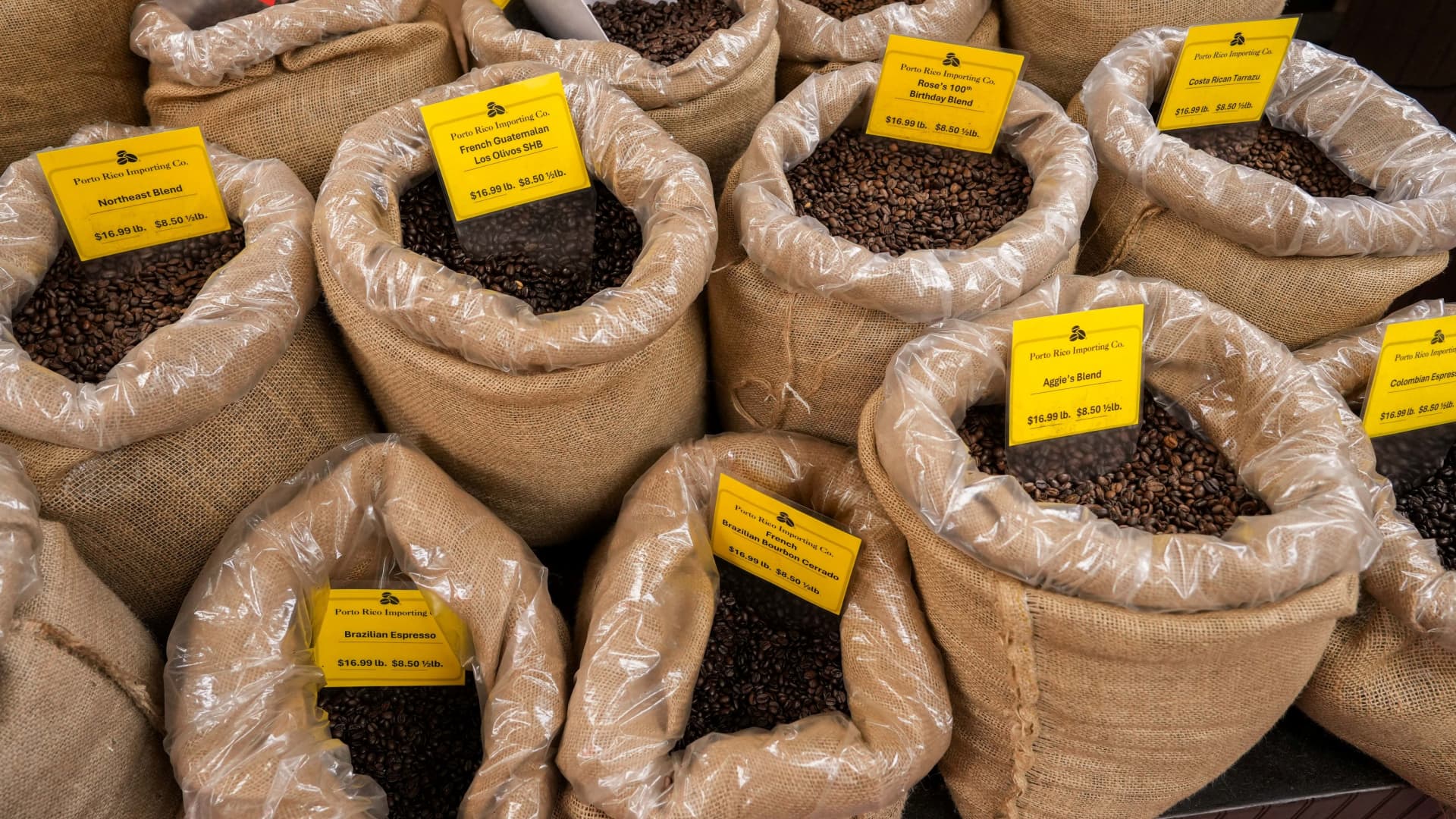
Coffee beans, including those from Brazil, are displayed for sale at Porto Rico Importing Co. coffee seller, in New York City, U.S., July 15, 2025.
Adam Gray | Reuters
Caffeine levels aren’t the only things spiking for coffee drinkers lately.
Prices for coffee have soared, fueled largely by volatile weather that’s reduced crop harvests among major growers like Brazil and Vietnam, according to analysts.
Ground roast coffee prices in the U.S. hit $8.41 per pound in July, a record high and a 33% increase from a year ago, according to Bureau of Labor Statistics data.
Global coffee prices are hovering near a 50-year high reached in February.
U.S. prices for all coffee varieties (including roasted and instant coffee) were up 14.5% year-on-year in July — the second-highest annual inflation rate for any CPI category behind eggs, according to the consumer price index.
Price pressures “should be easing off” in the near term, said Danilo Gargiulo, a senior research analyst at Bernstein.
But 50% tariffs that the Trump administration levied on Brazil threaten to put “upward pressure” on coffee prices, according to an August report from the International Coffee Organization.
‘Precipitation whiplash’ crimps supply
Like all commodities, coffee prices are a function of supply and demand.
Weather volatility is perhaps the “most critical” short-term factor underpinning coffee supply and prices, since coffee cultivation and yield are “highly sensitive to its environment,” according to a Bernstein report published in March.
A severe drought during Brazil’s last summer season “devastated” the harvest, Berstein analysts wrote.
Brazil is the world’s top coffee producer, supplying about 40% of the global volume, they wrote. The U.S., the world’s largest coffee importer, sources the bulk of its supply (32%) from the South American nation, it said.
Vietnam, the world’s No. 2 supplier, was hit by a drought that caused coffee production to fall by 20% in 2024, according to Bernstein.
That was followed by heavy rainstorms that also crimped production, said Mike Hoffmann, professor emeritus at Cornell University and lead author of “Our Changing Menu: Climate Change and the Foods We Love and Need.”
The dynamic — “precipitation whiplash” — reduces crop yield, he said.
“Your standard season isn’t as it should be,” Hoffmann said. “Drought stresses the coffee plants, then you get way too much water, and it affects the quality and quantity of the bean, the berries.”
Further, as coffee prices have risen, companies like Starbucks chose to draw down their existing coffee inventories instead of buying expensive beans on the open market, Gargiulo said.
Inventories came down “significantly below historical levels” in the last few years, Bernstein analysts wrote. While the market can weather a shortfall relatively well when inventories are high, low levels can lead to sharp price spikes if there’s a new demand or supply shock, they wrote.
How prices might impact coffee drinkers
Consumers may also feel higher coffee prices differently depending on whether they shop at the grocery store for coffee to prepare at home or consume it away from home, at restaurants or coffee chains, for example, Gargiulo said.
Coffee prices in the grocery aisle tend to fluctuate more with the commodity cost, meaning they are generally more volatile, he said. Grocers may be quicker to raise store prices as coffee prices rise, and may offer promotions to consumers when coffee prices fall, he said.
But prices for food commodities like coffee generally move in cycles, and improving weather and capital investment to boost productivity signal lower prices are likely ahead, Gargiulo said.
Additionally, the Brazil tariff “impact” may be somewhat limited for consumers who buy from big coffee chains, Gargiulo said.
He estimates Starbucks would have to raise prices by 0.5% or less to recoup the full cost of Brazil tariffs, for example.
More from Personal Finance:
Why inflation is retirees’ ‘greatest enemy’
Student loan borrowers pausing payments have doubled since 2024
68 jobs may qualify for Trump’s $25,000 ‘no tax on tips’ deduction
Over the longer term, consumers should brace for higher-than-average prices, analysts said.
Extreme weather that negatively impacts coffee harvests is expected to be more common, and coffee consumption worldwide continues to increase and bolster demand, they said.
“The prices will continue to go up, in my mind,” Hoffmann said.
“Climate change isn’t going away,” he said. “The severity of droughts, flooding, all of that will get worse. It’s not just coffee — it’s the whole food supply.”