
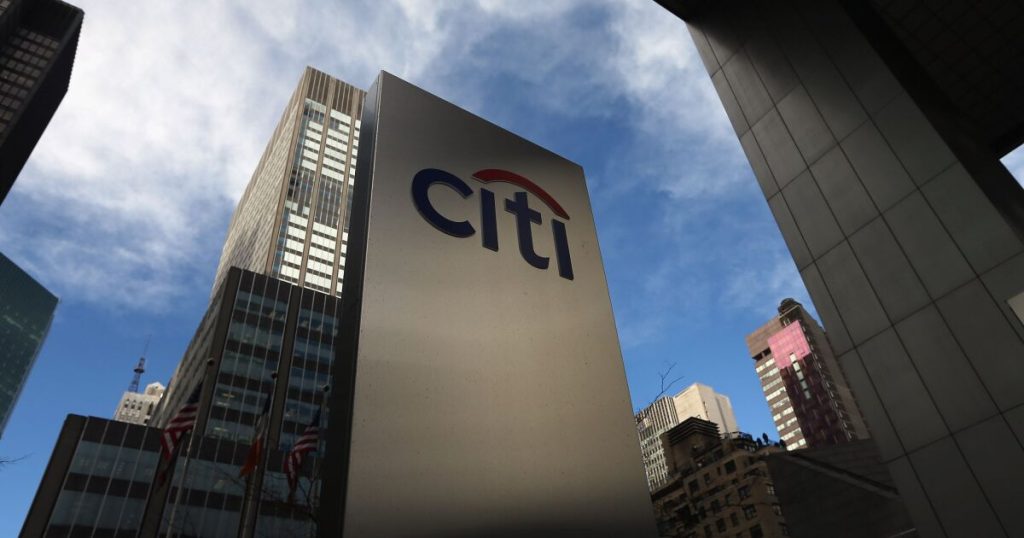
The artificial intelligence initiatives at large banks like Citi and Wells Fargo and banks’ efforts to foil scammers using AI attracted interest from American Banker readers in 2025.
Processing Content
Citi is rolling out agentic AI to its 40,000 developers
Mario Tama/Photographer: Mario Tama/Getty I
In July, Citi began rolling out agentic artificial intelligence to its developers to automate simple tasks like software patches and upgrades. The bank will formally announce this project in its Tuesday earnings call.
Agentic AI is a term for artificial intelligence systems capable of making autonomous decisions and taking actions with minimal human oversight. In this case, Citi has selected Cognition’s Devin agent.
This deployment came amid steadily increasing adoption of advanced AI by banks, especially the largest ones. For instance, Goldman Sachs is testing the same Cognition AI agent for an expected rollout to its 12,000 human developers; it has also rolled out generative AI tools to its entire employee base. JPMorganChase has deployed generative AI to all its 240,000 employees.
Read the full story
80% of banks have upped AI spending. Here’s what they’re buying
Most U.S. banks — 80% in fact — increased their artificial intelligence spending for 2025, according to American Banker’s Cost of AI study.
In a survey fielded earlier this year, 11% of bankers said they expect to make a significant increase (25% or more) in this technology category; 25% plan a moderate increase (10% to 24%); 44% project a slight increase (less than 10%); 7% expect no change and 13% intend to decrease AI spending.
This is good news for AI software providers. Experts say banks are focusing this spending in a few key areas this year.
Read the full story
Peter Thiel-backed Palantir plots AI tech for banks

In March, military data contractor Palantir paired up with TWG Group to create a joint venture that seeks to increase adoption of artificial intelligence in the financial space.
The joint venture combined Palantir’s artificial intelligence and cybersecurity infrastructure with TWG’s business technology experience to offer financial service organizations like banks, investment managers and insurance companies a product to expedite artificial intelligence adoption and integrate it at scale.
Palantir was founded by Peter Thiel, Alex Karp, Stephen Cohen and Joe Lonsdale. It began as a defense contractor before expanding into the private sector. Because of that, the company has long prioritized security. Thiel was one of the founders of PayPal, and has invested in several of Elon Musk’s companies.
Read the full story
Citi mandates AI prompt training for most employees

David Paul Morris/Bloomberg
In September, Citi kicked off a new AI training program that will teach employees how to write better prompts for the bank’s generative AI programs.
In an internal memo shared with American Banker, Tim Ryan, Citi’s head of technology and business enablement, and Anand Selva, the bank’s chief operating officer, stressed the importance of well-written prompts.
“Just as the right question in a client pitch can reveal clarity and create advantage, a well-crafted prompt can accelerate your work, surface insights and amplify your impact,” Ryan and Selva said. The memo was sent to 175,000 employees in 80 locations on Tuesday morning.
Read the full story
How Wells Fargo is building agentic AI into its workflows

Wells Fargo isn’t treating AI as just another IT upgrade. It’s re-architecting the entire bank to embed the technology into core workflows, including through agentic capabilities.
“We’ve broken our strategy into a couple key focus areas,” Tracy Kerrins, Wells Fargo’s head of consumer technology and generative AI, said during a panel at Money 20/20 in November. “We’ve had a developer platform that we’ve been working on and building and enabling and rolling out a lot of use cases. The portion we’re partnering with Google on is the employee capability.”
To be sure, Wells Fargo is not the only bank redesigning technology infrastructure and processes to prep for agentic AI. JPMorganChase and Citi have been rolling out agentic AI to developers and Capital One and Goldman Sachs have also been preparing to use AI agents across their organizations.
Read the full story
Content creators, banks use AI to waste scammers’ time

For scammers as much as anybody, time is money.
The more time a scammer spends talking to someone without taking their money or information, the less efficient their operation is. If a scammer gets unlucky, and a potential victim smells something fishy at the crucial moment when the scammer is supposed to take their money or information, the minutes, hours or in some cases days that the scammer spent developing that lead is now wasted.
This dynamic, in which some scammers are willing to dump a great deal of time into talking to a potential victim, has inspired a tactic called scambaiting — pretending to fall for fraudulent online schemes in order to waste the time of the perpetrators.
Read the full story
Banks tighten ID checks as AI deepfakes get better

“Your voice is your password.” That was the tagline many banks once used to promote biometrics as a secure, seamless way to verify customers. Now, deepfakes have flipped that idea on its head.
What was seen as a simple and foolproof authentication method is being challenged. As synthetic voice and video attacks get more convincing, banks are rethinking the degree to which they can rely on biometric authentication. That concern was raised by OpenAI CEO Sam Altman who, speaking at a Federal Reserve conference in July, said AI has “fully defeated” voiceprint authentication methods. He warned of a coming fraud crisis in financial services due to AI impersonations.
Analysts and bankers agree: biometrics — including voice and facial recognition — are vulnerable as AI-generated voice and video clones challenge systems. The solution lies in multilayered authentication systems and better detection tools. But it’s a constant race against fraudsters, whose tool kits keep getting better.
Read the full story
Goldman Sachs, Capital One prep for self-driving AI agents

In recent weeks, several new large language model-based AI agents have been introduced. OpenAI launched Operator, an AI agent that can order groceries and book flights. Google released Gemini 2.0, which can “understand complex scenarios, plan multiple steps ahead and take actions on behalf of users,” according to the company. Oracle announced AI agent services that automate business processes. Auquan deployed AI agents at private credit firms that research and draft deal memos.
This new generation of AI agents does more than translate prompts and craft answers. The new agents are capable of acting autonomously.
“Unlike today’s generative AI models, which respond to specific human prompts, agentic AI can independently perceive, reason, act and learn, without constant human guidance,” states a World Economic Forum report published in December. Gartner’s definition: AI agents are autonomous or semiautonomous software entities that use AI techniques to perceive, make decisions, take actions and achieve goals in their digital or physical environments.
Read the full story