

“Nobody knows nothin’.”
– Jack Bogle
Vanguard’s legendary founder, Jack Bogle, once relayed a story that when he was first starting out in the investment business, his mentor told him to remember that “Nobody knows nothin’.”
When it comes to Wall Street’s top professionals, it’s important to realize that – as usual – Jack Bogle (along with his mentor) was right.
This weekend, I read through Barron’s Roundtable, an annual discussion among some of the smartest people on Wall Street where they share their forecasts and picks for the year.
I’ve been in this business long enough to know that the best investors get it wrong and that their words are not gospel. But even I was surprised at how wrong they were in 2025.
In last year’s Roundtable, only two out of the 11 experts said stocks would go up in 2025. (The S&P 500 ended the year up 16.4%.) Not one of them mentioned gold or silver, which were the best-performing assets of the year.
I’ve seen so many times in my career where the markets behaved in a way that seemed to run counter to how they should.
The Fed has lowered the federal funds rate three times since September by a total of three-quarters of a percentage point. You’d expect other interest rates to follow. However, the 10-year Treasury yield only fell after the first cut (from about 4.3% to 4.0%). After that, even though the Fed reduced rates two more times, the yield on the Treasury bounced back to nearly 4.2%.
The market is made up of millions of players, and they do not all behave rationally. If you’ve ever played poker, been in a negotiation, or, really, just lived a day on this planet, you have probably thought to yourself, “What in the world is that person thinking?”
That is why, very often, the market moves in directions that aren’t rational. For example…
- Republicans are supposed to be good for business… but the market performs better when there’s a Democrat in the White House.
- The economy is strong and inflation is low… yet gold and silver are ripping higher.
- Dot-com stocks went insanely high in the late 1990s and early 2000s… despite most rational people realizing there was no underlying business behind many of these stocks.
In order to avoid investing according to how things should be instead of how they are, I use technical analysis (the study of stock charts) to frame my thinking.
As I always say, a chart is not a crystal ball. Not even close. But it is a visual representation of fear and greed in the market.
I have my Chartered Market Technician (CMT) designation, but you don’t have to be an expert to understand a trend.
For example, what direction is this chart going? You could ask a 7-year-old, and they’d give you the right answer.
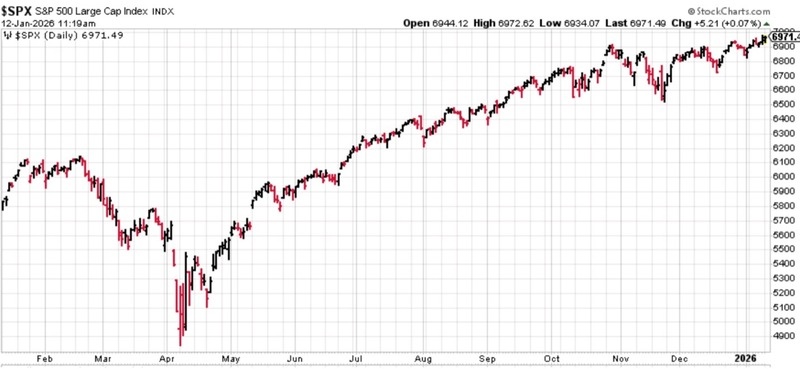
Technical analysis can be as complicated as you want it to be. I don’t like complications in my life. “Keep it simple, stupid” (KISS) is a mantra I live by. I use the charts to identify trends and notice warning signals that a trend may be weakening or coming to an end.
If I am positive on a stock, sector, or market and I see something that makes me say “hmm,” that’s not an automatic indication to sell. But it is an invitation to dig a little deeper, try to understand what’s going on, and set clear parameters for what I would need to see to change my outlook on the trend.
The way to make money in the markets is to ride the trends. It really can be that simple.
I get emails all the time from readers asking if they should buy puts or take on other strategies to protect against losses. I’m not going to tell someone not to take out insurance on their stocks (which is essentially what buying puts is) if it will help them sleep at night, but riding the trends is what will make you wealthy over time.
The charts – more than any other tool or data point that I’ve come across in my 30-year career – help you do that.
If you’re not looking at stock charts, you are handicapping your understanding of what’s going on in the markets – and your results.
If you know nothin’ about charts, it’s time to learn somethin’.