
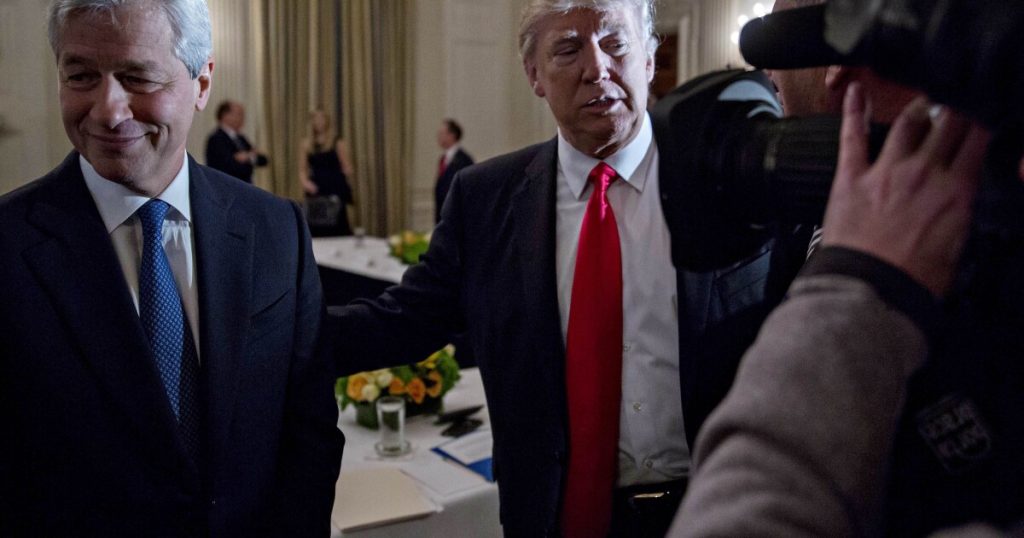
- What’s at Stake: The lawsuit accuses JPMorganChase of trade libel and breach of good faith, claiming CEO Jamie Dimon violated Florida’s Unfair and Deceptive Trade Practices Act.
- Supporting Data: Under commercial law and bank account agreements, banks can close accounts at any time for any reason, leading many experts to call the suit “frivolous.”
- Forward Look: The case will take years to play out, with the most likely outcome a dismissal or possibly a settlement but little regulatory or policy impact on the New York bank.
President Donald J. Trump’s lawsuit against
Processing Content
Allegations in
The $4.6 trillion-asset New York bank
Legal experts said they were surprised that Trump filed a private lawsuit and did not involve the Department of Justice or prudential regulators. Some also were surprised that Dimon was sued as well. The same day the suit was filed,
“Trump’s lawsuit is wholly frivolous,” said Adam Levitin, the Carmack Waterhouse Professor of Law and Finance at Georgetown University Law Center and principal at Gordian Crypto Advisors. “
Dimon recently has taken a more public stance against the president, criticizing Trump for attacking Federal Reserve Chairman Jerome Powell and calling the president’s proposal for
Jaret Seiberg, managing director at TD Cowen, said the lawsuit could stretch past 2029, and that
“We believe the most likely outcome is that the case is dismissed,” Seiberg wrote in a research note. “If anything, this could make it harder for regulators to single out
“We respect the president’s right to sue us and our right to defend ourselves — that’s what courts are for,” the bank said. “Our company does not close accounts for political or religious reasons. We do close accounts because they create legal or regulatory risk for the company. We regret having to do so, but often rules and regulatory expectations lead us to do so.”
The lawsuit alleges the president’s accounts were terminated on Feb. 19, 2021, with just 60 days’ notice, causing considerable financial and reputational harm.
“This is not partisan despite the Trump family’s lawsuit,” Seiberg said. “If the standard is that any legal business must be banked, then does that mean banks cannot assess if they want to be associated with certain businesses such as pornography or private prisons?”
Graham Steele, an academic fellow at Stanford University’s Rock Center for Corporate Governance and a former assistant secretary for financial institutions at the Treasury Department, said it was highly unusual for a sitting president to sue the nation’s largest bank, but it sets a precedent.
“The suit is obviously meritless,” Steele said, adding that “it should trouble us all when a sitting president attempts to use his office to enrich himself by shaking down private financial institutions.”
In August, Trump signed an
Trump also signed another executive order in September targeting financial support for antifa — an amorphous left-wing ideology —
Nicholas Anthony, a policy analyst at the Cato Institute’s Center for Monetary and Financial Alternatives, released
“President Trump is unlikely to be successful in his effort to attack
Trump’s accounts were closed in April 2021, before Florida enacted a broad anti-debanking law that expanded the prohibition on financial institutions denying services to include political and religious beliefs. Trump is asking for $5 billion in redress. Last year, Trump and his son Eric Trump sued Capital One for being debanked.
“Plaintiffs seek to redress the harm they and their affiliated entities have suffered and to shed light on these matters of great public interest and importance,” the lawsuit states. Trump is represented by Alejandro Brito of the law firm Brito PLLC in Miami, which filed defamation suits on Trump’s behalf against the New York Times, which was dismissed last year and the Wall Street Journal, which is ongoing. In 2024, Brito secured a $15 million settlement against ABC News and George Stephanopoulos for comments made about the 2020 election.
Trump’s suit also alleges that the Trump family was put on a blacklist that barred them from opening wealth management accounts, and alleges that Dimon personally authorized their ouster.
“This blacklist was an unfair and deceptive trade practice because it maligned their reputations and induced any other federally regulated bank in the United States, all of which can access this blacklist, from dealing with President Trump, the other Plaintiffs, the Trump Organization and its affiliated entities, and/or the Trump family,” the lawsuit states.
Levitin said that banks are not “common carriers,” like utilities, and thus are not obligated to serve all customers, though banks may not cease or refuse to serve customers because of their age, race, sex, religion or national origin.
“Banks can choose to do business with whomever they like — subject to anti-discrimination laws — but the last time I checked, Republicans are not a protected class,” he said. “The bottom line is that actions have consequences, and that includes January 6.”
Some experts suggested that Trump was publicly bashing banks as part of an effort to divert attention away from citizens disgruntled over affordability issues. Earlier this month, President Trump
“So to help our citizens recover from the Biden disaster, all caused by this horrible, just horrible precedent, I’m asking Congress to cap credit card interest rates at 10% for one year,” the president said. “And this will help millions of Americans save for a home. They have no idea they’re paying 28%. They go out there a little late in their payment, and they end up losing their house. It’s terrible.”
Dimon has sarcastically suggested that the government should test a 10% credit card interest rate cap and specifically suggested doing so in Vermont and Massachusetts, the home states of Senators Bernie Sanders and Elizabeth Warren, who also have called for credit card rate caps.
Levitin posited that the lawsuit may be more of an attempt by Trump to put Dimon off-balance rather than to win in court.
“It’s purely a shakedown of Jamie Dimon to get lower credit card rates and some cash in the President’s personal wallet,” said Levitin. “This is government by gangsterism.”