
- Key insight: The SBA is backtracking on a policy, instituted last year, that had permitted modest participation in its lending program by noncitizens who are in the country legally. The new policy is stricter than the one enacted earlier in the second Trump administration.
- Supporting data: Small-business advocates and some lenders say the agency’s latest guidance, which restricts eligibility to citizens and U.S. nationals, is needlessly strict.
- Forward look: The revised policy will take effect on March 1.
Less than two months after implementing a policy that opened the door a crack to businesses with limited noncitizen ownership, the Small Business Administration has forcefully slammed it shut.
Processing Content
The agency published a notice Monday limiting eligibility to its lending programs to companies that are wholly owned by U.S. citizens or nationals. In doing so, the SBA rescinded a narrow exception unveiled in December that had covered companies with up to 5% ownership by foreign nationals, and aliens with conditional legal-permanent-resident status.
And the latest policy restricts eligibility more than even tightened rules that the Trump administration enacted earlier in 2025, before easing the criteria in December. Under that earlier Trump administration policy, legal permanent residents, also known as green card holders, were permitted to participate in SBA programs. But under the most recent policy, which takes effect March 1, that will no longer be true.
Instead, the SBA will require that 100% of all direct and or indirect owners of small-business applicants be U.S. citizens or U.S. nationals who have their principal residence in the United States, its territories or possessions.
“The Trump SBA is committed to driving economic growth and job creation for American citizens,” SBA spokesperson Margaret Clemmons said Wednesday in a statement to American Banker. “Across every program, the SBA is ensuring that every taxpayer dollar entrusted to this agency goes to support U.S. job creators and innovators.”
Democratic lawmakers slammed the new policy.
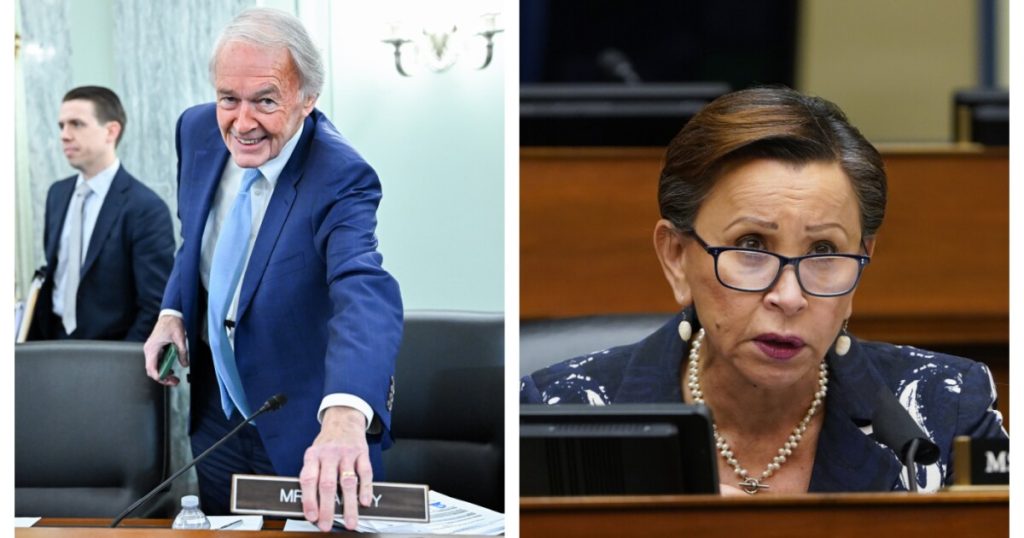
“Rather than support hard-working legal immigrants to start or expand a business, the Trump SBA is choosing hatred by barring green card holders from receiving an SBA loan,” Sens. Edward Markey, D-Mass., and Rep. Nydia Velazquez, D-N.Y., said in a statement.
Markey and Velazquez serve as ranking members of the Senate Committee on Small Business and Entrepreneurship and the House Small Business Committee.
In June, the Trump administration unveiled a policy limiting SBA eligibility to citizens, U.S. nationals and legal permanent residents. Residents with temporary legal status were blocked, and some critics complained the rule prevented mom-and-pop businesses where one of the spouses or partners was a temporary legal resident from accessing SBA-backed capital.
The agency moved to soften its eligibility requirements in December, permitting 5% ownership by foreign nationals and those with temporary legal residency.
Prior to President Trump’s second term, the SBA’s policy on foreign and noncitizen ownership was more accommodating. It required that applicant companies be 51% owned by a U.S. citizen, national or legal permanent resident. Minority investors had to be in the U.S. legally.
SBA officials, including administrator Kelly Loeffler, have linked the new citizens-and-nationals-only eligibility policy to a Jan. 20, 2025, executive order that requires all government agencies to cease the provision of taxpayer-funded benefits “to any illegal alien not authorized to receive them.”
President Trump issued the 2025 executive order after a surge of migration that saw the population of unauthorized immigrants swell by about 33% between 2021 and 2023, according to an
However, the SBA never permitted loans to unauthorized immigrants.
The SBA’s loan eligibility requirements have also drawn criticism from small-business advocates and some lenders, who have decried them as overly strict, adding the existing restrictions have resulted in a significantly smaller pool of lenders.
Longtime SBA lender Chris Hurn said Wednesday that a policy that creates obstacles to participation by foreign investors and legal permanent residents in small-business lending is inconsistent with the Trump administration’s efforts to lure large-dollar foreign investment.
“It’s a massive contradiction,” Hurn wrote in an email to American Banker. “How is it okay for big business but no longer for small business?”
“This is a terrible double-standard that will hurt the economy,” Hurn added.
The SBA’s new standard seems to fly in the face of statistics that indicate immigrants start small businesses at significantly higher rates than U.S.-born citizens, Carolina Martinez, CEO of the CAMEO Network, a California-based network of small business support organizations, told American Banker.
“A policy like this prioritizes discrimination over our economic interests,” Martinez said. “America is the land of opportunity, where people bring new ideas and build businesses that create jobs. Blocking lawful permanent residents from access to capital hurts American jobs and innovation.”
Lending under the SBA’s flagship 7(a) loan guarantee program has slowed noticeably in the current fiscal year. After reaching a record $37.3 billion in fiscal 2025, which ended Oct. 31, 7(a) lenders originated loans totaling $9.6 billion of 7(a) loans through the first four months of fiscal 2026. During the same period in fiscal 2025, lending under the program totaled $11.8 billion.
The 7(a) program guarantees loans up to $5 million to eligible small businesses.
Banks dominate the program’s ranks, making up 22 of the top 25 lenders.