
- Key insights: Visa and UnionPay will connect Visa Direct and UnionPay’s MoneyExpress platform.
- What’s at stake: Visa, Mastercard and other companies are trying to tap China’s huge payment market, but have faced difficult regulations.
- Forward Look: China’s payments market is on pace to pass $70 trillion by 2031.
Visa and Mastercard’s long quest to offer payments to Chinese consumers and businesses is starting to bear fruit through partnerships that enable at least partial access to the massive market.
The latest deal involves Visa.
Processing Content
Visa is looking for a slice of China’s payments market, which is expected to reach $47 trillion in 2026 and increase to more than $70 trillion by 2031, according to Mordor Intelligence.
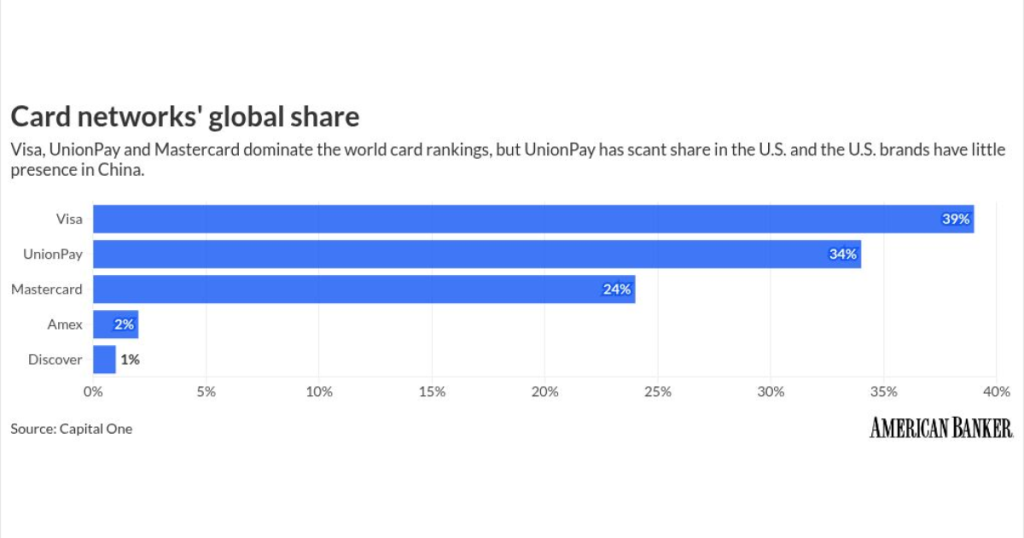
That size has created a battle of the titans. Among credit card companies, Visa has 39% of global share, Union Pay has 34%, Mastercard 24%, Amex 2% and Discover 1%, according to Capital One. But those numbers mask Visa and Mastercard’s share in China, and UnionPay’s share in the U.S, which is negligible.
“UnionPay exists in part to keep Visa and Mastercard at arm’s length in China, and has been a success by almost any metric, both at increasing electronic payments and growing a domestic network,” Aaron Press, a research director at IDC, told American Banker. “At the same time, China UnionPay is unlikely to gain significant presence outside of China, meaning that cooperation is the best path to extending reach in both directions.”
Visa and UnionPay
The Visa/UnionPay partnership will enable Visa’s customers to send cross-border remittances and business-to-consumer payouts to more than 95% of UnionPay International debit cardholders in mainland China through a single connection. The companies did not provide financial terms of the arrangement.
“China is one of the most mature real-time payments markets in the world. Bank-based instant payment rails have been live there for years, and the country’s mobile-first consumer base adopted digital payments at mass scale long before many other markets,” Vira Platonova, global head of Visa Direct, told American Banker.
The connection, which is expected to be live during the first half, is designed to support a range of uses, such as creator and freelancer payouts, contractor disbursements, reimbursements, and family remittances. The target market includes platforms, marketplaces and employers that are increasingly operating internationally, with payments requiring an ability to provide global scale and real-time processing, according to Visa.
“In China’s
“Sending money into China has traditionally been complicated, fragmented and unpredictable. Many senders face long settlement times and inconsistent visibility,” Platonova said “We’re helping simplify that last mile. The result is faster, more predictable inbound payments and remittances, with improved transparency and speed.”
Mastercard’s public relations office said Mastercard Move – the card brand’s real-time transfer app – already has access to UnionPay as a remittance delivery endpoint. Mastercard Move also has links to AliPay and Tenpay/WeChat, China’s two largest mobile wallets.
Account access and network penetration are the keys to the UnionPay deals, according to Press, noting China UnionPay has access to effectively all Chinese demand deposit accounts, and Visa has access to a significant share of accounts in many other markets.
“The deal gives Visa access to China and gives CUP access to much of the rest of the world,” Press said.
The great wall
China has long agreed to welcome outside payment companies, only to create restrictions that have made it nearly impossible for outside companies to independently process payments inside China. “For years, the U.S. payments industry gushed over the enormous ‘China opportunity’ notwithstanding Beijing flagrantly flouting this commitment,” Eric Grover, principal at Intrepid Ventures, told American Banker, noting Mastercard processed its first
According to the Office of the U.S. Trade Representative, China in 2001 promised to allow U.S. and other foreign companies to support payments in China as a condition of China’s entering the World Trade Organization, noting: “The ability of U.S. and other foreign banks to conduct domestic currency business with Chinese enterprises and individuals will be phased in. Within two years after accession, foreign banks will be able to conduct domestic currency business with Chinese enterprises, subject to certain geographic restrictions.
Within five years after accession, foreign banks will also be able to conduct domestic currency business with Chinese individuals, and all geographic restrictions will be lifted.” China has often
“Today, under Xi Jinping, while China is best characterized as a foe, it is still willing to work with U.S.-domiciled networks like Visa when there is a tangible benefit and no viable alternative,” Grover said. “For instance, China has no domestic alternative to enabling billions of Visa Direct endpoints outside China to send money to UnionPay MoneyExpress endpoints inside China. If UnionPay, Alipay, or WeChat Pay had network reach abroad comparable to Visa’s, MoneyExpress would not be working with them.”
Among U.S.-based payment companies,
“Partnerships such as this are necessary to enter China’s relatively closed economy, and also shows that Visa isn’t standing still when it comes to cross-border payments, but is acting to establish a beachhead,” Aaron McPherson, principal at AFM Consulting, told American Banker.