
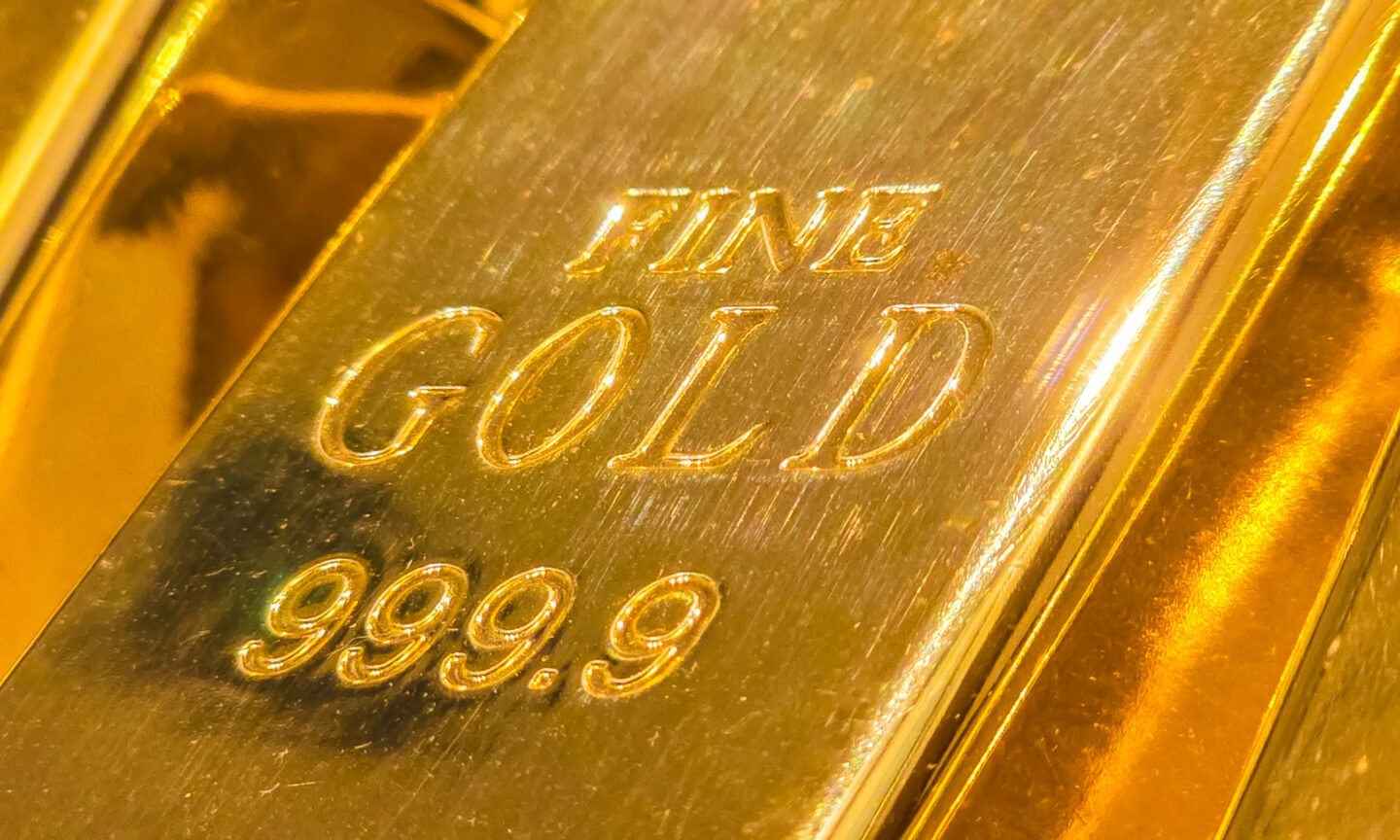
We’re only a month and some change into 2026, but it has already been a big year for gold. The yellow metal is up more than 15% year-to-date, and it surged past the $5,000-per-ounce mark for the first time ever in January. It fell more than 10% from that all-time high in early February, before rebounding in the middle of the month.
For investors, there are a few pressing questions about the recent gold rally and ensuing volatility: Is there still room to run, how high could the price go, and where and how exactly should you buy gold if you’re interested?
Below, we’re looking at the causes of the surge above $5,000, some price targets for the end of 2026, and a couple of brokers reviewed by SS that will ship physical gold bullion to you.
What’s going on with gold prices in 2026?
Gold prices have surged in 2026 for three main reasons: Geopolitical uncertainty, a declining dollar, and large institutions buying gold to hedge against those two things.
If you’ve opened a newspaper recently, you probably have some awareness of the geopolitical uncertainty in question. The U.S.’s tariff threats, as well as its military intervention in Venezuela and sabre-rattling in Greenland and the Middle East, have created a sense that the world order — and the U.S.’s role in it — is rapidly changing.
Not everyone has been thrilled about the U.S.’s recent moves, particularly with regard to tariffs. That discontentment has contributed to a “sell America” trade, in which international investors have dumped dollar-denominated assets and looked for alternatives (including gold).
That has pushed the value of the dollar down more than 10% in the last year compared against a basket of foreign currencies. The dollar’s fall has further juiced the price of gold in dollars, as gold has a long track record of holding its value against currency declines.
Another news story that had been fueling uncertainty about the U.S. economy, weakness in the dollar, and strong demand for gold in January was the prospect of another U.S. government shutdown — although gold briefly retreated below the $5,000 mark after Congress reached a last-minute deal to keep the government funded.
Against this backdrop, institutional investors have loaded up on gold as a hedge against uncertainty. These institutions include countries’ central banks, hedge funds, wealthy individuals and families, and some new types of financial institutions, including stablecoin issuers like Tether.
How high could gold go this year?
Gold has bobbed above and below the $5,000 mark multiple times already this year, and its price volatility is likely to continue for the foreseeable future. Many analysts at big banks are optimistic about where it could go from here.
Seven of the eight “bulge bracket” banks — a grouping of the most dominant banks with U.S. operations, consisting of Deutsche Bank, Morgan Stanley, UBS, Goldman Sachs, J.P. Morgan Chase, Citi, Bank of America and Barclays — have recently updated their gold price forecasts for the end of 2026.
We’ve compiled their highest (“bull case”) estimates below, in order of recency.
|
Highest gold price target per ounce, end of 2026 |
||
|---|---|---|
Data is current as of Feb. 2, 2026, and is intended for informational purposes only, not for trading purposes.
Which brokers let you buy gold bullion?
What if you want to buy gold bullion — physical gold that you can hold in your hands — through an online investment platform? SS recently wrapped up our broker review updates for 2026, and two of the brokers we review offer that capability.
Fidelity
The gold bullion offering: Fidelity offers gold bars and various coins in increments ranging from 1 ounce to 1 kilogram. There’s a minimum order size of $1,000, and a minimum initial investment of $2,500 for nonretirement accounts. Fees run from 0.99% to 2.90% on the buy side, and 0.75% to 2.00% on the sell side, depending on volume.Fidelity only acts as an agent for third-party metal bullion companies, such as FideliTrade, which can ship your bullion to you. FideliTrade (Fidelity’s only currently-operating bullion partner) can also store it on your behalf for an annual fee between 0.25% and 1.5% of your account value, depending on what kind of storage you want.
Other things to know about Fidelity: For several years running, Fidelity has won several of SS’s Best-Of awards for investing platforms, including Best Online Broker for Beginners and Best Investing App. That’s because it marries a wide investment selection and ultra-low fees with strong customer service and a popular, easy-to-use mobile app.
But like any business, it isn’t perfect: If you like to place trades the old-fashioned way, on the phone with a human broker, you’ll find that Fidelity’s fee for broker-assisted trades is on the higher end. Learn more in our full Fidelity review.
Interactive Brokers
The gold bullion offering: Interactive Brokers offers gold bars and coins in increments between 1 ounce and 1 kilogram, for a commission of 0.007% to 0.015% of trade value, depending on volume.
There’s a minimum commission of $2.00 per trade, and monthlystorage fees of $0.15 per ounce if you don’t take physical delivery of your bullion.
Other things to know about Interactive Brokers: Interactive Brokers consistently wins SS’s annual Best Online Broker for Advanced Traders award, owing to its enormous investment selection, top-of-the-line research selection and trading toolkit, and low margin rates.
However, its apps and website are really geared toward seasoned investors, and can be intimidating to navigate for beginners. You can read more in our full Interactive Brokers review.
What about Costco or Walmart?
It might sound absurd, but it’s true — there are also a couple of large retailers that will sell you gold bullion, including for delivery via their websites. These aren’t brokers, per se, but we figured we’d include them here under the umbrella of well-known institutions that you can buy physical gold from.
-
Walmart offers gold bars and coins on its website in increments between 1 gram and 1 kilogram (including a variety of 1-ounce and fractional-ounce items). There’s free shipping, and no explicit fees, and reviewers say that the shipping is quick and comes in discrete packaging, which is a plus from a security perspective.
However, the prices of many items appear to be higher than the spot price of an equivalent amount of gold on an exchange. For example, the first 1-ounce gold bar listed on Walmart’s gold bullion page sells for $5,519.99 at the time of writing, while the spot price of gold is $5,103.70.
-
Costco offers 1-ounce gold bars to members via its website. The quoted price includes insured shipping with a signature required upon delivery. But like Walmart, that price ($5,249.99 at the time of writing) is a significant markup from the spot price of gold, which probably exceeds the cost of insured shipping.
The pros and cons of gold bullion
Owning gold bullion may appeal to some investors because it provides a kind of “apocalypse insurance.” If something terrible happened in your area — like a war, a severe natural disaster, or some kind of political or economic catastrophe that severely disrupted access to banking and financial markets — many investments, like stocks and bonds, might not be worth much.
Although these things represent legal ownership of companies or income streams, they physically consist of just pieces of paper, or ones and zeros in a computer server somewhere. In the absence of a functioning legal system to enforce your rights over the things they represent, they are only pieces of paper or numbers on a computer.
Physical gold is different. Even in a doomsday scenario, gold is still gold. It’s rare, it looks pretty, it’s intrinsically valuable, and you can hold it in your hands. In families that have faced severe adversity — such as those that have had to flee their homeland due to war, instability or persecution — there is often a tradition of passing down precious-metal heirlooms as insurance against a future catastrophe.
Talk to someone who has lived through this kind of crisis and they will likely tell you that even when conditions are at their most dire, physical gold still holds its value, and can still be exchanged for essentials like food and shelter, or for passage to a safer place.
With all that said, there’s a catch: While we’re waiting for the apocalypse, physical gold comes with some hassles that most “paper” investments like stocks, bonds and ETFs don’t have.
For example, it has to be kept safe and in good condition. This creates costs (e.g., safe deposit box fees, cleaning costs) that may eat into your returns. And if you want to cash out your physical gold investment before the apocalypse, you’ll have to find a reputable buyer and physically transport or ship your gold to them.
One way to mitigate these hassles is by paying your broker to take delivery of your gold on your behalf, and store it — both Fidelity and Interactive Brokers offer this service. But this still costs money, and it reduces the “apocalypse insurance” appeal of physical gold ownership. At that point, you may want to consider some other, easier way of getting investment exposure to gold.
Gold ETFs: Gold ETFs hold bullion on behalf of their shareholders, which makes them similar in principle to buying and storing bullion through one of the brokers above (although the expense ratios on gold ETFs are often lower than the storage fees from brokers listed above, and you can invest smaller amounts of money). If gold ETFs interest you, see our Best ETF platforms list
|
Today’s gold price is $5,012.50 per ounce. The best performing gold ETF by one-year return is OUNZ, which is up 75.36% in the past year, but the fund with the lowest expense ratio is IAUM. |
|||
|---|---|---|---|
|
SPDR Gold MiniShares Trust |
|||
|
abrdn Physical Gold Shares ETF |
|||
|
Source: Finviz & Kitco. Data current as of Feb 9, 2026. |
|||
Gold stocks: Gold stocks are shares of gold mining companies. Their prices tend to move more or less in line with the price of gold, although other variables, such as operating costs, may also affect them. Sometimes they outperform the metal itself, and other times they underperform it. Our roundup of the best online brokers for stock trading is a good place to start your search if you’re interested in gold stocks.
|
The best performing gold stock in the last 12 months is Hecla Mining Co (HL), which is up 293.43%. |
||
|---|---|---|
|
First Majestic Silver Corporation |
||
|
Source: Finviz. Stock data is current as of February 2, 2026, and is intended for informational purposes only. |
||
Gold futures: Gold futures are derivatives that allow their owner to purchase physical gold at a fixed price at some fixed time in the future. In practice, futures are usually used as a way to speculate on the price of commodities, including gold, rather than as a way to actually buy and take delivery of those commodities. If you know how to trade gold futures (there’s a substantial learning curve), our Best Futures Trading Platforms roundup may be of interest.