
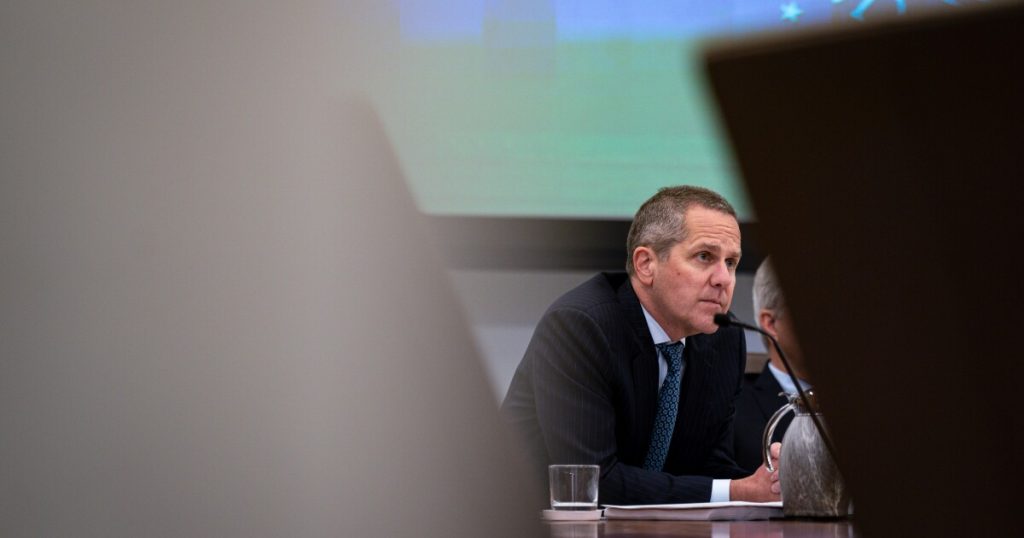
- Key Insight: Federal Reserve Gov. Michael Barr said the economy is currently ‘closest’ to a scenario in which AI gradually raises worker productivity without resulting in sweeping layoffs.
- Supporting data: Only 17% of firms currently use AI, according to a study cited by Barr.
- Forward look: Barr says policymakers must prepare for the worst, which could include a destabilized labor market or an AI bust that leaves investors with heavy losses.
NEW YORK — Federal Reserve Gov. Michael Barr on Tuesday argued artificial intelligence could provide a gradual productivity boost the labor market can absorb, though he warned policymakers must also prepare for either an AI bust that leaves Wall Street holding the bag or a rapid adoption that disrupts employment.
Processing Content
Speaking at an event sponsored by the New York Association for Business Economics, Barr — who served as the central bank’s Vice Chair for Supervision under the Biden Administration
“We are closer to the first scenario,” he said. “That is, AI contributes, over time, to higher productivity, it becomes an important general purpose technology, it contributes to research and development in a way that helps us build new things, maybe helps us provide energy more efficiently, cures disease faster — things that we all love — and it will help improve our lives, but doesn’t radically transform our labor market and doesn’t move as speed that makes it impossible to adjust.”
Barr added that in his forecast stronger productivity may increase demand for capital and the long-run potential growth of the economy, creating more incentive to keep rates higher.
“If you have a productivity boost, potential outlook goes up, growth goes up, the business investment goes up, there’s more demand for business investment, the savings rate falls because people are anticipating longer lifetime earnings and so all of that would suggest a higher R star,” Barr said, referring to a neutral interest rate that is neither accommodative nor restrictive. “The AI boom is unlikely to be a reason for lowering policy rates.”
But in this scenario, where AI delivers productivity gains at a gradual pace, the potential issuance of $1 trillion in new debt in the next five years — as has been forecasted — could leave winners and losers in the market.
“The investment in that space has probably one of two kinds of theses,” Barr said. “One is that adoption happens very rapidly and the other is that adoption doesn’t happen as rapidly, but the people who are left standing, it’s worth having that asset.
“So even if you can’t win enough in the short term, you win enough in the long term to make up for it,” Barr continued. “I think it’s worth watching. I actually don’t know what the answer is, how it’s going to play out.”
He contrasted this optimistic forecast with two alternative, but still plausible, paths that carry clearer risks for the financial sector and broader economy. In the rapid adoption scenario, where AI is rapidly adopted to replace workers, Barr says a “jobless boom” could be triggered, driving layoffs and causing “social and distributional challenges,” in the economy.
By contrast, if AI fails to meaningfully deliver on accomplishing complex tasks and boosting productivity, the risk could land squarely on financial companies, leaving lenders exposed if demand disappoints. In that case, “the risk of financial stress increases,” echoing past overinvestment episodes such as railroads in the 19th century and the early-2000s’ dot-com bubble.
“In a scenario where AI disappoints, the balance of risks shifts from the labor market to the financial sector,” Barr said.
On the macroeconomic outlook, Barr said he believes the labor market has stabilized after slowing last summer, but remains fragile.
With near-zero job creation and low firing, he says the market is in a “tentative” balance and remains vulnerable to negative shocks. Inflation has remained around 3% for a year, which he says partly reflects the impact of tariffs. Because inflation risks remain elevated, he said it will “likely be appropriate to hold rates steady for some time as we assess incoming data,” even though he argues tariff effects could settle down later this year.
Barr described generative AI as an “invention in the method of invention,” capable not only of automating tasks but accelerating research itself, from pharmaceuticals to materials science and coding.
At the same time, he notes, adoption is fast but still not widespread. Roughly 17% of U.S. firms and about 30% of large firms use it, according to a U.S. Census Business Trends and Outlook Survey report released in December 2025. Barr noted that most remain in experimentation phases.
So far, he says, the available evidence points to gradual adoption as the most likely outcome. AI improves worker efficiency and accuracy and could add roughly 0.3-0.9% to worker productivity, according to a
Even so, he
Barr said that regardless of how rapidly and explosively AI impacts the economy, the central bank is only able to address cyclical, rather than structural, changes in employment dynamics.
“Monetary policy is able to address cyclical conditions, like a downturn in the business cycle, but it cannot address the structural factors that determine the long run breaks of employment,” Barr said, adding that “it could be difficult for policymakers to assess in real time, whether changes are structural or cyclical.”
Barr also warned AI adoption could narrow income inequality gaps by boosting productivity among less-experienced workers, or widen them if high earning workers benefit most from AI adoption. Ultimately, even his optimistic scenario requires nimble policy changes.
“Even in my base case scenario, it requires painful adjustment … but it’s an adjustment that, if we take it seriously, is manageable,” he said. “It’s very hard to make new technologies productive in existing businesses — it takes time — so that gives room for us to, if we’re smart, think now about the investments required to [support] workers.”