
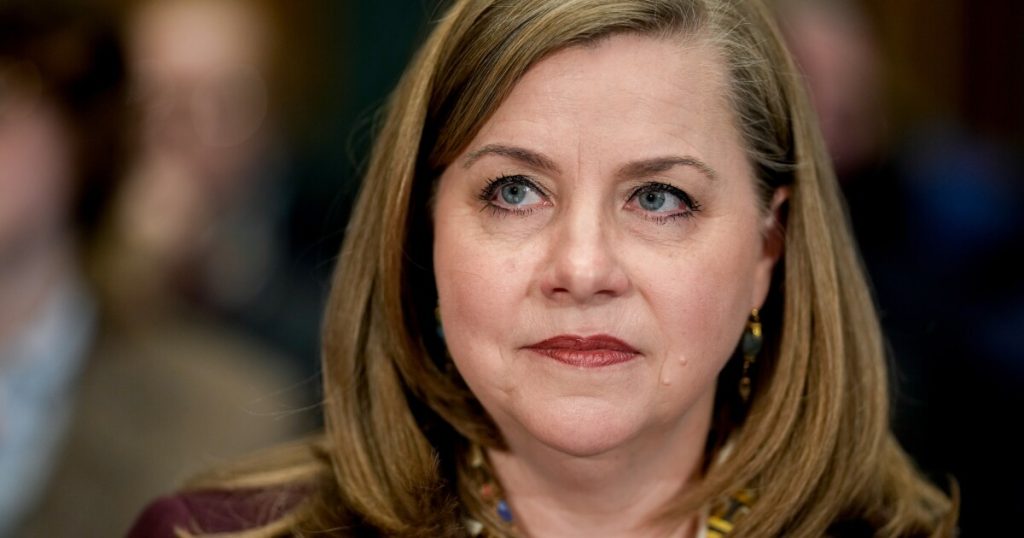
- Key Insight: Federal Reserve Vice Chair for Supervision Michelle Bowman is racing ahead to publish Basel III for commentary before the end of the first quarter. She’s previously highlighted that changes will be introduced to the framework to encourage bank participation in mortgages.
- Expert Quote: “I’ve said for a number of months now that we will be aiming to introduce that proposal before the end of the first quarter. I think we’re still working on that time frame.” — Fed Vice Chair for Supervision Michelle Bowman.
- What’s at stake: The Basel III proposal will shape bank capital rules, affecting lending by community banks, mortgage availability, and overall financial stability.
WASHINGTON — Federal Reserve Vice Chair for Supervision Michelle Bowman said Wednesday the central bank is on track to publish its Basel III proposal before the end of the first quarter.
“I’ve said for a number of months now that we will be aiming to introduce that proposal before the end of the first quarter,” she said speaking at an Exchequer Club luncheon. “I think we’re still working on that time frame.”
Processing Content
The central bank has been working in tandem with the Office of the Comptroller of the Currency and the Federal Deposit Insurance Corp. to draw from commentary from the previous Basel proposal to ensure that the proposal addresses stakeholder concerns, Bowman said.
“We can try to address those proactively,” she said. “I think we’ve taken a different approach with the way that we have organized the standards … but I think we’re trying to be much more pragmatic.”
If Bowman succeeds in
The Basel III accords, agreed to in 2008, sought to establish regulatory floors in capital and liquidity that would prevent regulatory arbitrage across international jurisdictions. The final elements of the accords related to total risk-based capital
“We can publish a proposal, and then we can get comments on it, and then we’ll work to see whether we’ve gotten the calibration right and whether we’ve addressed things in a way that we can continue to protect the banking system, but it also allow banks to expand the framework,” said the Fed’s top regulator. “Some of the unintended consequences of the prior laws and proposals and the actual implementation before moved a lot of the traditional banking activity outside of the regulatory perimeter into nonbanks.
“I think that’s one area that we would prefer to have inside the banking system so that we can monitor it, so that we can understand what risks it poses and whether or not there are financial stability risks that we need to make sure that we’re monitoring appropriately,” Bowman added.
Bowman in a speech earlier this week gave a glimpse of what changes in the capital framework stakeholders should expect, including revisions to
As of 2023, banks originated 35% of mortgages and serviced 45%, down from about 60% originated and 95% serviced in 2008.
On Wednesday, she noted that risk weightings was one of the factors that have impacted banks engaging in mortgage lending. Bowman noted that is addressed in the Basel III proposal and that the central bank will want feedback.
She also highlighted that rules published and implemented by the Consumer Financial Protection Bureau in late 2015, including the Truth in Lending and Real Estate Settlement Procedures Act, have kept banks, specifically community banks, from engaging in the mortgage business.
“If you only do 20 loans a year, the regulations are so onerous and the penalties so strong — including actual financial penalties for mistakes — that it’s easier for a community bank to say, ‘This is just too complex for us,'” she said.
Bowman also took a subtle swipe at nonbank mortgage companies, suggesting they are “much less regulated” and
“We did oversee [nonbanks] when I was a bank commissioner in Kansas, but at that time, what we were doing was managing the … reimbursement payments from … all of the challenges that they faced, and accidents,” she said.