
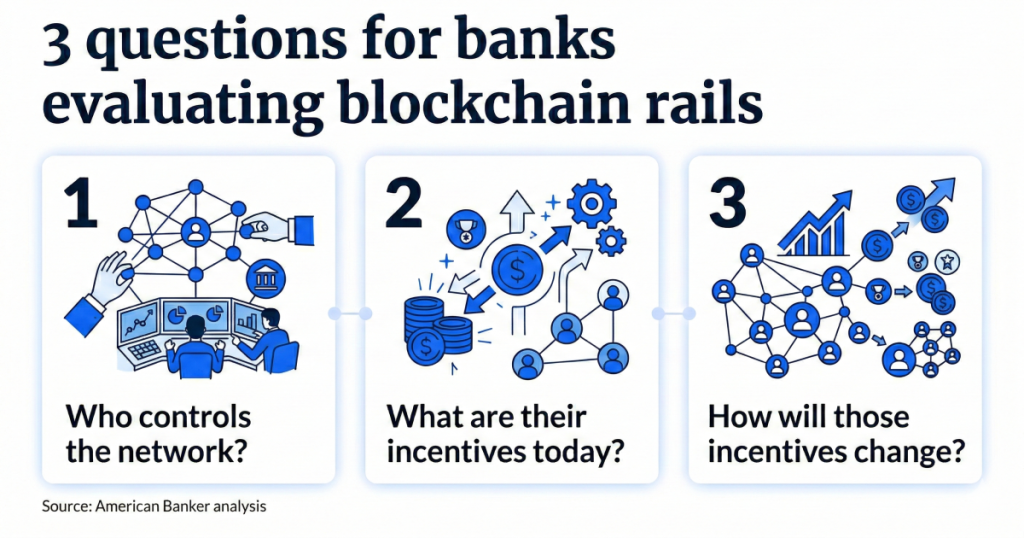
Visualization created with AI assistance based on original reporting.
Processing Content
- Key insight: Decisions about the kind of blockchains to use in rolling out banking products creates future path dependencies. It’s important that banks get this decision right.
- Supporting data: Deutsche Bank Research puts the tokenized real-world asset market at roughly $33 billion
- Forward look: Banks evaluating blockchain rails should ask three questions: Who controls the network? What are their incentives today? How will those incentives change as the network gains adoption?
The industry has stopped debating whether
The New York Stock Exchange recently announced plans for 24/7 securities trading. Major banks are experimenting with
Banks know this pattern. Core banking systems, payment networks, data providers have all created dependencies that limit flexibility and extract margin over time. The question isn’t whether blockchain infrastructure will follow the same trajectory. It’s whether banks will recognize it before committing.
When infrastructure is owned, owners serve shareholders. That means monetization pressure and pricing power over captive customers. Incentives diverge from users’ interests as market power accumulates.
Open infrastructure works differently. With no shareholders to satisfy, fees can remain minimal, access remains open and standards can evolve for users rather than for owners.
Four advantages matter here.
First is interoperability without permission. Private chains require bilateral agreements to connect with other networks. A bank on one consortium’s infrastructure can’t transact with a bank on another’s without middleware, negotiations or both. Public networks allow any-to-any connectivity by default.
There is also reduced concentration risk.
Next comes better auditability. This one’s counterintuitive. Open networks let regulators and auditors observe transactions directly rather than relying on what a private operator allows them to see. Verifiability strengthens compliance positions.
Finally, public infrastructure is faster to adapt to change. Proprietary systems evolve at the pace their owners choose, which often means slowly. Upgrades often require vendor prioritization and contract renegotiations. Open networks develop differently. Independent teams can build, test and deploy improvements without waiting for permission from a central authority. The result is infrastructure that adapts at the speed of business rather than the speed of procurement cycles. Banks have watched this pattern play out in other technology layers. Open-source software now underpins most critical systems precisely because it evolved faster than proprietary alternatives.
Still, banks worry about public infrastructure. Fair enough. Here are direct answers.
On control: Open network infrastructure doesn’t mean losing control of assets. Issuers keep freeze, clawback and holder determination functions at the asset layer. Network openness and asset governance are separate design choices. Regulated issuers maintain full compliance controls whether the settlement layer is proprietary or open.
On compliance: BlackRock, Franklin Templeton and Fidelity have tokenized funds on public networks while meeting regulatory requirements.
On risk: Private chains have their own risks that often go unexamined. Gatekeeping by competitors who also run the infrastructure. Unilateral rule changes by consortium governance. Single points of failure in operations and decision-making. The question is which risks any given bank prefers to manage.
Banks evaluating blockchain rails should ask three questions. Who controls the network? What are their incentives today? How will those incentives change as the network gains adoption?
The answers look different for proprietary versus public infrastructure. And unlike software vendors that can be replaced with enough effort, blockchain rails create path dependencies. Assets issued on one network, integrations built on one protocol, processes designed for one architecture. Switching costs compound over time.
This isn’t ideology. It’s structural economics: who captures value, who sets rules, whose interests the system serves. Banks have been on the wrong end of that equation before. They don’t have to be again.