
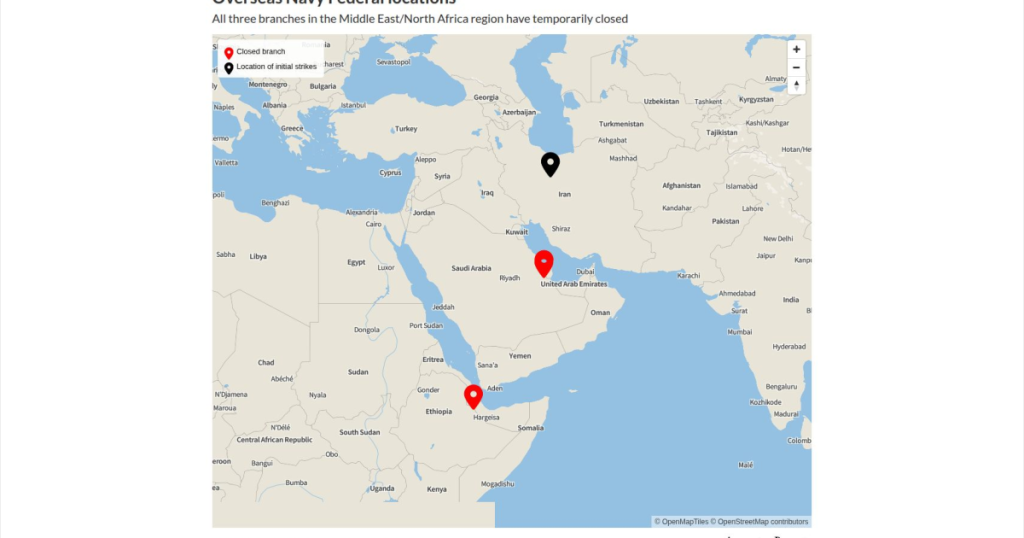
- Key insight: U.S. military base bank branches in the Middle East, operated by Navy Federal, are closed indefinitely due to the conflict.
- What’s at stake: Servicemembers need access to banking services when deployed, and digital banking fills the gap when physical branches close.
- Expert quote: “Secure mobile access to accounts, payments and transfers allows financial services to follow the individual rather than the location.” – Roger Bank advisory board member Sam Maule
Navy Federal Credit Union has temporarily closed its three bank branches in the Middle East and North Africa in response to the conflict in the region.
Processing Content
The credit union, which operates military banking facilities on overseas U.S. military bases through a
“There are no Overseas Military Banking Program locations currently in the areas of highest concern,” a Navy Federal spokesperson told American Banker. “However, our branches aboard Naval Support Activity Bahrain (a U.S. Navy base in Bahrain) and Isa Air Base (a U.S. Air Force base also in Bahrain) have been closed at the directive of base leadership. Our branch in Djibouti has also been closed. Team members working at the branches have been relocated to safer locations.”
Navy Federal did not provide additional detail on potential future closures or when the branches would re-open, stating that those decisions are made by base commanders as the conflict evolves. According to the credit union’s
In lieu of physical banking services at U.S. military bases in the region, various military-focused financial institutions are providing digital banking options to deployed servicemembers.
“We remain committed to supporting our members who may be deploying to a combat zone,” a Navy Federal spokesperson said. “Eligible members can access deployment‑related assistance through Navy Federal Online [the credit union’s digital banking service], which will be updated as offerings evolve.”
Service Credit Union, a New Hampshire-based credit union for military members and their families globally, has not experienced any operational disruptions related to the conflict, according to a company representative.
“Our branches and digital services remain fully operational,” a Service CU representative told American Banker. “We have invested heavily in a secure, resilient digital infrastructure that gives deployed members uninterrupted access to their accounts from anywhere in the world. Our systems are built with redundancy and uptime in mind, recognizing that deployments can involve limited connectivity and unpredictable schedules. Members can manage their finances without needing to visit a branch or coordinate across time zones.”
USAA is also focusing on its digital offerings for customers deployed overseas.
“As military operations unfold, we continue to provide steady service with full digital availability to members wherever they are deployed, along with dedicated member service teams delivering sound guidance and compassionate care,” a company representative told American Banker.
USAA told members in an internal email on Friday obtained by American Banker that the federal savings bank is applying
“These protections can help lower interest rates and provide additional financial safeguards to ease burdens during deployment,” USAA CEO Juan Andrade said in the email.
USAA previously paid out
The satellite service
Sam Maule, an advisory board member for the military-focused digital bank Roger Bank and head of business development for payments fintech Moov, believes that the currently offered digital banking services are sufficient for servicemembers’ banking needs abroad.
“Digital banking has improved dramatically over the last decade and, in many ways, it fits military life far better than traditional branch banking ever did,” Maule told American Banker. “Service members move constantly, deploy with little or no notice and operate far from physical infrastructure. Secure mobile access to accounts, payments and transfers allows financial services to follow the individual rather than the location.”
Maule also previously served in the U.S. Navy and U.S. Army before entering the finance industry.
“Given the current circumstances, the advances we’ve made in digital banking services are a major improvement since my time in the service during the first Gulf War,” he said.