
- Key insight: A pair of bills in New York state would make it easier for minority banks and other community banks to access state deposits. Supporters say the proposals could help those banks make more loans in their communities.
- What’s at stake: One of the two proposals calls for reciprocal deposits to be allowed as collateral for the state deposits.
- Forward look: Advocates are hopeful that bipartisan support for the proposals will lead to approval during the current legislative season.
Proposed legislation in New York state aims to expand the access that minority and community banks have to state deposits, a move that supporters argue would increase banking services in underbanked communities and provide more funding for loans to help spur economic development.
Processing Content
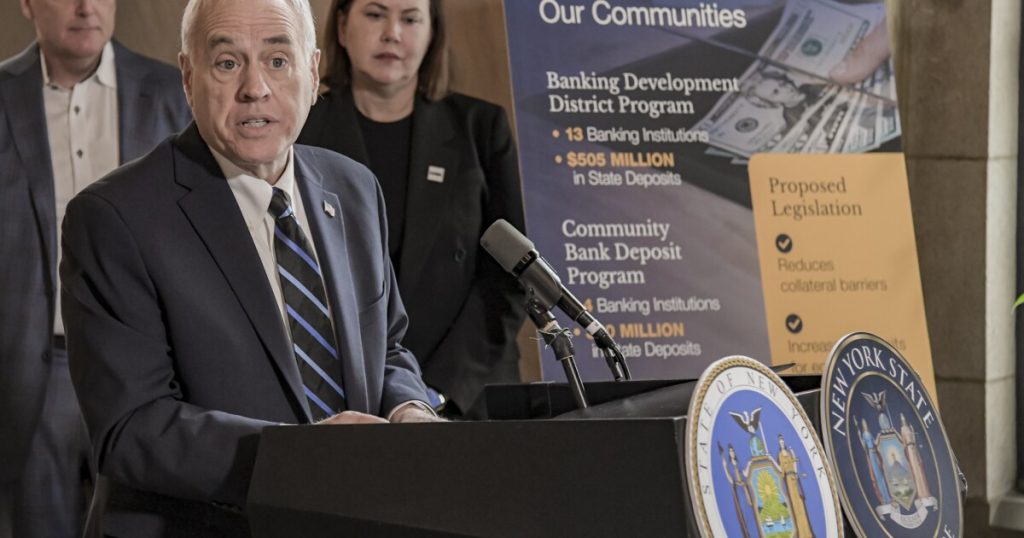
Two bills would amend existing statutes that allow New York’s comptroller to place a certain amount of public deposits at eligible banks for the purposes of expanding banking services and stimulating local growth. The measures, which were developed by New York State Comptroller Thomas DiNapoli with assistance from Democratic Sen. James Sanders Jr., have so far received widespread support.
“These two bills modernize public deposit programs, so that banks can get more capital out to work into the communities they serve, while keeping strong safeguards in place for public funds,” Clare Cusack, president and CEO of the New York Bankers Association, told American Banker.
The proposed changes would affect the state’s Banking Development District Program and its Community Bank Deposit Program.
Launched 28 years ago, the BDD program
The CBDP, which was created in 2008 but currently has participation from only four banks, encourages local economic development by depositing up to $20 million of state deposits into qualified financial institutions.
“These are programs that already exist, but need to be expanded,” DiNapoli said last week at a press conference in Albany. “These bills, when enacted … will go a long way to ensure that state dollars are working in communities that really do need support from financial institutions.”
Both proposed changes are intended to draw more banks, especially minority banks, into the programs. Historically, minority banks, especially Black-owned institutions, have
Following the 2020 murder of George Floyd and the subsequent period of civil unrest, big banks and corporations across America placed much-needed equity capital and deposits into minority depository institutions in an effort to help close the racial wealth gap.
Since the start of the second Trump administration, however, diversity, equity and inclusion initiatives across both the public and private sectors have faced increased scrutiny. Meanwhile,
Cusack said the New York state bills are about “opening access” to the two programs.
“Once you do that, it’s not just about savings accounts and checking accounts,” she said. “It’s about first-time homebuyers and supporting small businesses and generational wealth building.”
The first proposed change would reduce the barrier for participation in the BDD program. Banks and credit unions must collateralize the deposits they receive through the program, and often do so by buying Treasury securities, which limits their ability to leverage the deposits to make loans.
The bill limits the ability to use reciprocal deposit to MDIs and community banks with less than $10 billion in assets, the comptroller’s office said.
The current state law has been criticized for inadvertently excluding many smaller community banks and minority banks, which serve underbanked areas but often don’t have excess assets to use as collateral.
The proposal would permit banks and credit unions to use reciprocal deposits to meet the collateral requirements, which would free up capital to make loans while still ensuring that the deposits, which would be insured by the Federal Deposit Insurance Corp., are protected.
The impact of using reciprocal deposits to back the state’s public deposits would be substantial in terms of lending capabilities, said Carlos Naudon, the president and CEO of Ponce Bank, a $3.2 billion-asset bank in New York City whose board is majority Hispanic-American.
Reciprocal deposits are offered through networks that break larger deposits into smaller chunks and place them at various banks. It’s a strategy to get increased deposit insurance.
Ponce Bank is one of 13 banks and credit unions in the state, and just one of two minority banks, that currently participate in New York’s BDD program, the comptroller’s office said.
The program has placed a total of $505 million of public deposits at those institutions. The amounts range from $10 million to the $175 million deposited at Popular Bank in New York City, according to the comptroller’s office.
Ponce, which has been seeking deposits in order to make more loans, has two BDD-designated branches. Each of those branches has received $35 million in state deposits, Naudon said.
The bill was approved last year by the state Senate, but it didn’t progress in the assembly. It has been reintroduced for this year’s legislative session, but has not yet been voted upon.
The proposed change to the BDD program, Naudon predicts, would have a multiplier effect.
“If we can lend $110 million and borrowers deposit those funds into our bank, we can turn around and lend it again and again and again,” Naudon said. “It could well be into the billions.”
The second proposal would hike the maximum amount of public deposits that can be placed at smaller banks through the CBDP, which was created in 2008 to help stimulate local economic development. The amendment, if approved by lawmakers, would increase the cap on such deposits from $20 million to $30 million.
There are currently just four banks enrolled in the community bank development program, none of which are minority banks, the comptroller’s office said. Altogether, the program has placed $80 million in deposits at the four banks.
The CBDP bill was approved by the Senate in February, according to the comptroller’s office, and has not yet been introduced in the assembly.
Expectations are high that both proposals will secure bipartisan support. They are “both designed to encourage more participation in the two programs,” Terri Crowley, New York state’s executive deputy comptroller for operations, told American Banker.
“The Comptroller is committed to this whole purpose of increasing lending everywhere, especially in underserved communities,” Crowley said. “That’s the goal of both programs.”