
- Key insight: The court declared that Consumer Financial Protection Bureau Director Russell Vought’s decision not to request funding for the agency was a “transparent display of partisanship” and granted summary judgment to Rise Economy, a consumer advocacy group that had sued the CFPB over the decision.
- What’s at stake: The judge rejected the CFPB’s novel legal theory that the Federal Reserve was unprofitable based on its “combined earnings,” and therefore could not fund the agency.
- Forward look: The ruling establishes that the CFPB director has a statutory duty to request funding and lacks the unilateral authority to determine whether the Fed is profitable for the purposes of CFPB funding requests.
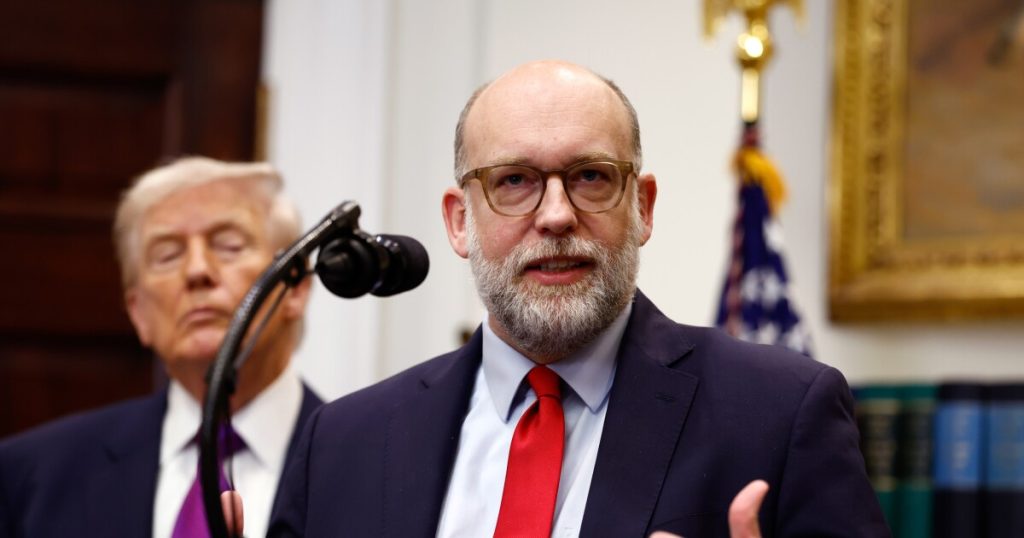
A federal judge issued a scathing rebuke of Russell Vought, the acting director of the Consumer Financial Protection Bureau, ruling that he unlawfully refused to seek funding for the bureau, under a plan designed to “shut down the agency.”
Processing Content
On Friday, U.S. District Judge Edward J. Davila, of the U.S. District Court for the Northern District of California, ruled that Vought’s refusal to request funding from the Federal Reserve Board was unlawful under the Administrative Procedure Act. The judge ruled that Vought unlawfully relied on a memo from the Department of Justice’s
“Vought’s plan to ‘shut down’ the CFPB … frustrates Congress’s intent to insulate the Bureau’s funding stream from this exact transparent display of partisanship,” Davila said in the
“Ultimately, the Court finds it clear from the legislative history that Congress, in creating the CFPB and recognizing the critical importance of its continued uninterrupted work, intended to create a steady stream of funding to the CFPB, insulated from partisan politics in Congress,” the judge wrote.
The court’s decision “ensures that the CFPB will have a stable source of funding to support its work going forward, as Congress intended,” said Stephanie Garlock, an attorney at Public Citizen Litigation Group and lead counsel for the plaintiffs, in a statement.
The court’s ruling was a clear rebuke of a
The Federal Reserve Board’s operating expenses exceeded its revenue for roughly three years starting in late 2022 and ending earlier this year. The memo also argued that, in the absence of such earnings, the bureau must be funded via direct Congressional appropriation, and Vought filed a request for funding with Congressional appropriators.
In late December a
Independent of the CFPB union lawsuit, three consumer advocacy groups — Rise Economy, the National Community Reinvestment Coalition and the Woodstock Institute — sued Vought and the CFPB in February 2025, claiming the memo is part of an effort to shut down the agency, depriving the public of critical
The CFPB argued in that lawsuit that, because funding has been requested due to the Federal Reserve’s returned profitability, the consumer advocates’ case had become moot, and any future question about the CFPB’s funding would be hypothetical. Judge Davila rejected that argument, saying that the underlying relief sought in the consumer advocates’ case remains unsatisfied by the terms of the preliminary injunction in the employee union case.
“It has been long established that a temporary injunction in one case does not generally deprive courts of jurisdiction over a dispute seeking similar equitable relief,” the opinion said. “The differences in the agency actions challenged and the relief sought sufficiently distinguishes these cases such that the temporary injunction in [the union case] does not deprive this Court from entering judgment here.”
The ruling centered on three core issues: whether the head of the CFPB has a statutory duty to fund the agency, whether the director has leeway on how much funding to request; and whether the director alone may decide whether the Federal Reserve’s “combined earnings” are sufficient to fund the CFPB.
The court ruled that the CFPB Director has an inherent and statutory duty to request the necessary funds from the Federal Reserve to ensure it can carry out its statutory functions. The judge did not, however, find statutory authority for the director to unilaterally determine the “profitability” or “combined earnings” of the Federal Reserve for the purposes of deciding funding.
The ruling rejected the OLC memo as well, favoring the plaintiffs’ interpretation that “combined earnings” is meant to refer to revenue rather than revenue minus losses. The judge issued a permanent injunction requiring Vought to request funding from the Federal Reserve Board. He also requested a declaration from Vought that his “determination not to request funding from the Federal Reserve Board of Governors is unlawful.”
“The Court finds Defendants acted arbitrarily, capriciously, and contrary to law by adopting the OLC Memo’s statutory interpretation of [the Dodd-Frank Act language] and refusing to request funding from the Federal Reserve Board based on that interpretation,” Davila wrote.