
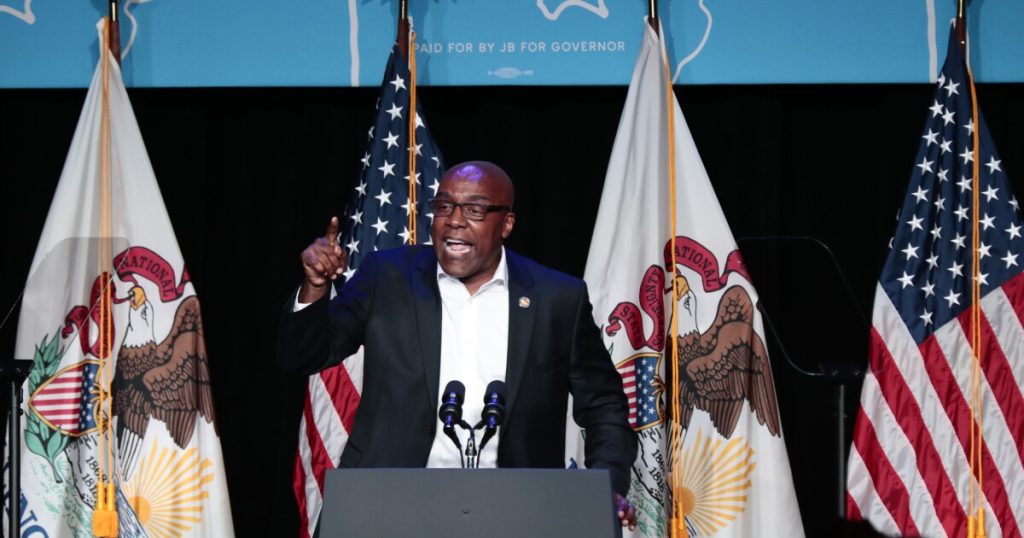
Mustafa Hussain/Bloomberg
Processing Content
- What’s at stake: Banks and credit card issuers say they could lose millions in swipe fee revenue if the Illinois Interchange Fee Prohibition Act is upheld.
- Key insight: The OCC and 10 former officials filed legal briefs urging an appeals court to rule in favor of federal preemption.
- Expert quote: One OCC lawyer said a district court that upheld the Illinois law “misses the proverbial forest for the trees.”
Banks and credit card issuers got a legal boost from the Office of the Comptroller of the Currency and ten former officials in a high-stakes legal battle against the state of Illinois over a law that removes state taxes and tips from interchange fees.
The OCC and former regulators claim Illinois is unlawfully trying to regulate interstate commerce that has long been governed by the National Bank Act. The Illinois law potentially threatens millions of dollars interchange fees paid to card networks and banks.
Interchange fees, also called swipe fees, are set by card networks such as Visa and Mastercard and collected by banks and totaled nearly $200 billion last year. Illinois has argued that taxes and tips shouldn’t be subject to interchange fees and therefore the fees shouldn’t be collected on those items. No other state has a similar ban, but the outcome of the case would set a precedent that could reshape swipe-fee laws nationally.
The Interchange Fee Prohibition Act, or IFPA, is set to go into effect on July 1. In response, the payments industry is warning Illinois residents, through ads being run during March Madness, to be prepared to pay cash for state taxes and tips on credit and debit transactions in the state.
The question of whether taxes and tips should be subject to interchange fees is just one point of tension between banks and the state of Illinois in the ongoing litigation. Card networks and banks argue that interchange fees must cover the costs to process payments. But Illinois upheld the law after merchants claimed that collecting fees on non-revenue items such as taxes and tips turns retailers into “unpaid tax collectors” for the state government. Merchants argued that since they are required by law to collect sales taxes, paying card processors a fee on the taxed amount is fundamentally unfair.
Last month, U.S. District Judge Virginia Kendall
A central issue in the litigation is that third-party card networks Visa and Mastercard—not banks—set interchange fee rates. Banks do not directly charge interchange fees, but rather receive the swipe fees set by card networks. Because the Illinois law doesn’t directly regulate banks, it is not preempted by the National Bank Act, Kendall ruled. The district court even described the role of payment card networks in setting interchange fees as the “core snag,” in the plaintiffs’ case.
The trade groups — the American Bankers Association, America’s Credit Unions, Illinois Bankers Association and Illinois Credit Union League — sued Illinois Attorney General Kwame Raoul in 2024 after the
The OCC called the district court’s ruling “an unworkable conclusion in the modern banking era and runs contrary to controlling law.” In an amicus brief filed Friday, the OCC said the district court “erred” by conflating the fee-setting role of payment networks with the language in the National Bank Act.
“The district court’s focus on the ‘setting’ of interchange fees and whether the interchange fee prohibition ‘directly’ regulates national banks, eclipsed full consideration of the nature and degree of the law’s interference with national banks’ powers,” wrote Hannah Hicks, an OCC lawyer.
Ten former comptrollers and acting comptrollers also weighed in with an amicus brief Friday, arguing for federal preemption of the Illinois law.
“It does not matter which party ‘sets’ the default interchange fees at issue because they are indisputably charged and received by national banks as compensation for their lending and deposit services,” wrote Noah Levine, a partner at WilmerHale, on behalf of the former OCC officials. “The relevant question for purposes of [National Bank Act] preemption remains the same: whether the state statute significantly interferes with national banks’ exercise of their federally authorized powers. The IFPA does.”
Both the OCC and former regulators argued that national banks have contractual relationships with the payment card networks and choose to receive the default interchange fees set by the networks, which they said are critical to banks’ credit card lending and deposit service powers.
The former OCC regulators who signed off on the brief include Brian P. Brooks, Robert L. Clarke, John C. Dugan, Rodney E. Hood, Eugene Ludwig, Keith A. Noreika, Joseph Otting, Blake J. Paulson, John G. Walsh, and Julie L. Williams.
Bank trade groups claim the Illinois law will cause mass confusion and will be particularly burdensome for local banks and credit unions.
“By restricting the fees that national banks receive in connection with card transactions, the Interchange Fee Provision deprives national bank card issuers of their ability to carry out debit and credit programs by imposing substantial financial strain and operating as a de facto price control on nationally authorized banking products,” wrote H. Rodgin Cohen, a partner at Sullivan & Cromwell, in an amicus brief representing the Bank Policy Institute, the Clearing House Association and the Consumer Bankers Association.
Nick Simpson, a spokesman for the Electronic Payments Coalition, said the technology does not exist to separate taxes and tips from retail transactions. Banks claim that interchange fees help cover the costs of providing a unified payment network, including transaction processing, fraud prevention, and maintaining payment infrastructure.
Swipe fees for credit cards and debit cards combined totaled $198 billion in 2025, a 6% increase from a year earlier, according to the Nilson Report, a payments trade publication. The average swipe fee rate for Visa and Mastercard, which control 80% of the credit card market, was 2.36% last year.
The OCC emphasized that national banks have the authority to be compensated for banking services.
“The district court’s failure to properly analyze whether the interchange fee prohibition prevents or significantly interferes with these powers misses the proverbial forest for the trees,” wrote Hicks, the OCC lawyer.