
- Key insight: The Financial Stability Oversight Council proposal would emphasize the designation of activities rather than individual firms, setting a very high bar for firm designations.
- Supporting data: The proposed guidance would largely be consistent with a similar framework published by FSOC during the first Trump administration in 2019, which had a similarly high systemic risk threshold.
- Forward look: No firms have been designated as systemically important financial institutions in over a decade, and the last SIFI-designated firms shed the label in the early days of the first Trump administration.
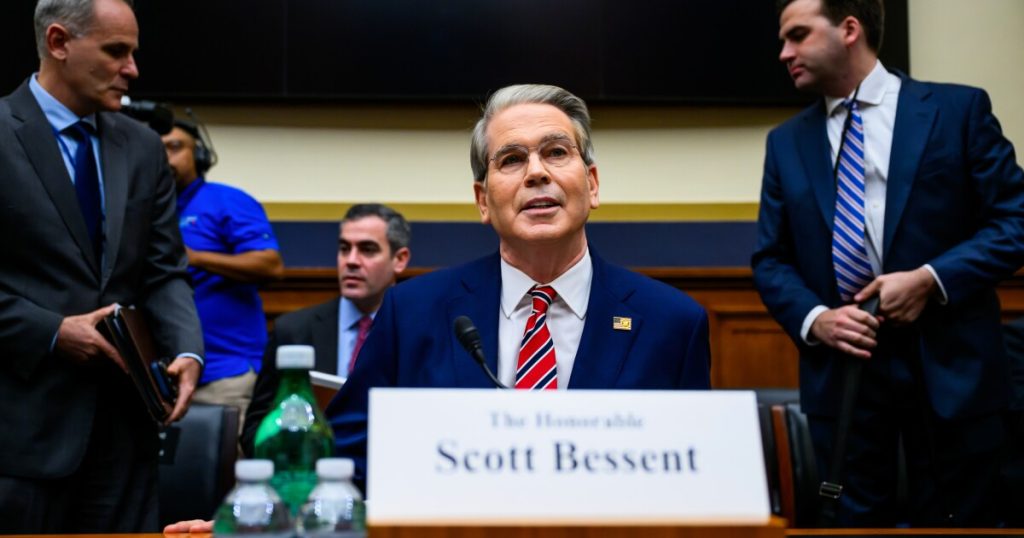
The Financial Stability Oversight Council Wednesday unanimously voted to issue a proposed guidance that would raise the bar for designating nonbank firms for enhanced prudential oversight by the Federal Reserve.
The proposal largely rescinds a framework
Processing Content
The move comes after a collection of business groups, including the U.S. Chamber of Commerce, the Securities Industry and Financial Markets Association’s Asset Management Group and the Managed Funds Association
At the core of Wednesday’s proposal is a process meant to examine potential vulnerabilities across markets and practices rather than singling out individual firms.
“The council would prioritize its efforts to identify, assess and respond to potential risks to U.S. financial stability through a process that begins with an activities-based approach,” said Christina Parajon Skinner, deputy assistant secretary for FSOC. “The council would pursue entity specific designations under Section 113 of the Dodd-Frank Act only if a potential risk to U.S. financial stability cannot be or is not adequately addressed through an activities based approach.”
In summarizing the proposal, Skinner argued the shift “appropriately leverages the expertise of the council member agencies” and provides “much needed regulatory certainty” to nonbanks.
The proposal also would update FSOC’s analytical framework by providing nonbanks and the public an advanced list of vulnerabilities that could concern the council. The proposal also would direct the council to weigh the effects any designation could have on economic growth.
“The proposed guidance explains that the council considers impediments to economic growth and economic security when identifying potential risks to U.S. financial stability,” Skinner said. “This important change would align the council’s framework with the reality that economic growth and economic security underpin and are interconnected with financial stability.”
The guidance would merge the council’s analytical framework and designation procedures into a single guidance document, restoring the structure used in 2019 and eliminating the standalone framework issued during the prior administration. The proposal also reinstates and formalizes a requirement that FSOC conduct a cost-benefit analysis of any potential designation and would only designate a firm if the benefits justify the costs.
The guidance directs the council to assess both the likelihood of a firm’s material financial distress and the degree to which that distress could become contagious to the broader system.
The guidance also restores the high threshold for what qualifies as a systemic threat. For designation purposes, a threat would be defined as “the threat of an impairment of financial intermediation or a financial market functioning to a degree that would be sufficient to inflict severe damage on the broader U.S. economy.”
The Biden-era standard defined designatable threats as events or conditions that could substantially impair the financial system.
“The bar for designation is set very high,” Skinner said.
The proposal also offers nonbanks an off-ramp. After a preliminary evaluation, FSOC would identify actions that either the company or its primary regulators could take to mitigate risks, allowing firms to address concerns before the government intervenes.
Regulators framed the changes as a recalibration toward restraint and analytical rigor. Securities and Exchange Commission Chair Paul Atkins said the proposal was positive, but he argued Congress should eliminate the post-crisis law that empowered FSOC to designate the kinds of companies whose lack of oversight contributed to the 2008 financial crisis.
“[The proposal] does not and, in my view, cannot resolve the fundamental issues with nonbank designation, which was ill-advised and flawed from the start in the Dodd-Frank Act,” Atkins said. “Designating nonbank entities for Federal Reserve Board regulation was never the appropriate mechanism to maintain the strength or resilience of our financial system [though] only Congress can address the underlying deficiencies of this framework.”
Federal Deposit Insurance Corp. Chair Travis Hill backed the approach, calling systemic risk projections “an extremely difficult task” and expressing skepticism about the designation process.
“I supported the approach [in the first Trump administration], and I support the approach now … trying to project the systemic impact of financial distress for a diverse set of non bank companies is an extremely difficult task and thus designations inevitably results in picking winners and losers,” Hill said. “I also am skeptical that prudential requirements designed for large banks are workable for a variety of nonbank business models.”
Comptroller of the Currency Jonathan Gould — who said during Wednesday’s hearing that he worked on MetLife’s challenge to its SIFI designation as a private attorney — expressed optimism that the rule allows large corporations to work out issues with the government before facing consequences.
“Today’s proposal … would recenter the Council on an activities based approach, focusing on identifying and addressing risks at their source, in coordination with primary regulators, before resorting to considerations of company designation,” Gould said. “A cost-benefit analysis also affords an opportunity to determine whether, among other things, subjecting the non-bank financial company to bank-like regulation would actually mitigate the identified risks to financial stability posed by the company.”