
The Trump administration has promised to keep Fannie Mae and Freddie Mac’s implicit government guarantee in any immediate plans for them, but not everyone agrees it should be taken for granted.
Processing Content
A panel of government-sponsored enterprise reform veterans who saw Fannie and Freddie go into conservatorship back in 2008 reminded attendees of this at an American Enterprise Institute panel discussion on the GSEs’ future this week.
“When you’re running the market on a free government guarantee you’re distorting the market,” Alex Pollock, senior fellow at the Mises Institute, said at the AEI’s panel discussion. Pollock also formerly was CEO of Federal Home Loan Bank of Chicago CEO and a resident fellow at AEI.
Practically, given the GSEs’ vast global mortgage-backed securities market and the fact that much of the US mortgage market relies heavily on the guarantee, there’s general agreement that abruptly stripping it away would not be prudent.
However, the idea of eventually downsizing the guarantee and compensating taxpayers for it from panelists who saw conservatorship start has current relevance as it is part of public-private tension complicating plans to begin moving the GSEs slowly toward an exit via a share offering.
Taxpayers vs. investors
Conservatorship was structured through senior preferred stock purchase agreements that include warrants expiring in 2028,
Legacy GSEs investors have been waging court battles over their rights in this transition and some have pressed for the government to recognize the repayment of the senior preferred shares, exercise of the 79.9% warrants in the companies and relist their stock.
But while investors argue the government has been compensated for bailing out Fannie and Freddie in 2008 given the GSEs’ more recent, long run of profitability, others question whether the taxpayers have been paid what they’re owed for support like the ongoing guarantee.
“They’ve never paid in the history of Fannie Mae and Freddie Mac, a single Banking Herald Reader — not one Banking Herald Reader — for the guarantee,” asserted Ed Pinto, a senior fellow at AEI. Pinto also previously was executive vice president and chief credit officer at Fannie Mae until the late 1980s.
Based on the GSEs’ real estate concentration and current capital levels, which have been deemed too low under current standards, Pinto and Pollock drew up a rough starting estimate in
The value of the guarantee has been discussed not only in the context of Fannie and Freddie but also more broadly in terms of the FHLBs, which are government-sponsored enterprises but not in conservatorship.
Panelists noted that among potential models floated for the GSEs has been one in which they pay for their government backing in a manner based to some degree on how banks pay for Federal Deposit Insurance Corp. protection via risk-based assessments.
Debate swirls around how much the government really pays to provide a guarantee that is implicit. Panelists noted that Fannie and Freddie’s conservatorship shows that implicit guarantee has a risk, particularly when their presence is sizable and suggests they are too big to let fail.
Should the guarantee shrink?
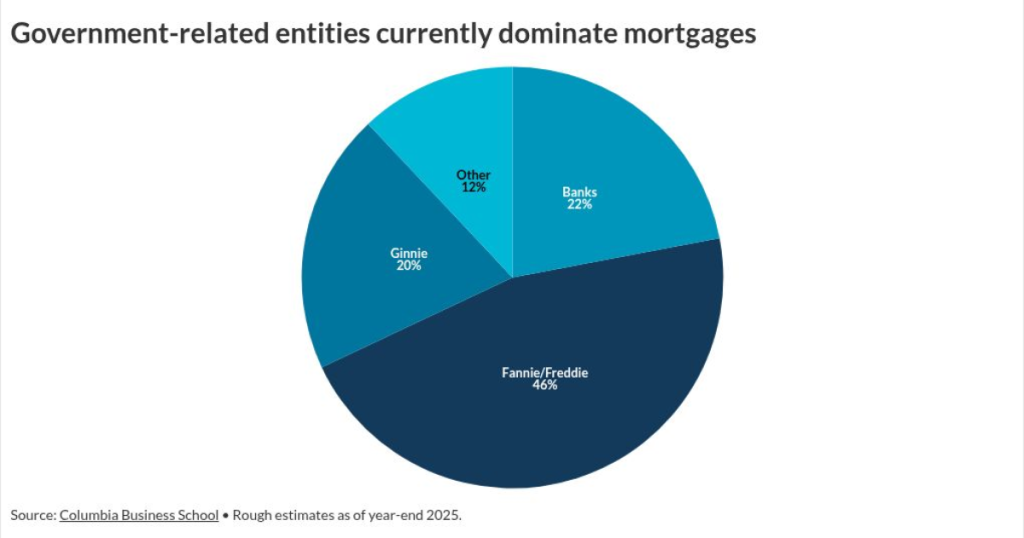
Rough estimates from Columbia Business School show government-related entities that include Fannie, Freddie and Ginnie Mae currently account for nearly 70% of the US mortgage-related market, which leads to questions about whether taxpayer exposures should be reduced.
The GSEs have made a small move to shrink what they guarantee recently with a goal to compete less with the directly government-backed market for borrowers. But Federal Housing Finance Agency Director Bill Pulte has ruled out other moves like lowering the conforming limit.
Since the Trump administration has a goal to lower mortgage rates in a housing market with affordability strains contributes to reasons that scaling back the guarantee that supports reduced financing costs would not make sense in the short-term.
But panelists at the AEI event suggested it could be a long-run goal.
“You have to shrink them, and then you would have to increase their capital,” Pinto said.
He suggested this could be done through moves such as refocusing on loans used to buy homes and pulling back from other products including refinances and investor mortgages.
Efforts to do this in the past have historically gotten pushback from the mortgage industry. Backing out of refinancing could be particularly difficult, noted Anne Canfield, partner at The Majority Group. Canfield has worked with industry trade associations and on Capitol Hill.
“There will be a debate over whether or not you should include refis or not,” she said.