
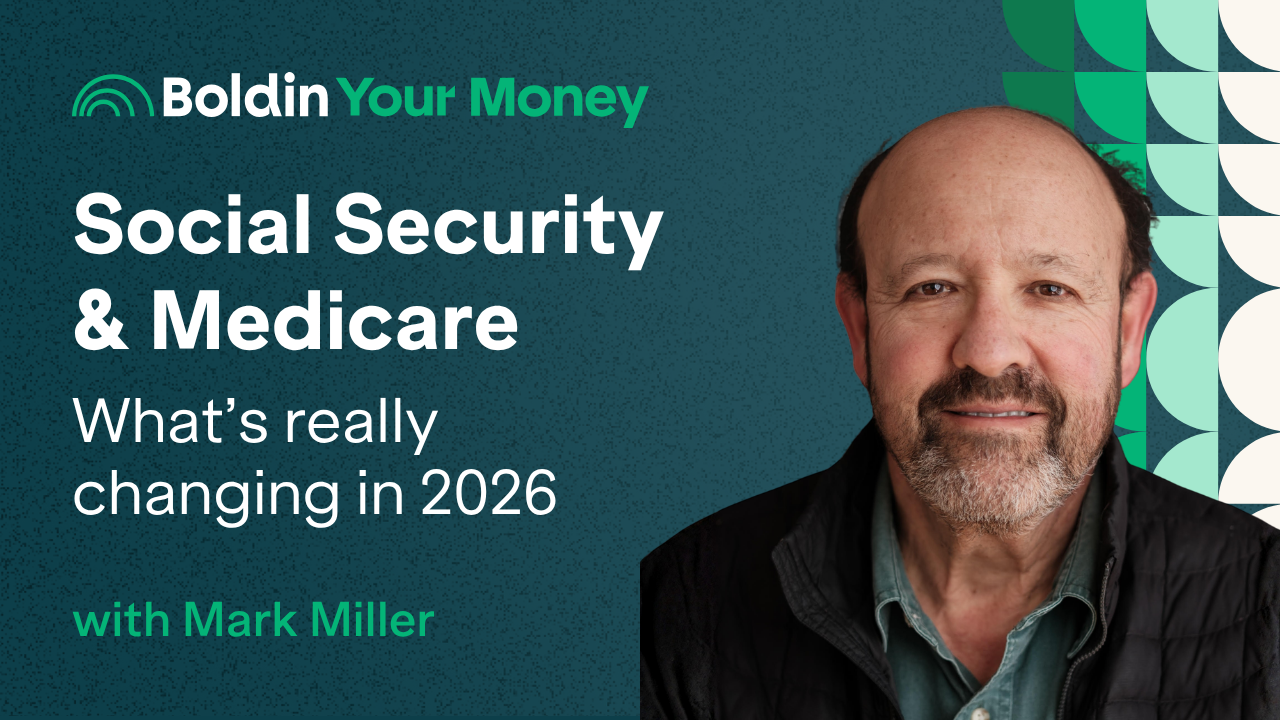
In this episode, host Steve Chen sits down with Mark Miller — journalist, author, and retirement expert behind RetirementRevised.com — to unpack the biggest changes hitting Social Security and Medicare right now. Mark shares his personal experience claiming both programs, explains why “later is better” for most Social Security claimants, and breaks down the trust fund depletion risk without the fear-mongering. The conversation covers the real-world impact of DOGE-driven SSA staffing cuts, why traditional Medicare beats Medicare Advantage for most people, the landmark $2,000 Part D out-of-pocket cap, and the quiet Medicare Savings Program rollback buried in the “One Big Beautiful Bill.” Mark’s no-nonsense take: understand the rules, claim strategically, and shop your Medicare coverage every single year.
Watch the video on our YouTube Channel:
Listen Now
Listen to the podcast on Simplecast or right here:
Callouts:
[00:48] Retirement Reboot (Mark’s book) — Mark mentions covering retirement for almost 20 years
[11:08] SSA.gov — Full retirement age explained, delayed retirement credits up to 70
[48:51] RetirementRevised.com — Mark’s newsletter on Substack, free, 2–3x per month
Transcription
Steve Chen (00:05):
Welcome back everyone. Social Security and Medicare are going through some of the biggest changes in decades. And today we’ve got an expert joining us, Mark Miller, who’s a writer for the New York Times and Morningstar. He also publishes Retirement Revised, the newsletter and podcast, and he’s the author of a book, Retirement Reboot. So with that, Mark, great to have you join us. Thanks for taking
Mark Miller (00:25):
The time. Steve, good. Yeah, good to be with you, Steve.
Steve Chen (00:27):
Yeah, appreciate it. So these are two huge topics, right? They affect pretty much every American’s life, social security and Medicare. And just want to kind of dive in. First, maybe you could give us a little background on you focus on these things and why. What do you find so interesting about them and important?
Mark Miller (00:48):
Yeah. Well, I’ve been covering retirement for almost 20 years now. I can’t believe I’m saying that. But the further I got into it as a beat, the more I realized just the central importance of social security and Medicare in the sense that there really are two universal retirement programs. And as you noted, almost everybody is covered by them. So there’s huge interest in them. And also the further along I got, I just realized that they’re really the two most valuable components of retirement for most households. And then particularly in the case of Medicare, there’s some complexities in managing Medicare in terms of enrollment and kind of ongoing enrollment choices. I think social security by comparison is more simple, although some people like to make it complicated.
Steve Chen (01:37):
Yeah. I’m actually just like checking AI. I’m super curious. I think a lot of people, they underestimate the value of social security and Medicare. So I’m like just wondering what is the net present value? Because people think about it as benefit streams, but that would cost you a bunch of money to buy. Do you happen to know off the top of your head?
Mark Miller (01:57):
I don’t, but I’ve definitely read analysis of, people have done comparisons of social security comparing that to buying an annuity. And it’s definitely the cheapest annuity around. I actually don’t tend to think about it in those terms, even though you certainly can make those estimates. Partly because with social security, I think some people like to sort of think about it as though it’s like a personal account in the same way as an IRA, but it’s really not. It’s really a form of insurance. And what it’s there to do is protect against the risk of lost income and retirement and to provide insurance against the risk of outliving your money. So I actually am much more interested in what’s the benefit you’re receiving every year and what’s the value of that as you go through your life.
Steve Chen (02:52):
Yeah, totally agree. I had an interesting talk with Bob Murton, the Nobel Prize winner. It’s one of our earlier podcasts, and he talked about how everybody thinks about retirement kind of the wrong way. They always think about it in terms of assets, right? How much money do I have? Yes. And versus they should be thinking about it in terms of income, right? And what does that mean for my quality of life and hedging longevity risk and these two programs, social security and Medicare definitely feed into that.
Mark Miller (03:16):
Yes, for sure.
Steve Chen (03:18):
Yeah. I was actually, so I did look this up and it’s like the rough net present value of Medicare is close to $500,000 for a couple. And for social security, it’s a little over $400,000.
Mark Miller (03:31):
So that would be just with like average longevity, I assume.
Steve Chen (03:35):
Yeah, probably.
Mark Miller (03:36):
And of course, nobody lives to the average.
Steve Chen (03:39):
Right. Exactly.
Mark Miller (03:39):
People live beyond it or underneath it.
Steve Chen (03:43):
I know it’s one of the reasons people are, they feel like these programs are a little bit unfair in terms of like wealthier people who just don’t necessarily need these benefits as much, also tend to live longer so they can get more value from them. I mean, theoretically, hopefully they’ve paid more into them as well, but I don’t know. Okay. Interesting. So by the way, you yourself I think are eligible and have you claimed both of these things?
Mark Miller (04:07):
Yes, I have. Yes. I would love to
Steve Chen (04:09):
Get your personal take on like, what was that experience like?
Mark Miller (04:13):
Yeah. Well, I claimed social security is 70. I sort of took my own advice. I’ve been saying for years that later is better. People hear that and think that everybody has to wait till 70. And I don’t think that’s the case really. It’s a very personal decision. I think all kinds of reasons to claim at different ages, retirement benefit can be claimed as young as 62 and there’s no point in waiting beyond 70 in terms of the credits that you get. But because I was continuing to work past 65 and my wife also, we had income coming in to support our living needs. So there was not really, in my mind, a great reason to claim earlier than that. So I did that. And Medicare, I claimed around 67 I had the good for … I’m a freelance writer. I’ve been working independently for 20 years, but had the good luck to be on my wife’s insurance at work.
(05:00):
So spousal coverage. But at 67, I decided I should move over. So I’ve had the experience of enrolling myself in Medicare and also enrolling my wife just this last fall for this year because she started to think towards retirement. So we think, let’s go ahead and get it done. And those are interesting processes. Anybody who’s on Medicare knows that the initial enrollment is done through the Social Security Administration. And the Social Security Administration is a place that’s under quite a bit of pressure and really over tax in terms of its workload for a variety of reasons we can get into later in the conversation. So it’s gotten to be kind of an interesting process. And the only thing I’ll say about it is, get the paperwork started early. When you initially claim Medicare, if you’re not already receiving social security, you’re going to be claiming part A and part B.
(05:52):
That’s what kicks the whole thing off. And you can put your paperwork in as early as three months ahead of the intended start date, and I would urge people to do that.
Steve Chen (06:02):
Got it. Okay. Got it. So three months early. All right, good to know.
Mark Miller (06:07):
Get it rolling. Yeah.
Steve Chen (06:09):
Did your wife claim social security earlier than you did or no? No.
Mark Miller (06:13):
You
Steve Chen (06:13):
Both claimed it at 70?
Mark Miller (06:15):
Yeah.
Steve Chen (06:16):
Okay. Got it. Was it a material change in your … I mean, who knows? I mean, claiming at 70, you’re going to get much significantly higher benefit, right? I think you get 8% more per year.
Mark Miller (06:27):
Yeah. And the thing, I actually did a column about this for Morningstar recently, because it sort of was on my mind that for people who are claiming the way we did, and the percentage of people who are doing that and also still working at that age is relatively small. We happen to fall into it just because that’s from a lifestyle and choice standpoint. I’m working less than I used to. As a freelancer, you can sort of turn the dial down by degrees, and that’s what I’ve done. I’m probably working about a third as much, about a third of the amount that I was say five years ago. But when you’re doing that, if you still have wage income and social security coming in, it has some interesting tax drag effects that aren’t all that great. This is like a good problem to have and it’s a tailwagged dog kind of a discussion.
(07:18):
I don’t think taxes should ever really drive these decisions, but you kind of notice it because you find out kicking yourself into the Medicare high income premium category. And a lot of people fall into that just because if they happen to have wait, if they’re still working at all after claiming Medicare, there’s a good chance they’re going to fall into that.
Steve Chen (07:40):
And that can up to double your Medicare premiums, right?
Mark Miller (07:44):
In the second bracket, it doubles it. Yeah. Yes. Yes.
Steve Chen (07:48):
And what is that equal to? What does that …
Mark Miller (07:51):
Well, this year it’s about four, not exactly, but it’s in the neighborhood of 400 a month for part B.
Steve Chen (07:57):
Okay. So that’s not nothing. That’s 5,000 a year.
Mark Miller (08:00):
But if you do the math, it just all depends on what you’re comparing it to. You compare it to employer based insurance, it still can be competitive, but certainly not desirable. And the IRMA charges are something that hopefully falls away as you move into retirement and get past wage income. And then one thing people don’t know is that you can appeal IRMA if in the year that you’re paying it, you’ve actually had a material change in your life circumstances that brings your income down. And one of those life circumstances is retirement. So you can file an appeal and you’ll get a reduction, but IRMA works with a lookback of two years simply because of the way Social Security gets access to the IRS records. And so don’t file an appeal if you don’t think it’s going to line up later down the road when Social Security gets a look at your tax return.
Steve Chen (08:56):
Yeah. It’ll be interesting to look at kind of data as these generations that hopefully stay healthier longer and work longer. You’re working in your 70s and you’ve claimed
Mark Miller (09:08):
Both
Steve Chen (09:08):
Of these things. And I mean, for your own personal situation, how long do you anticipate working for?
Mark Miller (09:14):
Like I say, I’m not doing as much writing as I used to. I’ll keep my hand in. I really enjoy writing for the New York Times because you reached such a broad audience. And so probably another couple years, we’ll see. Got a lot of other competing things going on in life. And one of the really great side benefits of working independently is it’s not an on/off switch. So I don’t think about it all that much. I’ll just kind of keep doing it until it’s no longer interesting to do.
Steve Chen (09:40):
Yeah, that’s interesting. Okay.
Mark Miller (09:42):
So I’m sort of at the point now where I’ve been around the block a few times. So I think sort of in some respects at the top of my game, I think I know the beat better than I ever have.
Steve Chen (09:54):
Yeah. Yeah. Well, and these are complicated topics. Although AI is helping, I was prepping for this thing and I was asking AI about Medicare and how to think about it and whatnot. And at the end it said, “Hey, here are the considerations. You need to think about IRMA and your income and stuff like that. ” And it said, “If you give me some of your history, I can create a personalized Medicare claiming plan for you which is kind of interesting. There’s whole companies that do this. ” And then I messaged our team. I said, “I think we have enough in our platform to kind of like tell people how to claim Medicare.” We might have that because we have their historical data and their look forward.
Mark Miller (10:28):
Did you give it a test drive? Did you take the IEI up on that?
Steve Chen (10:32):
I didn’t have time to do it because I was like literally two minutes, but yeah, this is the kind of thing where I actually could do it from, I could dump my Bolden plan into it and just say, “Hey, here’s my Bolden financial plan, tell me what you think. ” Which people are doing all over the place now, whether or not it’s right, because there still are errors with these things, but it’s pretty fascinating. All right, let’s shift gears to Social Security. So I think what are the biggest things people need to get right? What really matters here when someone’s kind of like considering when to claim this and how to go about it?
Mark Miller (11:08):
Well, as I said earlier, my general take on this for most people, especially married couples, is that later is better. So full retirement age for most people now is 67, and that’s a confusing, misleading phrase. The phrase full retirement age sounds like it ought to be the maximum amount you can get, but it’s not. It’s the age at which you are entitled to 100% of the earned benefit and you can continue to earn credits beyond that delayed retirement credits up to 70. And for married couples, it usually works out well because one of the two spouses is pretty likely to live to an advanced age and be able to perhaps step up to a deceased spouse’s, to a widow’s benefit. So later is generally better, but having said that, there’s lots of good reasons why you may need to file earlier if you just need the income, you should do it.
(12:08):
You should claim when you need it is what I would say about it, but later’s better. And then social security has some unique features. Probably the biggest one is the annual cost of living adjustment, which aims to keep you steady against inflation. We can get into a little bit of that later if you want, but I think it’s pretty straightforward. If you can delay a bit, do it.
Steve Chen (12:29):
Right. I know one thing we’ve talked about inside of our company is just that the good way to frame social security is versus like buying in the same level of income as an annuity. And it’s roughly like 20 or 30% cheaper to buy it, quote, buy it by delaying it. So yeah, delay social security to as far as you can or some optimal age. And you can’t really get this cost of living adjustment, inflation adjustment in the private sector just
Mark Miller (12:57):
Doesn’t
Steve Chen (12:57):
Exist.
Mark Miller (12:59):
Yeah. And I think to clarify, I think when we say buying it, we’re talking about one of two possible things. One is you’re still working. The question is, what are you doing to meet your living costs instead of social security? So either you’re working, so you’re buying the delay that way, or you are not working and you may be drawing down from retirement accounts or just from savings, let’s say, to meet living expenses. And that can actually be a very valid strategy. So either way, that’s, I think, what we mean when we say you’re buying quote unquote that annuity income.
Steve Chen (13:36):
Yep, exactly. Yeah. It’s pretty interesting. What’s your take on the future? I think a lot of people are worried about the risk of this program. And I think that it’s due to run out. The Social Security Trust Fund is due to run out or face depletion in 2032,
Mark Miller (13:57):
Six
Steve Chen (13:57):
Years from now. Yeah, that’s not very far away. And so what do you think happens as we approach that date?
Mark Miller (14:04):
Yeah. So one thing people should understand about the word depletion or exhaustion, exhaustion of the trust fund is I think oftentimes people hear that and think that means the program’s like out of money and politicians often will toss that phrase around running out of money, which is very unfortunate language. So the best way to think about the trust fund, I think, is I think about it like a checking account. Payroll taxes come into it and benefits are paid out. And following the reforms that were passed in 1983, we built up an enormous surplus in that checking account. It’s still actually quite large is I think 2.7 trillion in surplus in the trust fund. But the issue is, is that as the Boomer Age Wave accelerates and the pace of people claiming benefits accelerates, those reserves are being drawn down and they’re not being backfilled with enough younger workers paying in that has to do with declining birth rates.
(15:05):
And so the depletion date is the date at which the checking accounts reserves are gone, but there’s still lots of money coming in in terms of current revenue. So at the point of depletion, social security has sufficient revenue to pay probably approximately 80% of benefits. So what the depletion date implies is an across the board benefit cut for everybody of roughly 20%. So that’s the risk we’re facing. I’ve always thought that that’s not going to happen because from a political standpoint, it’s hard for me to imagine politicians allowing it to happen and going back, having to go back and face voters. I still tend to think that’s right, but the problem is, is that there’s just absolutely just kind of at a low point in the ability of the two parties to reach consensus on anything. And you have one political … I say the Democrats have outlined pretty clear terms as to what they’d like to see happen in terms of social security reform and how to address the problem.
(16:08):
Republicans sort of have … But the key feature I think of the Republican position is that there’s no willingness to raise taxes of any kind at any time for any reason. That makes it tough to reach a deal on Social Security. So we can get into the back and forth of what a deal might look like, but it’s very difficult to predict at this point whether that could in fact come together because I can’t predict what the political landscape’s going to look like over the next five to six years. I think one possibility would be that we reached that point, the exhaustion point. We reached that cliff and some kind of an emergency solution is reached to bridge over it. One possibility would be Congress decides to essentially borrow money to backfill the difference. In other words, they could say, “We’re going to pay the difference out of general revenue,” which implies borrowing because the government’s operating in a deficit.
(17:05):
So that could happen, and there could be different terms for that. If we were operating in sort of a normal policy environment, I think there’s any number of people who could sketch out some areas where there really could be some agreement between Republicans and Democrats on this. It probably involves something like this, some increases in taxes, which would probably look like an increase in the cap on the amount of wages that are subject to FICA, perhaps a gradual increase in payroll tax rates, that sort of thing. And then probably some modest trims and benefits at the high end, which could be done a number of different ways. And then some targeted increases aimed at sort of middle income and low income households. I think a deal like that could be … It’s not that hard to imagine something like that happening in theory, but I think in terms of the current political reality, I don’t think so.
Steve Chen (18:02):
Right. I mean, I was reading back to when this happened, the last social security crisis, which was in 1983, and basically we got to three months away from being running out of money. So they ran the clock all the way to the end. And then Ronald Reagan and Tip O’Neill created a bipartisan group known as the Green Span Commission, and they basically figured this out. And it was this. It was a mix of like, “Hey, push out the retirement age so you have to wait longer.” That’s where I think this idea of like, went from 65, it’s cranking up to 67 for full retirement age to put the full benefit, payroll tax hikes, pay tax benefits. So anyway, they did a bunch of different things like we just described to make it work and that fixed it for 40 something years.
Mark Miller (18:50):
It also was the time when benefits were taxed for the first time that was phased in as part of that reform package. I
Steve Chen (18:56):
Mean, I think my take is this is overblown, the fear is overbrown. The government will solve this problem because without social security, you have a lot of people put it in the street and you have a bigger problem, you’ve got more people destitute, and it’s your more caregiving costs if Medicare is not … I mean, Medicare also has the similar risk, but we’ll see, but it might be the same story. We were right up to the edge, like we’re solving this
Mark Miller (19:25):
Problem. It could be. One thing, additional thing to say about this is that concern about this question is not a good reason to claim early. You’ll sometimes hear people say, “I’m going to just claim now and get my money while I still can before it’s all gone.” That I think is not a good way of thinking about this because these cuts would apply across the board to everybody, including you if you claim it’s 62. So you’ve hurt yourself twice, you’ve claimed early with all the attendant issues there with lower benefits and you get hit with the theoretical 20% benefit cut along with everybody else. So don’t do that. By the way, the other thing I like to say about this claim earlier, claim later is that I sometimes get this argument from folks that say, “Well, I’m going to claim early and just invest my benefits because I think I can beat the social security delayed credit the 8% a year.” And yeah, I even used to have people sending me spreadsheets showing me how this was going to work.
(20:27):
And you can probably relate to this given the business you run. You’ve got a lot of do- it-yourselfers who are, I’m sure, tinkering and figuring out great ways to beat the system. But when people say that to me, I always like to say, “Okay, well, show me your 8% risk free
(20:45):
Because the 8% is guaranteed.” I mean, assuming we don’t let the system become itself.
Steve Chen (20:50):
It’s hard to beat. Yeah. It’s hard to-
Mark Miller (20:52):
It’s pretty tough to … It’s a guaranteed 8% inflation adjusted for the rest of your life, so
Steve Chen (20:58):
It’s
Mark Miller (20:58):
A good deal.
Steve Chen (20:59):
Yeah. No, totally. I’m a big believer in hopeful for myself for social security and stuff like that. Let’s talk a little bit about the service levels and staffing. So what has played out? I know there was Doge and they’re trimming the government and trying to optimize everything, but what are you seeing kind of play out for average Americans when they’re going to the office or the Social Security Administration offices or calling or whatever it
Mark Miller (21:25):
Is? So the first thing to say about this is that the problems that the Social Security Administration predated Doge have been going on for quite a while. I’ve written numerous times about it. And the issue here is that Congress gets to approve the SSA administrative budget, even though the dollars actually come out of the payroll tax and city with a kind of peculiarity in the way federal budgeting works. But there’s been no consistency to the budget approvals. And there have been years when the SSA has gotten the increases it needs, the years where it doesn’t. And it’s an agency facing an increased workload. It has a lot of untended to needs in terms of technology upgrades. They have an older workforce that’s starting to retire, not starting to, and already very much in that process. And it takes time to train social security administration staffers. The helping people with benefits is not simple business.
(22:25):
So for years, it’s been an issue and they’ve been short staffed, field office closures, short staffing on the 800 line. Also for years, the SSA has been trying to push as much of its transactional business onto the internet as possible on SSA.com. And that makes sense. I mean, for all the reasons we could discuss, but it doesn’t serve the needs of everybody. With a universal program like this, not everybody is sitting with an iPhone in their hand or sitting at a nice sleek desktop computer to take care of what they need to do with the SSA. So there’s just an ongoing need for human interaction, whether that’s on the phone or in the field offices. Dose comes along and worsens the situation by firing staff and making all kinds of further changes. So things are not great there. The calls into the 800 center are kind of bouncing all over the country now.
(23:24):
People are picking up calls in random field offices. Like I said, Medicare applications can take longer than they need to. And also it can take quite a while to get an appointment at a field office and you need an appointment now to go into a field office. So if you’re going to be doing business with the SSA, give yourself plenty of lead time, do whatever you can online, I would say. It’s a rough situation.
Steve Chen (23:51):
Got it.
Mark Miller (23:52):
And it’s really so unfair. It’s unfair to the people who work there. My experience over the years dealing with people at the SSA is they’re really, really great people dedicated to their work, hardworking, very mission driven, and this is just really unfair to them. And it’s very unfair to the public who should have a reasonable expectation of getting good service back for the payroll taxes they’ve put into the system all their working lives.
Steve Chen (24:20):
I’m looking at this right now. So there’s 52,000 federal workers as of mid 2025 and 12,000 state level people. So that’s 64,000 people, but that’s down from, there are 58,000 federal in September 2024, and then it’s come down even more. So it looks like they’ve dropped material 20% plus 25% of headcount or something like that.
Mark Miller (24:48):
And they’re also, I think, kind of cooking the numbers. They report out their performance data, but they’ve cut back on what they report and they even got caught red-handed trying to claim that they had in fact reduced the wait times on the 800 number when they were doing were including … I think what they were doing was including … When you call and do an 800 number sometimes to say, “Would you like to press one if you’d like us to call you back?” It’s a 60 minute wait, press one to get a call back. They were including those press ones as answered calls.
Steve Chen (25:25):
Got it.
Mark Miller (25:26):
Well, those are not answered calls, right? So it’s hard to know actually what’s going on there.
Steve Chen (25:31):
Yeah. Wow. That’s interesting. So it looks like, by the way, just as I’m reading this, the average person gets 2,000 a month. Does that sound right for social security?
Mark Miller (25:39):
Yeah, that sounds roughly right. I haven’t checked it lately. It changes every year.
Steve Chen (25:42):
No, if you have a couple and the average person, that’s 4,000 a month for a couple. So I mean, it’s definitely, it depends where you live, right? It’s hard to live on that, but it’s also not nothing, right? It can be 50,000 a year, right?
Mark Miller (25:54):
Definitely not.
Steve Chen (25:55):
Okay, cool. Okay. As we pivot into Medicare, I want to talk about Medicare, but there’s been also headlines about fraud, people fraud and that’s a reason to cut things and whatever. What’s your take on … Is that an issue in Social Security or in Medicare?
Mark Miller (26:11):
It’s a very small issue in both programs, and it’s really just kind of an excuse to go after things. I mean, there’s been numerous studies, inspector general reports, internal inspector general findings that show that fraud in these programs … Yes, is there fraud in Medicare? Yes. It’s not a significant number. And Medicare’s probably more vulnerable. They’re both a little bit vulnerable to it. Medicare may be more because there’s so many moving parts. So for example, there’ve been like medical equipment scams, for example, and Medicare, but they don’t amount to much. In social security, this is going back maybe 10 years, the human cry was over supposed fraud in the disability insurance program, which at the time, the disability trust fund was having trouble. And the argument from the right was, well, there’s all this fraud in this program. And there were a couple of high profile investigative stories.
(27:06):
60 Minutes did a famous one about this town where the whole town was scamming the disability insurance program through one attorney who had figured out how to do this and was buying off judges. And it was a terrible story, but it’s like, I call it policy by anecdote because it was a drop in the … Yes, that was bad and that needed to be cleaned up and you don’t want fraud in these programs, but they’re small in the grand scheme of things. And you realize that these are just huge programs in terms of the amount of money involved in them. And by and large, they’re trouble free. One issue in social security that people should be aware of is one way to guard against identity theft and social security is to go online on the SSA website and claim your account. They set up your MySSA account, which gives you access to your statement and you can see what your projected benefits are.
(27:59):
But it’s also a way to guard against scammers, quote unquote, stealing your identity on the website and then claiming your benefits. And that you hear these stories from time to time about people go on to claim their benefits and find out that they’re already supposedly receiving a benefit. And it’s
Steve Chen (28:16):
Like- Yeah, we suggest that at Bolden that one of your best practices is just go claim my social security account and look it up and have the account for sure.
Mark Miller (28:25):
And once you have that, anytime you can download a statement, which they used to send you in the mail, very few people get it in the mail nowadays. But once you’re online, you can download a statement anytime you want, which is helpful. It’s
Steve Chen (28:38):
Also good just to look at your wage earning history because I think a lot of people, if it’s wrong, your benefit calculation will be wrong.
Mark Miller (28:45):
True.
Steve Chen (28:46):
And it’s also just a moment in time to look back and be like, “Oh man, I’ve been working for 20 or 30 years and I remember when I made 25 grand a year or whatever.”
Mark Miller (28:54):
And then when it comes time to claim Medicare, you’re good to go because you can do that on the … You can claim your part A and part B on the social security website.
Steve Chen (29:03):
Yeah. Okay. Well, let’s shift gears to Medicare. And by the way, I was just looking at these numbers. It’s like there’s 75 million people enrolled in social security and there’s 67 million people in Medicare probably because you get a little bit later or whatever, you’ve got other things, but can you give us just a quick overview of what do you have to think about with Medicare structurally? How does it work and what are your big decisions?
Mark Miller (29:26):
Well, a couple of big picture things to be aware of is that you need to enroll in Medicare Part A and B in a window around your 65th birthday, unless you’re still working and have employer insurance. If you’re like, say on an ACA policy, you need to enroll at 65. I should amend what I said a minute ago, in my situation, I had spousal coverage through my wife, so that also counts. So either you or your wife, if your coverage through work counts for a delay past 65, but Otherwise, you should be enrolled at 65 because if you’re not, these late enrollment penalties kick in, which are equal to a 10% for every 12 months of delay on part B. And that’s a lifetime penalty that goes on. So 24 months late, you’re looking at very substantial late enrollment penalties. So watch out for the late enrollment penalties, be on time.
(30:26):
And if you’re filing after 65 because you were still working, there’s a form you file. It’s basically an affidavit that your employer also signs that states that Mark had valid coverage for make 65 to 67 and therefore doesn’t have to pay a late enrollment penalty. So number one, watch out for the late penalties. The other big decision you make when you first sign up, you’re going to claim part A and part B, and then the decision is whether you’re going to be in traditional Medicare or moving to Medicare Advantage. And Medicare Advantages like this managed care, alternative traditional Medicare is kind of all in one solution. The traditional program is part A, part B, you’re likely going to enroll it for a Medigap supplemental plan and probably a standalone part D drug plan. So there’s kind of more moving parts to it, but we can get into this if you’re like, I’m kind of a fan of the traditional program versus going into Medicare Advantage.
Steve Chen (31:26):
Well, I’ve heard that’s the best practice. I’d be curious why people prefer original Medicare versus Advantage.
Mark Miller (31:32):
Well, it’s the greatest range of choice of providers. When you go into Medicare Advantage, it’s like a PPO or an HMO situation. So it’s networks. Lots of us are familiar with that and comfortable with it because we’ve had it in our working lives. But keep in mind that as you get older, unfortunately, that’s when health problems tend to crop up. And so you want the range of being able to see just about any healthcare provider. That’s traditional Medicare. The other issue with access to care and advantage is that there’s high rates of the so- called prior approval processes where they kind of run you through the mill to get the care approved or outright denial of care.
(32:15):
The old joke is everybody loves their health insurance until they have to use it. And that’s, I think, the case for people who … People are often seduced into Medicare Advantage because the marketing pitch is pretty compelling. You go into Medicare Advantage, you continue to pay your Part B premium, but it may come with no additional premium for drugs. You don’t need a Medigap. In fact, you can’t use a Medigap when you’re in Medicare Advantage because unlike the traditional program, Medicare Advantage comes with a built-in ceiling on your annual out- of-pocket exposure. It’s generally about six, $7,000 a year for in- network services. So that’s not nothing. So there is more variability. But if you’re looking at it from just an upfront cash standpoint, advantage looks like the better deal. And it often comes with all kinds of other goodies built in. There’s gym memberships or cash cards that you can use at the grocery store.
(33:12):
They have ways of generating all this extra cash out of the government that they’re using to try to entice people into the program. So there’s all that. But I think that traditional Medicare, especially for … I’m assuming that our audience here, since Bolden is doing financial planning, tends to be a more affluent audience. I’m going to go on the assumption that our listeners are probably more affluent folks I think probably can handle the upfront premium costs. I think traditional Medicare is just the gold standard. You get Part A is hospitalization B for outpatient. Part D for drugs, Medigap, you’re in great shape. You’ve got predictability annually of what your healthcare expenses are going to be. People absolutely love it. You don’t have an insurance company in between you and your doctors telling you what you can and can’t do. Yeah. So it’s, I think, the best option.
(34:09):
And we can get into some of the ins and outs if you like of shopping the drug coverage and shopping the Medigap stuff.
Steve Chen (34:15):
With Medicare Advantage, are you claiming A and B or you’re …
Mark Miller (34:20):
Well, you always have … Whenever you enroll in Medicare, that’s the starting point is to enroll and claim A and B.
Steve Chen (34:25):
Okay.
Mark Miller (34:26):
And then from there, you go on to make decisions about what this additional coverage is going to look like. Yeah. So you can go into the Medicare plan finder at medicare.gov and you can shop Medicare Advantage plans, or you can say I’m going to shop Part D plans and a Medigap. You wouldn’t do both.
Steve Chen (34:43):
Got it. Got it. That makes sense. Well, we’ll point to that to the Medicare Plan Finder.
Mark Miller (34:48):
Okay. Yeah. And those plans are on the Medicare site. So the initial enrollment in A and B is done through the SSA.gov site. And then once you have your Medicare number, you can go on and sign up at the medicare.gov site and start shopping for these other plans. Got it. It’s all complicated. Steve, it’s just like, of all the things I cover, I’m just amazed at how complexities and the ins and outs of Medicare. It’s way more complicated than it needs to be, honestly.
Steve Chen (35:16):
Well, I think a lot of people say that about the US tax system too. It’s like, does it need to be so complicated? Can we automate taxes? And then you hear that like, oh, Intuit has a lobbying group because they want to keep the tax code the way it is because there’s such a giant franchisor on it. I mean, who knows?
Mark Miller (35:34):
But I think within the case of Medicare, we have this marketplace based system where you go into a marketplace, the plan finder and shop for these privately offered drug plans or privately offered advantage plans or privately offered Medigap plans. And the underlying rationale is sort of this, I think, kind of neoliberal economics. It’s competition creates better choices and better prices. And I think just health insurance and healthcare are not sort of normal consumer markets. It’s not like shopping for a refrigerator. And I just think we could simplify this greatly. I don’t think actually there’s a need for the plan market. You could have a standard prescription drug benefit with a cap on it and you pay a premium and you’re done.
Steve Chen (36:22):
Yeah.
Mark Miller (36:23):
And I would just love to see something like that.
Steve Chen (36:25):
Keep it as simple as possible and then let the drug manufacture.
Mark Miller (36:28):
I mean, the complexity, one of the things I point out in my book, Retirement Reboot, one of my premises is that complexity is the enemy, generally speaking, with retirement planning. But I also think that in some of these situations, complexity is a feature, not a bug. I think it’s built that way on purpose. One small example I’ll give is that people who are enrolled in advantage plans or Part D plans should every fall go and recheck their coverage during the fall enrollment period that runs from mid-October to early December. Maybe a quarter of people do that and older people are even less likely. So if people move into their 80s and beyond, they’re really unlikely to log onto the Medicare Plan Finder and reshop their coverage. So they wind up sticking with whatever they had, which maybe is okay, but it is a pretty good chance that there’s a drift between the match of coverage to needs the longer you stick with it.
(37:25):
I mean, I’ve been on Medicare now, I think three years. I’ve changed part D plans every year.
Steve Chen (37:30):
Really?
Mark Miller (37:31):
Yeah. So this is how the system is built.
Steve Chen (37:35):
Yeah, totally. Well, I think a lot of financial services, there’s a big bet on inertia. People just don’t pay attention to the fact that you’ve got … The average person that has some wealth has like 25 grand sitting in cash and at big banks, you basically get zero interest. So that’s getting, whatever, 4%, that’s real money, 1,000 bucks a year to the bank essentially.
Mark Miller (37:59):
No, so good example. This year I moved into a … The Medicare Part D market can be really surprising and it’s going through some evolution and change as a result of the changes that were made in 2022 when the most important reform to Part D occurred since the program was created in the mid-aughts, which is the addition of this $2,000 out- of-pocket cap on what you can need to spend in any given year. Before that, there was no such cap. So for people who had really intensive drug needs, it could be a big, big, big problem. But that has put some changes in motion in the Part D market as the insurance companies kind of figure out how to adjust to the changed risk exposure. So for this year, I enrolled in a … The plan I was in was going to put through this big premium increase.
(38:53):
So I go into the Plan Finder and shop. I find a zero premium plan and I have very modest drug needs. I’m on a few just generic cheap drugs. So I’m really just buying it for the so- called catastrophic exposure protection in case I should need a lot, but I don’t. Okay. Zero premium, it has like a $600 ish deductible, which is kind of standard in these plans. The plan is almost free. Okay? Yeah. So I’m interviewing for a story I did for the New York Times, an analyst who covers the Part D market. And I said, and there are a number of these plans out there. And I said, “Well, what gives? Why are these insurance companies offering these things?” And the answer was inertia because they’re assuming that people will just sign up for it, stay there, and over time they’ll start charging more and nobody will notice.
(39:38):
So in other words, it’s a marketing come on.
Steve Chen (39:40):
Yeah, yeah. Interesting.That’s super interesting. And by the way, I totally believe it. Okay, got it. Yeah. So another topic here, it looks like Medicare Part B premiums are rising in a non-zero way. What’s your take on where that’s going and what’s happening there? Well,
Mark Miller (39:58):
The projection is that the part B premium’s going to double over the next decade and there’s a few reasons driving this. One is that’s kind of interesting is there’s been a market shift in the way healthcare is delivered to more outpatient settings. So if you think about it, you probably know people who say, “Oh yeah, I had such and such a procedure and they didn’t hospitalize me. They just did it outpatient and sent me home.” So those things now fall under part B rather than part A hospital. Increasing cost of healthcare services, the cost of healthcare is escalating. And that’s a problem that is not Medicare specific. That’s just a problem we’ve got in the health sector of our economy. And then another thing is that back to Medicare Advantage for a minute, is that it’s been well documented that the Medicare Advantage insurance companies are basically … They’re gaming the system, they’re getting overpaid to the tune of about 10% compared to the cost of delivering services within traditional Medicare.
(40:58):
And they do it in a number of different ways, but those costs get spread out among … Number one, everybody is paying part B. So whether you’re an advantage or not, you’re paying … A joint congressional committee just published a report bipartisan. So last year, everybody enrolled in part B paid about $215 extra just for those Medicare Advantage overpayments. Got it. So something needs to be done to reform Medicare Advantage and get it back in line. The promise of managed care is we deliver the same healthcare for less and they’re delivering the same healthcare maybe for more. So those are some of the reasons that Part B costs are escalating and it’s a problem and it’s acutely felt by people who are paying the IRMA surcharges because that ramps up. So yes, the cost of part B is going up.
Steve Chen (41:52):
Yeah. Well, I just did the math. So 67 million people on Medicare, 215 bucks a year, that’s 14 and a half billion dollars of overage charges that the US taxpayers are paying. So that’s
Mark Miller (42:06):
Why-That’s just the premium payers. Now the other side of the coin is the taxpayers,
Steve Chen (42:10):
Right?
Mark Miller (42:11):
So in part B, the way part of the part B premium is set is the Medicare actuaries project the total cost of part B for the coming year, for the year ahead. 25% of it’s paid through the standard premium. Forget Irma. If I pay the standard premium, 25%, and then the other three quarters is taxpayer, general revenue. So it’s costing the taxpayer and it’s costing premium payers.
Steve Chen (42:37):
Crazy.
Mark Miller (42:38):
So let’s do something about that.
Steve Chen (42:39):
Yeah, let’s do something about it. All right. Well, let’s raise
Mark Miller (42:41):
Awareness. This is not good.
Steve Chen (42:42):
Yeah. Is there places people can go to get smart or talk to their representatives about this?
Mark Miller (42:50):
Well, I think it would be talk to your representatives because there’s no shortage of Medicare Advantage lobbying going on. Right now there’s a huge fight going on. It’s kind of interesting. The Trump administration proposed a much smaller increase for 2027 in Medicare Advantage pay rates than what they were looking for. And so the industry’s going wild now. The stock market reacted, the big health insurance company stocks took a hit because Wall Street’s not dumb about this. So of course the lobbying engine is revved up, so they’re fighting tooth and nail to reverse this. So yeah, let your congressman know that or woman know that you’re paying attention.
Steve Chen (43:30):
I think the last topic here, just on this, you had mentioned something about the one big, beautiful bill was going to leave Medicare benefits untouched, but that there’s actually more going on here. I mean, any other big dynamics happening? I mean, we’re not here to like … By the way, I’m not here to trash the administration or anything like that, but I’m just curious what your career take is on …
Mark Miller (43:48):
Well, there’s one thing that was in that bill that I thought was really just kind of cruelty, frankly. It was just a targeted attack on low income people. And here’s what it is, is that there was a plan in place that would have increased enrollment in what’s called the Medicare Savings Programs. And these are administered at the state level through state Medicaid departments, but it’s a joint federal and state program that helps very low income people meet the cost of part B. The effort was to auto enroll people who the government knew were entitled to this assistance. And what that bill did was put a 10 year moratorium on implementation of that plan. So it’s going to save Medicaid about $66 billion over a decade. They used it as a way to help pay for the tax cuts and the bill. And it is effectively a transfer of $66 billion from poor people to the wealthy, as far as I’m concerned.
(44:53):
So shameful. But just generally speaking, the bill did not address Medicare, but it did address Medicaid in quite a number of ways. And in this way, it hurts low income people. There’s kind of a companion federally run program called Extra Help that helps low income people with meet drug costs that was not affected here, but that’s the way that I think the bill did in fact touch Medicare.
Steve Chen (45:21):
Yeah. I mean, it’s kind of amazing when you have tens of millions of people getting benefits and paying more or less taxes and incrementally more like 200 bucks times tens of millions of people, it’s tens of billions of dollars. It’s like, we’re moving this around. It is tough, these trade offs. And it’s kind of interesting as our society gets hopefully wealthier and we’re more productive with AI and other things. I mean, generally, I think we are trying to help people, but it’s definitely bumpy for sure.
Mark Miller (45:56):
Yes.
Steve Chen (45:57):
Mark, this has been super helpful. So anything else you think our audience should know about Social Security and Medicare to keep in mind here?
Mark Miller (46:05):
Well, we didn’t touch really too much on the annual cost of living adjustment. It’s always a topic of big interest for people because it feels like a raise, right? Yeah. The thing to know about it is it’s there to basically try to keep people even with inflation. The wildcard is what we were just discussing, which is rising part B costs, which takes a bite. So for most people who are enrolled in both Social Security and Medicare, the Part B premium comes out of the Social Security check. So it effectively reduces the coal. It’s 2.8% this year where for a lot of people it was closer to 1.8%, that sort of thing. It does reduce it. And that’s kind of the thing I worry about in terms of maintaining a standard of living for people with modest incomes, is that ability to hold even, that’s probably the threat to it.
(46:57):
But it’d be interesting to see what happens with the COLA for next year. It’s way too early to speculate, but with what’s going on with energy prices right now with the war in Iran and probably a big impact on food prices this year, because as I understand it, a lot of the world’s fertilizer shifts through the strait of hormones. So we may see a big spike in inflation that would then produce a larger than average COLA. They’ve been all over the place the last few years, but always a topic of interest.
Steve Chen (47:27):
It’s going to be an interesting year. I know that as you kind of get older, once you hit kind of 60 and call through 80, people as they go to retire, they actually start spending less money about 1% per year. So over a decade, you might be spending 10% less. So yeah, I mean, it is good to have this COLA adjustment and kind of people naturally spend a little bit less, but yeah, inflation, obviously we’re all feeling it. It’s super real. I mean, I will say, I made this joke on Twitter or X at one point, but the average household throws away like 30% of their food too. So another way to cut your food cost by 30% is just eat what’s in your refrigerator, completely consume the food you buy. I mean, this is true in our family. I’m like, “I think a blueberries is
Mark Miller (48:12):
Expensive.” Ethan before they go
Steve Chen (48:14):
Back. Exactly. Buy less food, but just make sure you do it. Okay, cool. Well, look, Mark, this has been great and I really appreciate what you’re bringing to the table in terms of like, obviously covering this story for 20 years and living through it. And we’ll point to these resources. So my social security, well, retirement revised, right, your site and your book, Retirement Reboot, and my social security, my account, and then the Medicare Planfinder as well at medicare.gov, maybe some links to go talk to a representative if you want to have a stronger voice about what’s happening with the government’s budget and how it’s getting spent.
Mark Miller (48:51):
And the easiest way to keep up with me is with my newsletter that I do via Substack. But if you go to my website, there’s an easy link to just sign up for the newsletter. It’s free and I generally publish it a couple times a month. I put out an edition whenever I do a news story for the Times or Morningstar and then with whatever else is on my mind. But I won’t be in your inbox constantly just two or three times a month.
Steve Chen (49:12):
Got it.
Mark Miller (49:13):
So yeah, retirementrevised.com is where you can find me.
Steve Chen (49:16):
Okay. Awesome. Thanks, Mark. Well, I want to say my over under is that I think that there’s a greater than 50% chance you were still cranking away at this in five years. Could
Mark Miller (49:25):
Be, could be, but it depends how you define cranking.
Steve Chen (49:29):
Yeah. Well, it’s amazing what the world’s going to be so different.
Mark Miller (49:33):
Yeah. I mean, I love the work and I think it’s important. I’ve found that this transition to retirement is which is one of those things where there’s a huge information need that people have. So it feels very kind of mission driven work and I love the topic. So yeah, you could be on target there, at least doing some writing. And now that I’ve got AI to back me up and fact check me, it’s really great.
Steve Chen (49:56):
Yeah, exactly. Mark, thanks for coming on.
Mark Miller (50:00):
My pleasure. Thank you, Steve.
Steve Chen (50:01):
Yeah. And for folks that are listening, thanks for taking the time. Definitely check out Mark’s work at Retirement Revised and all feedback to us. Reviews of this podcast are welcome and hopefully you are checking out bolden.com and trying out the platform and all feedback there is welcome as well. So with that, thanks again and we’ll talk to you guys next time.