
American Banker’s 2026 Value of On-Chain Survey
American Banker’s 2026 Value of On-Chain survey was fielded online during February of 2026 among 199 banking professionals who work across a variety of roles at banks, credit unions, online-only divisions of traditional banks and unchartered neobanks.
Top findings from the report
Results from the report are highlighted below using interactive charts. Mouse over each section for more detail, click on the chart labels to show or hide sections and use the arrows to cycle between chart views.
This item is the start of a series diving into new research from American Banker. Click the links below to read the other parts of the overall research.
Processing Content
What’s driving institutions to pursue on-chain technology?
Key takeaway: Client demand is a strong motivator for institutions pursuing on-chain technology products and services.
Institutions moving towards on-chain adoption are driven by the pull of long-term revenue potential, the push of client demand and a host of other factors.
Client demand was the top motivator for institutions enabling the public use of digital currencies and assets across a variety of business lines: Loyalty programs or rewards tokens for consumers (62%); custodianship of public digital assets for business clients (61%); exchange services for consumers (54%); exchange services for business clients (48%) and custodianship of public digital assets for consumers (47%).
For enabling intrabank and interbank processes through tokenization, long-term revenue potential was the number one factor for pursuing on-chain use cases: Tokenization of deposits for business clients (63%); tokenization of deposits for consumers (61%); tokenization of real world assets for business clients (61%) and tokenized real world assets for consumers (60%).
Also worth noting is how client demand played a strong role in pushing institutions to pursue infrastructure and enablement services: White-labeling digital asset services for business clients (59%) and reserve management for business clients (38%).
The pursuit of on-chain technology is the latest frontier bankers are exploring to retain and expand their consumer bases, as nonbank entities such as
The growing presence of these firms has created a fair amount of fervor among banking advocacy groups like the American Bankers Association, which have expressed concerns that granting uninsured firms access to central bank payments rails could pose significant risks.
Brooke Ybarra, senior vice president of innovation and strategy at the ABA, said in a
“With so many related issues still unsettled, including final GENIUS Act rules and the development of a ‘skinny’ master account framework, we have serious questions about why regulators are granting access to the Fed payment system and charters before completing the public notice and comment process that will inform any official guidance,” Ybarra said. “This action puts the cart so far ahead, that the horse will never be able to catch up.”
The short-term gains from on-chain adoption
Key takeaway: Payments and settlement efficiency stands to yield the greatest near-term value from on-chain tech adoption efforts.
Payments improvements are the short-term wins eyed by banks adopting on-chain tools.
A broad majority (40%) of institutions adopting on-chain technology in the near term are expecting to see the greatest return on investment in payments and settlement efficiency. Other areas of note included client retention or acquisition (18%), added revenue stream from on-chain offering(s) (12%), back-office automation (10%) and cost reduction (9%).
Eight percent of respondents aren’t expecting to see any near-term value from on-chain adoption efforts.
Payments has become a de facto proving ground for
“As we further introduce blockchain into this mix, the fundamental question becomes: Does this technology solve efficiency problems, or does it just build a new set of walled gardens,” Ryan said.
Where are banks expecting to reap long-term value from on-chain tech?
Key takeaway: In both the near and distant future, banks see on-chain technology yielding the greatest value in payments and settlement efficiency.
Investments in on-chain infrastructure have bankers forecasting enhancements to payments operations not just in the immediate future, but long term as well.
At an institutional level, payments and settlement efficiency (67%) is the top area in which respondents are expected to realize long-term value from on-chain technology adoption, followed by cost reduction (65%) and client retention or acquisition (62%). Back office automation (61%) and added revenue stream from on-chain offering (57%) were other areas of note.
For the broader banking industry, payments and settlement efficiency (63%) was tied with back-office automation (63%) for the top spot. In descending order was added revenue stream from on-chain offerings (58%), cost reduction (56%) and client retention or acquisition (47%).
Only a select cohort of institutions are currently engaged with on-chain technology, as the vast majority still await further regulatory clarity before venturing into a decentralized world of finance.
Ryan said that the few who can “identify their specific on-chain ROI, whether that’s back-office automation or expanding their deposit capabilities,” will be the ones at the end with a strong foundation for further development.
“While a total convergence of TradFi and DeFi remains a work in progress, the institutions that prioritize interoperable, reliable infrastructure today will be the ones defining the standards of global value transfer tomorrow,” Ryan said.
The risk versus reward dynamic of on-chain payments rails
Key takeaway: While on-chain payments rails reduce costs, many feel that higher levels of risk are introduced.
More than half of respondents (64%) agreed that on-chain payments rails significantly reduce costs compared to traditional payment rails, while only 6% disagreed with that perspective. Roughly 30% said they neither agreed nor disagreed.
That being said, a similar share of bankers (57%) were in consensus that these same payments rails introduce a high level of operational risk. About one third (32%) were neutral and 11% disagreed that on-chain payment rails introduce high levels of risk.
About 43% of respondents agreed that the revenue potential from adopting on-chain technology was worth handling the risks associated with such products, while 22% didn’t think the risks were worth the revenue possibility. More than one-third of respondents (35%) neither agreed nor disagreed.
“There have been occasions in the past when ambitions diverge and factions emerge, leading to an upgrade followed by only some of the community,” Noelle Acheson, author of the Crypto is Macro Now newsletter, told American Banker. “This is known as a fork as one chain splits into two, the new and the old running side by side, with the scary possibility of double spending — assets issued on one chain also appear on the other.”
The customer segments eyed by bankers for on-chain strategies
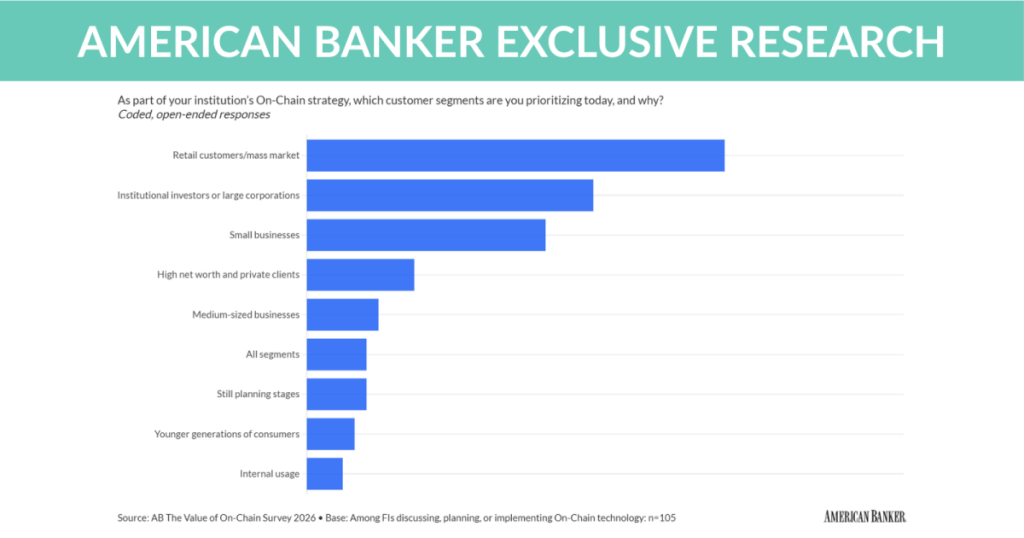
Key takeaway: Bankers surveyed are prioritizing retail customers for their on-chain efforts.
More than one-third (35%) of respondents said retail customers and the mass market are a prime area of focus as part of their institution’s on-chain strategy, followed by 24% who said the same for institutional investors, 20% for small businesses and 9% for high net worth and private clients.
Banks of all asset sizes are turning to outside firms specializing in digital assets and other on-chain products to spin up offerings of their own, as nonbank firms entering the traditional finance space onboard newer generations of consumers.
At American Banker’s On-Chain Executive Summit earlier this month in New York, Vast Holdings, the parent company for
Tokenized deposits are digital representations of traditional fiat currency deposits, in this case the U.S. dollar, recorded on a distributed ledger and held at chartered banks.
“Internally we’ve got everything working, and we have a phased rollout this year for individual customers and then extending into the API layer,” Linda Jenkinson, chief executive of Vast, said at the event. “The Trump administration has been absolutely incredible for banking, crypto and fintech. … They came out and said that they want the U.S. dollar to be dominant and want us to be leading in innovation.”
The value of on-chain for the individual consumer
Key takeaway: Fast payments and lower transaction costs were the top benefits bankers expected on-chain products to bring to consumers.
Institutions predicting short- and long-term wins in payments from on-chain investments also see these same benefits trickling down to consumers.
Faster payments or transfers (82%) was the number one value identified by bankers that on-chain technology could bring to individual consumers. Close behind was lower transaction costs (73%), improved access to financial services (54%), greater transparency (53%), reduced risk/greater security (42%) and new investment opportunities (24%).
Only 2% felt that on-chain technology was unable to solve any problems for consumers and 1% were unsure.