
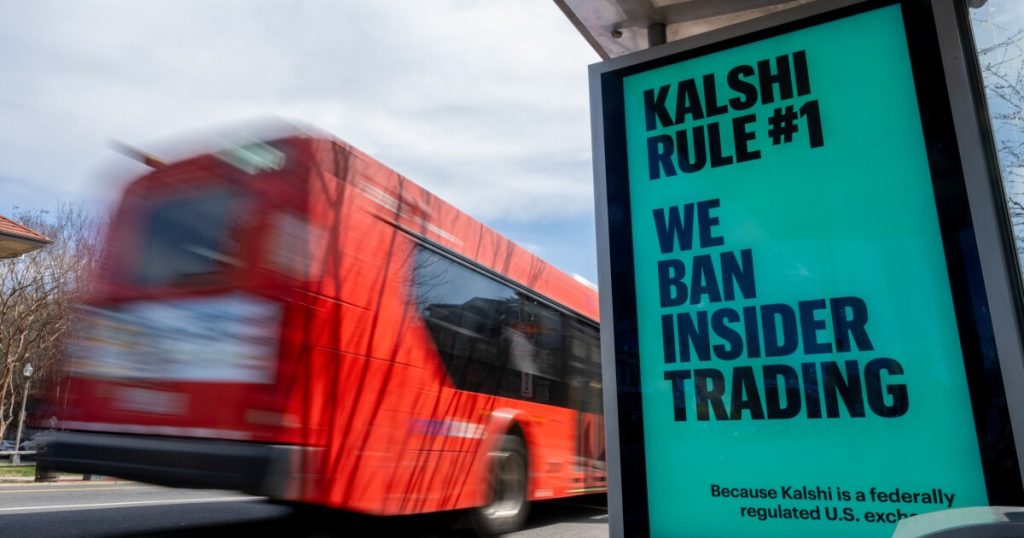
- Key insight: The rules around insider trading in prediction markets are hazier than those that apply to trading traditional securities.
- Supporting data: A recent study found that in two years of trading on Polymarket, at least $143 million of profit was tied to suspicious activity. The research flagged more than 210,000 trades as suspicious, and found that the traders’ win rate far exceeded the norm.
- What’s at stake: Regulators, lawmakers and prediction market platforms have all made moves in recent weeks to expand oversight of insider trading, especially in cases where politicians and athletes make the trades.
The largest banks in the country are actively reviewing their policies to explicitly address employees’ use of prediction markets, as lawmakers and regulators seek to get a handle on how to oversee risks of insider trading on the platforms.
The issue has taken on greater urgency amid the rapid rise of prediction markets such as Kalshi and Polymarket. Trading volumes on such platforms grew from around $16 billion in 2024 to nearly $64 billion last year, according to
Processing Content
America’s megabanks mandate that employees protect confidential information, and they prohibit the use of material nonpublic information for trading and investing. But while the codes of conduct at
A Bank of America spokesperson told American Banker that the company is in the process of reviewing its policies related to prediction markets.
JPMorgan
The $4.4 trillion-asset bank has reminded employees that its current trading policies extend to the use of prediction markets, a JPMorgan spokesperson said in an email to American Banker.
“When you transact in these markets, you must follow the same standards as your personal trading,” JPMorgan has said in communications with its workforce. “Never engage in transactions that create the appearance of conflict or use information you learn through work for personal gain.”
Other megabanks also include language about appropriate or ethical investment and trading conduct. Some of the companies, such as Goldman Sachs, mandate employer approval of certain trading activities, including the trading of securities, commodities and derivatives.
Goldman Sachs, Morgan Stanley and Citi declined to comment. Wells Fargo did not respond to a request for comment.
The question of how to address insider trading by bank employees internally could become more complex if banks start to have more direct involvement in prediction markets.
In an interview with CBS News on Tuesday, JPMorgan CEO Jamie Dimon said it’s “possible” that his bank will one day offer something similar to what Kalshi and Polymarket provide. But he added that the bank would be picky about its offerings, and has “strict rules around insider trading.”
‘You want to have a very strong policy in place’
Sophisticated financial institutions already prohibit their employees from engaging in fraud, trading on misappropriated information and violating confidentiality agreements, noted Ryne Miller, a lawyer in the financial services practice at Morrison Foerster. Still, out of an abundance of caution, financial institutions should be — and for the most part, likely already are — thinking about revising policies to specifically address prediction markets, he added.
“I think it’s helpful to look at those policies now and consider whether you need to add something about prediction markets,” Miller said. “At the same time, I think the policies, because they’re generally principle-based, would already prohibit someone from using company information acquired at work to trade in prediction markets.”
Laws and regulations around insider trading on prediction market platforms are hazier than insider trading laws regarding securities, said Joshua Mitts, a law professor at Columbia University who published a paper last week that analyzed two years of Polymarket data to investigate potential instances of insider trading.
Trades on prediction markets are often tied to macroeconomic events, meaning they typically aren’t securities, because they aren’t tied to individual companies. It’s more likely that those transactions are commodities, meaning they’re under the regulatory purview of the Commodity Futures Trading Commission, said Mitts.
“Once you’re not a security, things get a lot trickier in terms of enforcing insider trading law,” Mitts said. “The commodities anti-fraud rules are much, much less developed when it comes to insider trading than securities laws.”
Efforts by banks to hold their employees to ethical standards of behavior can be effective, Mitts said, “in terms of creating a culture of compliance and following the law.”
“If you’re a bank, you want to have a very strong policy in place, simply to protect yourself from the risk that regulators say, ‘Well, you facilitated this, or you encouraged this sort of trading,'” Mitts said.
Still, he said, that doesn’t necessarily mean the internal policies will be meaningful in cutting down on instances of insider trading in prediction markets.
Mitts’ study found more than 210,000 examples of suspicious trades on Polymarket, with traders logging almost a 70% win rate — far exceeding the results of random chance. The paper estimates that at least $143 million of the profit found in the study was tied to suspicious activity.
The patterns are “sufficiently unusual to warrant serious scrutiny,” wrote Mitts and his co-author, Moran Ofir, a professor of finance and law at the University of Haifa.
The paper, which the authors say is the first systematic empirical and legal study of insider trading in prediction markets, notes that those markets are attractive avenues to exploit nonpublic information, especially because of blockchain-enabled accounts that make identifying traders more challenging.
If bank employees are using such accounts, Mitts said, even if they’re disclosing their activity to their employers, enforcement could be challenging.
Beyond banks
The issue of how to deal with insider trading is picking up steam both in Washington and at the company level.
CFTC Enforcement Director David Miller said Tuesday that the agency will be prosecuting cases against those who tip or trade with misappropriated information.
“Unfortunately there’s a myth in mainstream media and social media that insider trading law doesn’t apply in the prediction markets,” Miller said during an event at New York University.
Earlier this month, the CFTC issued an advanced notice of proposed rulemaking seeking comments regarding prediction markets trading. The agency also issued a staff advisory letter to designated contract markets, reminding them of self-regulatory obligations and compliance with monitoring guidelines.
Still, there have yet to be any federal criminal prosecutions or CFTC civil cases related to insider trading in prediction markets.
Some lawmakers are beginning to propose legislation that could stymie possible insider trading in prediction markets. Sen. Richard Blumenthal, D-Conn., and Rep. Ritchie Torres, D-N.Y., have each proposed bills aimed at curbing conflicts of interest and insider trading on the emerging platforms.
Last week, both Polymarket and Kalshi issued updates about their efforts to oversee suspicious trading. Polymarket, after facing scrutiny about possible instances of insider trading, banned certain kinds of bets, such as those made with stolen confidential information and illegal tips, or those that the trader may influence. When reached for comment, a Polymarket spokesperson pointed to its updated guidance.
Kalshi said it has been updating its internal capabilities and policies regarding insider trading by politicians and athletes. Insider trading violates Kalshi’s rules, which it enforces when it catches violators, company spokesperson Elisabeth Diana said in an email.
In February, Kalshi said it had opened 200 investigations in the last year, more than a dozen of which were active cases. The company also said it had frozen “a number of flagged accounts,” and imposed monetary penalties in some cases.
“The platforms, to their credit, are stepping up and trying to address the problem,” Mitts said. “They’re trying to communicate expectations. I think we have to also be candid about the limitations of platform-level regulations.”