
- Key insight: Banks are gearing up to monitor transactions related to the World Cup soccer games, looking for signs of human trafficking.
- What’s at stake: Some banks have paid multi-million dollar fines for failing to spot signs of human trafficking, for instance, in the Jeffrey Epstein case.
- Expert quote: “Traffickers are always using different methods to try to launder money, to move it around to transfer it, and those footprints have to be identified by people who are aware of what’s happening,” said Tyler Dunman, vice president of programs at the Human Trafficking Institute.
For soccer fans, this summer’s FIFA World Cup games will be a chance to root for their favorite players. For human crime and scam investigators at banks, it will be an opportunity to assemble clues to human trafficking and scams in coordination with other banks and law enforcement experts.
There’s nothing inherently risky about the World Cup, which will be held at 16 venues across the U.S., Canada, and Mexico, according to Ian Mitchell, orchestrator of the dragnet. But at large sporting events, “there’s money flying around, and people sell many things, including humans,” he told American Banker.
Processing Content
MItchell is the founder of
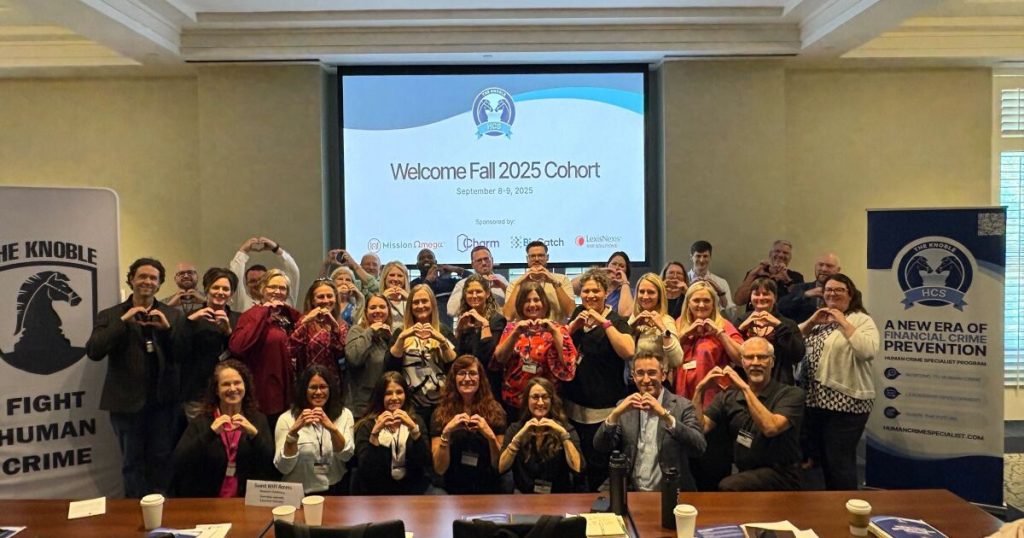
The Knoble works with law enforcement organizations, banks and credit unions to detect human trafficking, financial scams, child sexual exploitation and elder financial exploitation. Law enforcement officials share intel about investigations and banks use that information to set alerts in their fraud detection and anti-money laundering software.
For the past few years, the group has led initiatives around the
Shortly after this year’s Super Bowl, the Santa Clara County District Attorney’s Human Trafficking Task Force reported the arrests of 29 traffickers and the recovery of 73 sex trafficking victims, including 10 minors. One of the victims was 12 years old.
Major sporting events create measurable spikes in risk: financial institutions have reported increases of up to 80% in scam activity tied to ticket releases and other transactions.
Human trafficking rarely appears as a single transaction. It emerges through patterns — clusters of short-term lodging, rapid fund movement and linked accounts or devices.
Financial institutions have visibility across payment rails, such as P2P, cards, wires and crypto, giving them a unique ability to detect coordinated activity and intervene earlier.
AI is helping with these efforts, Mitchell said.
“We’ve been using advanced machine learning and AI in the fraud space for decades, but it’s gotten to a point now where not only is it more sophisticated than our neural networks and such have been in the past, the cycle times have gotten shorter, and so we’re able to detect things faster,” he said. “Financial institutions are using AI to handle the increase in volumes that are flooding around financial crime, to be better at investigations and to help with triaging of alerts that are coming in. AI is now being deployed to actually make intelligence actionable.”
The Knoble’s next big push will be at the World Cup in June and July and will create a surge in travel, temporary labor, resale activity and digital engagement, Mitchell said.
“The labor trafficking that happens around these events just to facilitate building the venues, but also employing the folks to provide services around the venues, is such an opportunity,” Mitchell told American Banker.
The Knoble is encouraging its bank members to monitor transactions for this activity before, during and after the World Cup, with the help of a
“Most banks have a reactive investigative response to human trafficking and, for the most part, scams,” Mitchell said. “The institutions are getting better about that, but this detection guide has the opportunity to give financial institutions a step by step approach to the threats they need to be aware of related to human trafficking and scams.”
Forty experts from banks, law enforcement and payment companies helped write the guide, as well as Kitboga, a YouTube star who calls scammers and videotapes the calls.
“We all brainstormed about, what are the threats that we are expecting to see in sex trafficking, labor trafficking and scams?” Mitchell said. “Then we documented that, and then we said, okay, so if we need to combat that, how do we do that? And what’s a framework we could use effectively?”
The value of bank-law enforcement collaboration
Human traffickers are usually financially motivated, according to Tyler Dunman, vice president of programs at the Human Trafficking Institute, which is not involved in this initiative. HTI works with law enforcement and prosecutors to enhance the investigation and prosecution of human trafficking-related crimes.
“Ultimately what they’re trying to do is make money by exploiting other human beings,” Dunman told American Banker. “So the financial piece of the equation is something that law enforcement has to be looking at. And in order to do that effectively, it does require that financial institutions have to be involved and have to be aware of the crime, and ultimately, have to be a part of the solution. The Knoble’s work with banks and others in these investigations are very important.”
Banks often compete with one another, “so information sharing is not always a first priority,” Dunman said. “So when one bank is experiencing or detecting certain criminal activity, it’s not always true that other banks might also be aware of that.”
The information sharing across the financial sector is important, he said.
“Traffickers are always using different methods to try to launder money, to move it around to transfer it, and those footprints have to be identified by people who are aware of what’s happening,” Dunman said. “That requires a lot of coordination, a lot of proactivity on behalf of the banks. This is one area where banks need to work together and cooperate, and The Knoble is an organization that’s stepping into some of those gaps and ensuring that there is some sort of deliberate collaboration happening to identify patterns and to make them visible across the sectors.”
More awareness, better identification of human trafficking
The World Cup effort comes at a time when some banks are being punished for ignoring suspicious transactions made by human trafficker Jeffrey Epstein and his network. At the end of March, Bank of America agreed to pay $72.5 million to survivors of Epstein’s operation who allege the bank enabled and profited from his crimes. Earlier, JPMorganChase agreed to pay $290 million to settle a similar lawsuit and Deutsche Bank paid $75 million to victims.
The Epstein case has raised awareness of the problem of human trafficking among consumers and organizations. It’s also generated misconceptions.
“A case like Jeffrey Epstein’s does two things,” Dunman said. “One, it paints a picture of what some people might think trafficking looks like, which could be that it involves some sort of wealthy individual that is operating a network,” he said. “People tend to think of human trafficking as a crime involving children being kidnapped and taken abroad to a foreign jurisdiction, which is rarely the case. Most of the time victims are recruited, they’re groomed, manipulated by an individual who then exploits them.”
Some Epstein case details, such as his private islands, are not the norm, he said.
“Most of the time, exploitation happens at a local level, Dunman said. “It’s familial trafficking, someone being trafficked by their own parent, or they’re being recruited by a peer or someone they know,” he said.
Victims rarely see themselves as victims, Dunman said. “They may think that something bad is happening to them that they obviously don’t enjoy, but they don’t know how to describe it,” he said. “They also blame themselves for the situation they’re in, they almost never report to someone what’s happening to them. And traffickers are master manipulators. People don’t realize the level at which they play this game, and the fact that victims, particularly vulnerable victims, are very susceptible to being manipulated and taken advantage of. And it can happen in a short period of time.”
Dunman said that while initiatives like The Knoble’s at big sporting events like the Super Bowl and the World Cup raise awareness of trafficking, more needs to be done.
“We have to understand that trafficking is typically ongoing at a local level,” he said. “It’s not driven by a single event. It’s happening all the time, in every part of the country. And so although these big events can draw attention and can help drive coordination of enforcement, we don’t want the public or even banks thinking that it is only these sorts of large events that we have to be mindful of. These investigative tactics have to be applied on a Tuesday around the country for us to be effective.”
Banks also need to have protocols in place for freezing accounts and blocking transactions, Dunman said.
“They need to have a team, or at least designated individuals that are working directly with law enforcement in their areas,” he said. “The challenging piece sometimes is the delay or the amount of time that it takes to share information. Law enforcement oftentimes are needing information in real time, and so sometimes privacy things and other processes might cause some delays. But those sorts of coordination efforts are what’s really key to building a stronger approach.”