
- Key insights: FedNow is considering a change to its rules that would allow member banks to access real-time payments for cross-border transactions.
- What’s at stake: Most real-time rails focus on domestic payments, though there has been some movement by networks such as RTP to add international options.
- Forward look: The Fed will accept public comment until early June, and its decision will not not require congressional approval.
One of the criticisms of real-time transactions is that they’re
Processing Content
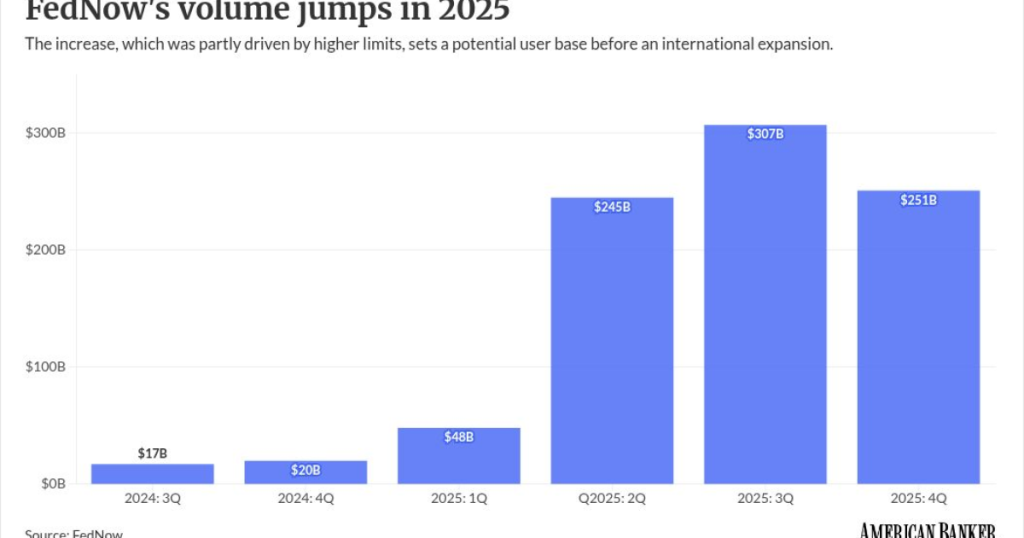
Fresh off of a huge boost in domestic volume, the Federal Reserve is
“FedNow would still settle only the domestic leg between eligible U.S. participants,” Stuart Cook, a fintech industry investor and advisor, told American Banker. “The cross border component would be handled through a separate leg by the intermediary, before or after the FedNow transfer.”
The Fed is seeking public input on the proposed amendments. Comments are due within 60 days after publication in the Federal Register, which would be June 7.
FedNow, which launched in 2023, has about
This will likely be correspondent banks, which provide services where a primary bank in a transaction does not have a presence. Swift, the international messaging service, has about
“By using FedNow for the domestic settlement leg, the U.S. portion of the transaction becomes instant,” Erika Baumann, managing director of banking and payments for Datos Insights, told American Banker, noting the rest of the model – using the correspondent-banking network – stays the same. “This is an improvement, but not real-time cross-border settlement. For sure more work to be done, but every step helps.”
The use of correspondent banking in general has declined by about 50% in the past 10 years,
What the FedNow proposal does accomplish, according to Cook, is add speed to the domestic leg. If a person is sending money from Germany to the U.S., the receiving U.S. bank could credit the beneficiary’s account in seconds via FedNow, rather than waiting for a batch settlement or a slower internal process.
“That’s definitely an improvement,” Cook said. “But it doesn’t fix the correspondent banking chain itself. The international leg still runs through the same intermediaries, the same compliance processes, the same liquidity requirements. It makes the last mile faster without redesigning the road.”