
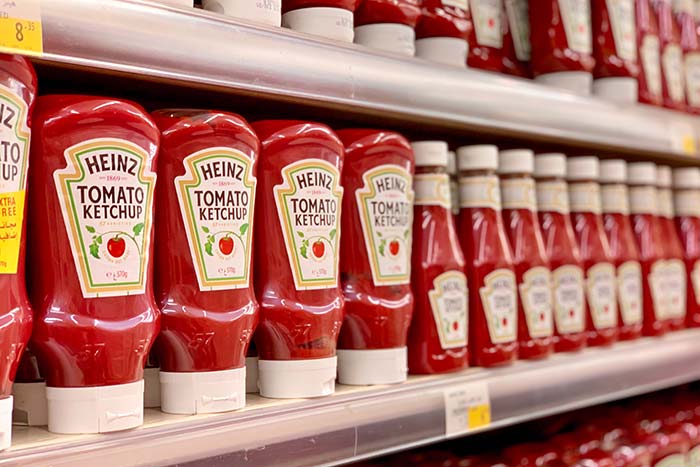
When I look at many of the brands owned by Kraft Heinz (Nasdaq: KHC), it takes me back to my childhood: Cool Whip, Kool-Aid, Jell-O, Kraft Singles, Oscar Mayer, and, of course, Kraft Mac & Cheese, a staple in the diet of nearly every kid born between 1950 and today.
It’s a tougher market for Kraft Heinz now than when I was growing up. Today, store brands compete strongly with national brands. They’re cheaper and often just as good.
Among Kraft’s lineup of brands, the only ones I go out of my way to buy are Heinz ketchup and Philadelphia Cream Cheese.
Fortunately for the company and its shareholders, I’m not the only consumer out there. Kraft Heinz posted nearly $25 billion in revenue last year. That’s a lot of Maxwell House coffee and A1 steak sauce.
In fact, 94% of U.S. households buy Kraft Heinz products.
But unfortunately for shareholders, the stock has been as popular as the watery liquid that comes out when you first open a bottle of ketchup. It’s lost 28% over the past year and is down 46% since May 1, 2023. The last time the stock price was this low was during the COVID Crash.
The company has kept its dividend steady at $0.40 since 2019, so the declining stock price has pushed its yield up to a gigantic 7.2%.
Can shareholders rely on that dividend like Stove Top stuffing? Or will it spoil like Lunchables that have been left out in the sun?
Despite its woes, Kraft Heinz has been steadily growing its free cash flow.
Last year, free cash flow grew 16% to $3.7 billion, and it is expected to grow another nearly 17% this year to $4.3 billion.
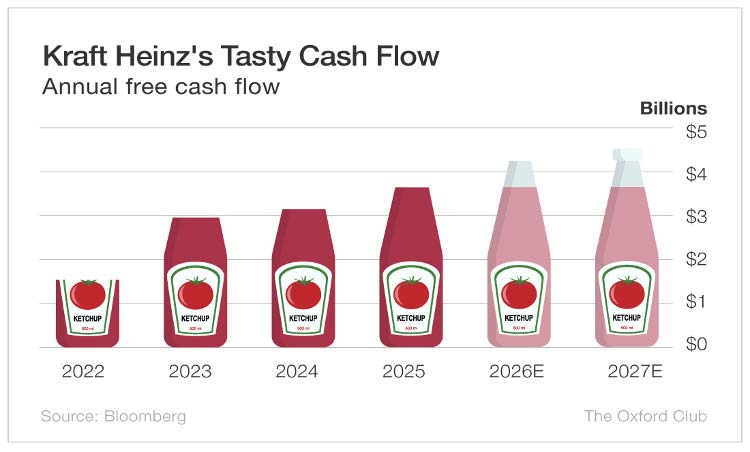
In 2025, Kraft Heinz paid shareholders $1.9 billion in dividends, or 52% of its free cash flow. This year, that dividend figure is expected to be nearly identical for a payout ratio of 44%, so Kraft Heinz can afford its dividend.
The only stain on the company’s record is a dividend cut in 2019. Prior to the current $0.40 quarterly dividend, Kraft Heinz paid shareholders $0.625 per quarter.
It really needed to slash the dividend at that point, because the amount it was paying in dividends was consistently exceeding free cash flow. But ever since it reduced the dividend, the company has been generating more cash than it pays out.
The dividend is fairly safe. The only foreseeable hiccup is if the company sells a lot less Velveeta and other products than Wall Street expects. As long as cash flow is in the ballpark of where it has been, the company should have no problem paying the dividend.
It’s not often you find a safe 7% yield that’s not from a REIT, MLP, or BDC, but that’s what we have with Kraft Heinz.
Dividend Safety Rating: B

What stock’s dividend safety would you like me to analyze next? Leave the ticker in the comments section.
You can also take a look to see whether we’ve written about your favorite stock recently. Just click on the word “Search” at the top right part of the Wealthy Retirement homepage, type in the company name, and hit “Enter.”
Also, keep in mind that Safety Net can analyze only individual stocks, not exchange-traded funds, mutual funds, or closed-end funds.