

Mortgage rates have had a really bad month.
After falling to the lowest levels in three and a half years in late February, they abruptly changed course.
The reason why wasn’t a mystery. An unexpected war broke out in Iran, sending oil prices above $100 a barrel and mortgage rates back above 6.50%.
At last glance, the 30-year fixed is priced around 6.625% and mortgage rate charts look parabolic.
But maybe, just maybe, we are nearing a top for mortgage rates.
Is the Worst Almost Over for Mortgage Rates?
Before we talk about mortgage rates possibly falling, I will admit that I think it gets worse before it gets better.
The war in Iran is still developing and they’re sending lots of troops to the region.
At the same time, it seems President Trump is pushing more and more for a ceasefire and an end to the conflict.
Of course, Iran keeps countering any talk of progress on that front, which makes you wonder what’s actually going on.
So given that uncertainty, I believe mortgage rates still have a bit more room to move higher.
However, given the movement that has already taken place, in such a short span of time, you could argue it’s nearing a top.
After all, the 10-year bond yield surged from around 3.95% in late February to nearly 4.50% today.
That’s a massive move in less than a month, which tells you it might be a bit overdone.
And given most expect the 10-year to trade in a range of 3.75% to 4.50%, we are basically already at the high end.
However, once you sprinkle in the surging oil prices, and accompanying gas prices, you can see where the 10-year could go a bit higher.
But even then, is it 4.70% or something around those levels?
If so, we’re talking only another 20 basis points higher for mortgage rates, assuming spreads don’t widen.
Could a 6.875% 30-Year Fixed Be the Next Stop?
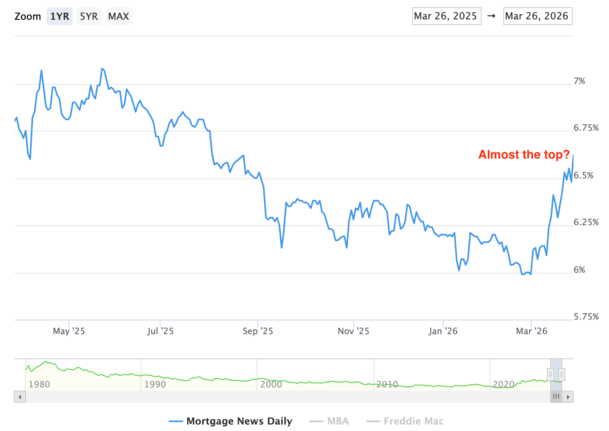
To my point about rates getting worse before they get better, I do see the next logical step being a 30-year fixed around 6.875%.
Before they get there, it’ll be 6.75%, but basically another 0.25% higher relative to current levels.
Importantly though, I don’t know if they make it all the way back to a 7-handle again.
I actually hope they don’t because the damage to home buyer sentiment will be very real.
The housing market got battered by 7% mortgage rates time and time again over the past few years.
Then we finally shook them last spring and didn’t look back. The last thing this very fragile housing market needs is to return there.
If we do the math, a 10-year bond yield at around 4.70%, up from current levels of roughly 4.42% would push the 30-year fixed up about another 0.25%.
So if Mortgage News Daily’s rate index is at 6.62% today, that would get us to around 6.87%.
Since mortgage rates are priced in eighths, that would be very convenient math.
Of course, that still requires the 10-year bond yield to rise pretty significantly from current levels.
This does assume mortgage spreads don’t widen, though they too already have so you could argue that’s already baked in.
The spread between the 10-year bond yield and 30-year fixed was below 200 bps in late February and now it’s around 220 bps.
In other words, both yields and spreads have already factored in the war and higher gas prices. Perhaps it’s mostly baked in.
Trump Will Want Lower Mortgage Rates Before the Midterms
There’s one last thing working in favor of mortgage rates not moving much higher, nor staying high.
We have the midterm elections this year, albeit not until early November.
However, knowing that, there’s going to be a lot of eyes on the economy from now until then.
And issues like high gas prices and high mortgage rates won’t play well for the President or his constituency.
So you better believe he will do everything in his power to get gas prices AND mortgage rates down again.
If that all goes according to plan, it might mean elevated mortgage rates from now through summer, then rates drifting back toward recent lows in fall.
In the meantime, we still have to pay attention to the economic data that is released, both CPI and PPI reports (and PCE) to determine if inflation is rising again, and labor data like the ever-important jobs report.
Mortgage rates could move lower faster if inflation turns out to be cooler than expected, or if jobs data is worse than anticipated.
The opposite is also true.

Before creating this site, I worked as an account executive for a wholesale mortgage lender in Los Angeles. My hands-on experience in the early 2000s inspired me to begin writing about mortgages 19 years ago to help prospective (and existing) home buyers better navigate the home loan process. Follow me on X for hot takes.