
Colorado residents fill out cards and share their stories for content to send to congressional representatives regarding health-care cuts on Nov. 1, 2025, the first day of ACA open enrollment, in Northglenn, Colorado.
Tom Cooper | Getty Images Entertainment | Getty Images
Some states are stepping in to blunt the financial fallout of lapsed federal subsidies for Affordable Care Act health insurance premiums.
California, Colorado, Connecticut, Maryland, Massachusetts and New Mexico have all started offering additional state-funded premium subsidies in 2026 in order to help keep insurance premiums from becoming unaffordable for many residents after enhanced federal subsidies expired at the end of 2025, experts said.
In most cases, the state assistance is less generous than the lapsed federal aid, they said.
But state subsidies will help many consumers — especially those with lower incomes — and reduce the number of households that drop their insurance coverage, experts said.
“They soften the blow,” Louise Norris, a health policy analyst for healthinsurance.org, an insurance referral site, said of the state-level premium subsidies.
Roughly 2.6 million people in California, Colorado, Connecticut, Maryland, Massachusetts and New Mexico received enhanced federal premium subsidies in 2025 — about 12% of all consumers getting them nationwide, according to federal data tracked by KFF, a nonpartisan health policy research group.
Blue states offer ACA subsidies
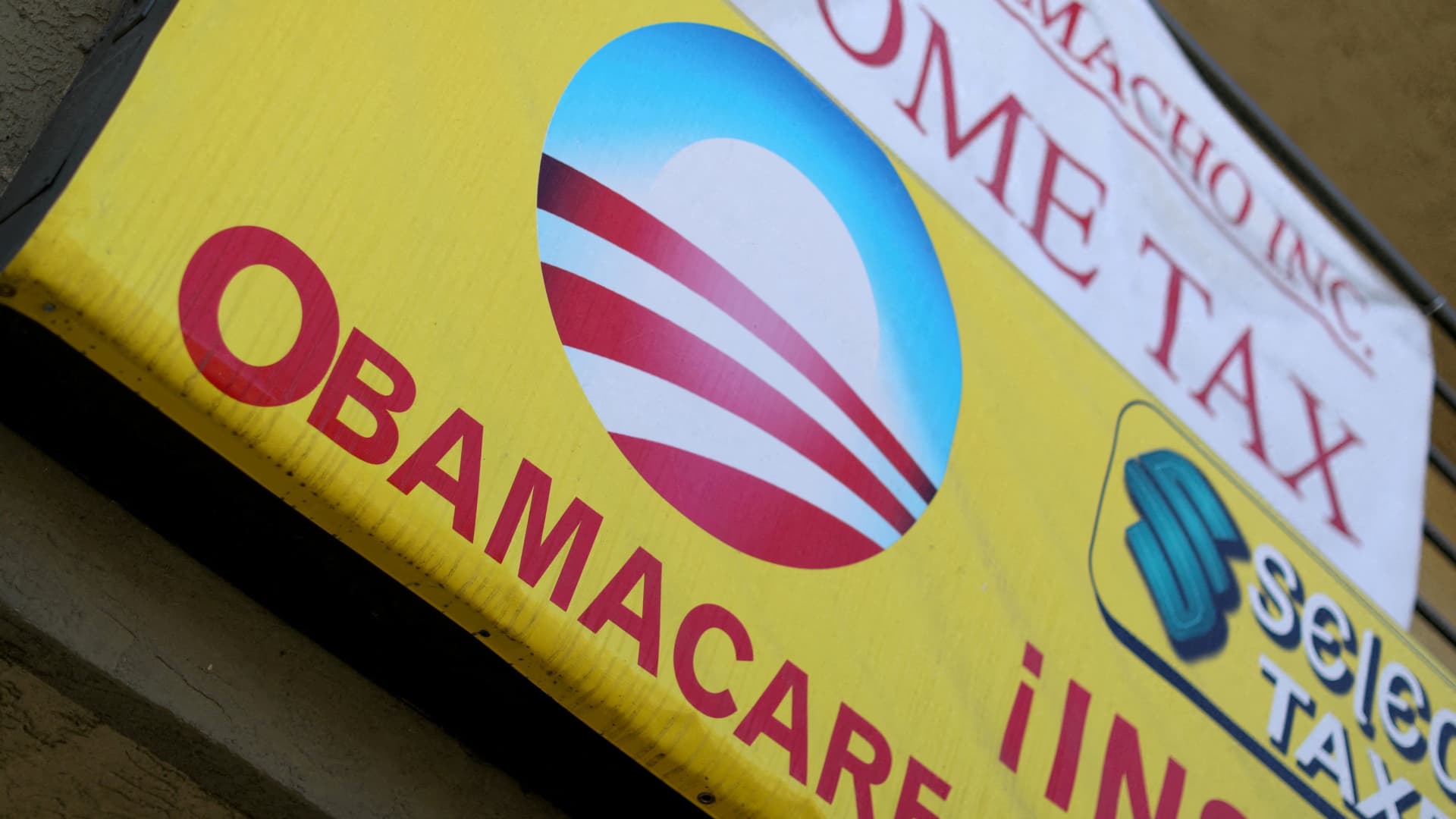
A sign on an insurance store advertises Obamacare in San Diego, California, Oct. 26, 2017.
Mike Blake | Reuters
The maneuvers may deepen the political divide on the issue of health insurance subsidies, experts said.
Democrats on Capitol Hill have pushed to extend the expired federal subsidies, even centering the record-long government shutdown around the issue. The Republican majority has thus far stymied their efforts.
Blue states are the ones that have chosen to offer extra premium assistance to residents, said Matt McGough, an Affordable Care Act policy analyst at KFF.
Even then, it’s only a “very small handful” that have done so, he said.
Red states like Texas and Florida saw by far the largest growth in ACA enrollment after enhanced federal subsidies took effect in 2021 — and stand to see many of those consumers drop their insurance coverage now that the federal subsidies have ended, McGough said.
About 4.5 million people in Florida and 3.7 million in Texas received premium subsidies — also known as premium tax credits — in 2025, according to a KFF analysis of federal data.
Together, they account for more than a third of the roughly 22 million Americans who received premium subsidies that year.
By comparison, in California, the most populous state in the U.S., 1.8 million people received premium tax credits last year.
The partisan disparity on ACA subsidies comes in a midterm election year in which Republicans are trying to hold onto a razor-thin majority in the House of Representatives, and as affordability has emerged as a key focus for politicians and consumers.
Financial impact of ACA enhanced subsidy lapse
The average person who received a premium tax credit last year is expected to see their insurance premiums more than double in 2026, to $1,904 per month from $888, due to the expiry of the enhanced federal subsidies, according to KFF.
The enhanced subsidies had been in place in 2021. They built on the original framework of premium tax credits that had been available since 2014, in the early days of the Affordable Care Act, also known as Obamacare.
That original tranche of federal subsidies remains. They work on a sliding scale, with more assistance available to lower-income households.
However, they aren’t as valuable as the enhanced premium tax credits. The enhanced subsidies had capped out-of-pocket payments for households at 8.5% of their annual income; now, that cap has increased to about 10%.
Additionally, certain households no longer qualify to receive a premium tax credit due to the return of the so-called “subsidy cliff.”
Specifically, enhanced subsidies allowed middle-income households that earn more than 400% of the federal poverty level — about $63,000 for a single individual or about $129,000 for a family of four — to qualify for a premium tax credit for the first time.
Now, they’re once again ineligible.
The federal government uses the 2025 poverty guidelines to determine income eligibility for 2026.
What states are doing to plug the gap
The healthcare.gov website on a laptop arranged in Norfolk, Virginia, Nov. 1, 2025.
Stefani Reynolds | Bloomberg | Getty Images
States like New York, Connecticut, Vermont, Massachusetts, New Jersey and Washington state had already offered additional state assistance to help make health insurance more affordable — on top of federal premium tax credits — before the federal enhanced subsidies lapsed, according to McGough.
Those remain in place, he said.
Other states have taken measures to shore up financial assistance, due specifically to the expiration of enhanced federal subsidies.
New Mexico
New Mexico is the only state that has fully replaced the enhanced federal subsidies for residents, experts said.
“They backfilled everything,” Norris said. “Nobody lost out on their subsidies in New Mexico. As a result, enrollment really grew.”
ACA enrollment has grown by about 17% year-over-year in 2026, according to state-level data, a dynamic that Norris said bucks the national trend.
Federal data suggest that about 1.5 million U.S. households had already dropped their insurance coverage by early January. The Urban Institute estimates nearly 5 million people will ultimately drop their health coverage in 2026 and be uninsured due to lapsing subsidies.
New Mexico state lawmakers are offering the funding through June 30. Gov. Michelle Lujan Grisham, a Democrat, has called for an extension beyond June 30 if Congress doesn’t legislate additional funding.
Connecticut
Connecticut is the only other state that has moved to replace at least some of the expiring subsidies for those whose incomes are over 400% of the federal poverty line, the group of consumers who fell off the federal subsidy cliff, Norris said.
Connecticut will replace half of the lapsed subsidy amounts for those with income between 400% and 500% of the federal poverty level, according to Access Health CT, the state health insurance marketplace. That equates to about $63,000 to $78,000 for a single individual, for example.

Connecticut will also fully fund the expired enhanced subsidy amounts for households with incomes between 100% and 200% of the federal poverty level, or $15,650 to about $31,000.
The state is targeting consumers “particularly hard hit” by expiring subsidies, Norris said.
For example, the average household with an income over 400% of the federal poverty line is expected to see its annual ACA health premiums jump to about $8,500 in 2026 from $4,400, according to the Urban Institute.
Massachusetts
Massachusetts Gov. Maura Healey addresses the public while surrounded by Texas state legislators during a press conference at the Massachusetts State House on Aug. 5, 2025.
Ben Pennington | Boston Globe | Getty Images
Massachusetts is investing an extra $250 million into its state health insurance marketplace, called ConnectorCare, for 2026, bringing the total to $600 million, according to a Jan. 8 press release issued by Governor Maura Healey and Lt. Governor Kim Driscoll.
The funding comes from the Commonwealth Care Trust Fund, a special revenue fund for state expenses, according to the release.
The investment means about 270,000 consumers earning less than 400% of the federal poverty line “will see little to no premium increases because of the expiring federal credits,” according to the release.
The state also capped health deductibles and co-pays for the first time, as well as the cost of insulin and inhalers, it said.
Separately, Massachusetts had also previously established a pilot program offering state premium subsidies for people who earn up to 500% of the federal poverty line, according to Norris. The state extended that program for 2026.
Maryland
Other states have taken steps to blunt the impact largely for lower-income households, experts said.
For example, Maryland’s state subsidy program will fully replace the enhanced federal premium subsidies for those under 200% of federal poverty level, according to the Maryland Insurance Administration.
It will also replace half of the lapse federal subsidies for those between 250% and 400% of the federal poverty level.
California
Smith Collection/gado | Archive Photos | Getty Images
California allocated $190 million to offer state subsidies in 2026 for people earning up to 150% of the federal poverty level, according to Covered California, the state’s health insurance marketplace.
The sum ensures “monthly premiums remain comparable to 2025 levels” for those with incomes of roughly $23,500 for an individual or $48,000 for a family of four, according to Covered California.
They soften the blow.
Louise Norris
health policy analyst for healthinsurance.org
However, the $190 million offsets just a small share of the total $2.5 billion that California residents are losing in 2026 due to the expiration of the federal subsidy enhancements, according to Norris.
California is also offering “some additional assistance” to those earning up to 165% of the federal poverty level, according to the state marketplace.
Colorado
Colorado is offering a maximum $80 per month in 2026 for an individual enrollee, and another $29 for each subsequent family member that pays a premium, according to McGough.
The premium subsidy is available to households making between 100% to 400% of the federal poverty level.
The plan will backfill about 40% of the lost federal assistance, McGough said.