
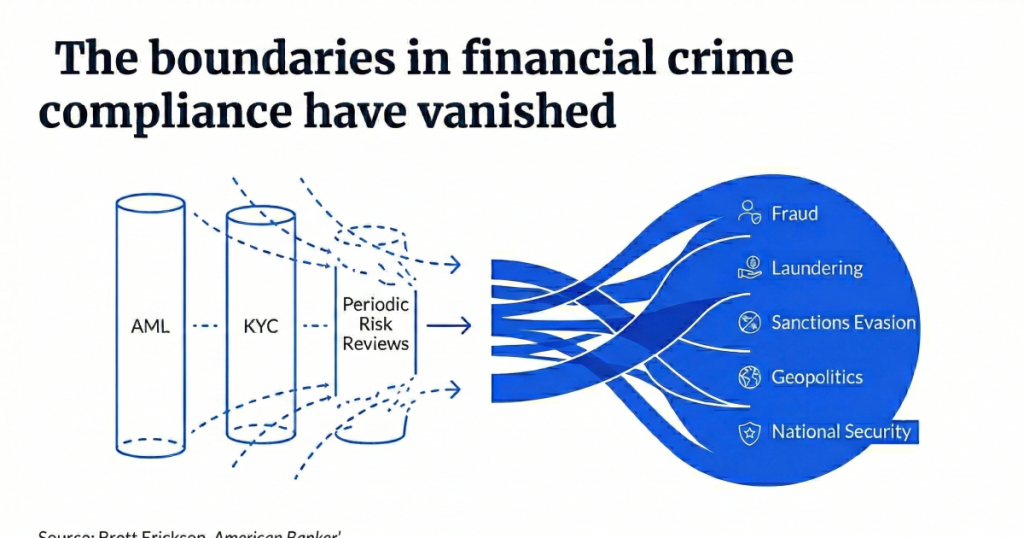
Visualization created with AI assistance based on original reporting.
Processing Content
- Key insight: Financial crime is evolving at a pace that far outstrips the education of bankers charged with combating them. That needs to change.
- What’s at stake: The risk is now a board-level issue, a geopolitical variable and a reputational threat.
- Forward look: The solution lives inside the institution. Not in the abstract, but in how compliance training is funded, prioritized and maintained.
The fight against
Unlike other core finance disciplines, financial crime compliance has never benefited from a clearly defined or standardized entry pipeline. There is no established academic pathway, no consistent early‑career recruiting ecosystem, and only a small number of universities that offer programs meaningfully aligned with the realities of the field. As a result, the profession lacks the kind of structured feeder system that underpins talent development elsewhere in finance. Most professionals arrive mid-career. Some come from audit or law enforcement. Many land in compliance roles as a lateral move or are appointed to lead teams with little prior domain exposure. There are superstars in the field. But institutionally, the bench is thin.
This wasn’t a critical flaw when the field was more narrowly defined. For years, financial crime was largely
What makes the problem harder is that the threat evolves faster than institutional learning cycles. Financial crime actors change tactics constantly. When methods are flagged, they are replaced. Laundering corridors shift. Evasion networks adapt. New typologies emerge in weeks, not years. The response from most institutions? Training modules that refresh annually, at best.
Over the past 12 months, the gap has widened. The second Trump administration has brought a dramatic shift in enforcement posture. Some priorities have been relaxed; others have hardened. Sanctions, once static, are now a central pillar of statecraft and diplomacy. Maritime evasion has exploded. Narcotics flows, trade finance and sovereign risk have become deeply entangled. And yet, in many institutions, the training cycle has not meaningfully changed. People are still being trained for yesterday’s problems in tomorrow’s environment.
This isn’t just a U.S. issue. Globally, we’re watching the same trend play out: growing exposure paired with a shallow pool of professionals trained to manage it. Compliance teams are over-extended. Specialist roles are rare. Interdisciplinary learning between sanctions, fraud and AML is even rarer. And the idea that geopolitical context should be part of a compliance team’s day-to-day analysis is still treated as optional in too many organizations.
The academic pipeline won’t solve this. If there were strong demand for financial crime programs, universities would have already expanded them. Instead, some of the few that exist are being wound down. This isn’t a critique of academia. It’s a recognition of pace. The problem isn’t that formal training is bad, it’s that it can’t keep up.
Which means the solution lives inside the institution. Not in the abstract, but in how compliance training is funded, prioritized and maintained. If you accept that financial crime evolves rapidly, and that the people charged with managing it are often underprepared, then the response must be built around continuity, not compliance cycles. Learning has to be embedded, and it has to move.
Baseline expectations need to change. Fraud, sanctions and laundering cannot be taught in siloes. They intersect in practice. They should intersect in training. Governance functions should abandon the notion that training is something to be resolved through periodic refreshes or static modules. Instead, it must be approached as a dynamic, continuously evolving discipline — one that draws directly from real-time threat intelligence and responds to shifting risk patterns in near-term cycles. Senior executives should not be briefed after the fact; they should be embedded in that process. Exposure isn’t limited to staff-level decision-making. Boards must understand how financial crime exposure changes quarter to quarter, because that’s how fast it’s moving now.
What makes this urgent isn’t just the scope of the threat, it’s the mismatch in pace. The institutions being exploited aren’t necessarily incompetent. They’re just static. And in an environment that’s defined by movement, static behavior is the weakest position you can take.
Every headline about a fraud breach, a sanctions violation or a laundering scandal is usually followed by the same internal realization: The controls didn’t fail. The understanding of risk did. The signals were missed not because the tools weren’t working, but because the training that governs how those tools are interpreted hadn’t kept up. That is a preventable failure.
The answer isn’t more headcount. It’s sharper focus on the infrastructure of learning. Financial crime risk is now a board-level issue, a geopolitical variable and a reputational threat. The speed at which that risk changes requires systems that move with it.
Compliance is often described as a function of enforcement. But in the current environment, it functions more like memory. It either remembers how the threat actually operates, or it doesn’t. And when it forgets, that’s when institutions fall behind.
The risk isn’t being wrong. It’s being too slow to see the change.
And right now, that’s exactly where too many institutions are sitting.