
- Key insights: BMO and Monument are separately supporting tokenized deposits, an alternative to stablecoins.
- What’s at stake: Banks are embracing tokenized deposits to improve payment processing without using other forms of cryptocurrency.
- Forward look: Monument plans to place more products on blockchains, hoping to reach a high-net-worth audience.
A
Processing Content
This week BMO and the U.K.-based Monument Bank both made moves to support
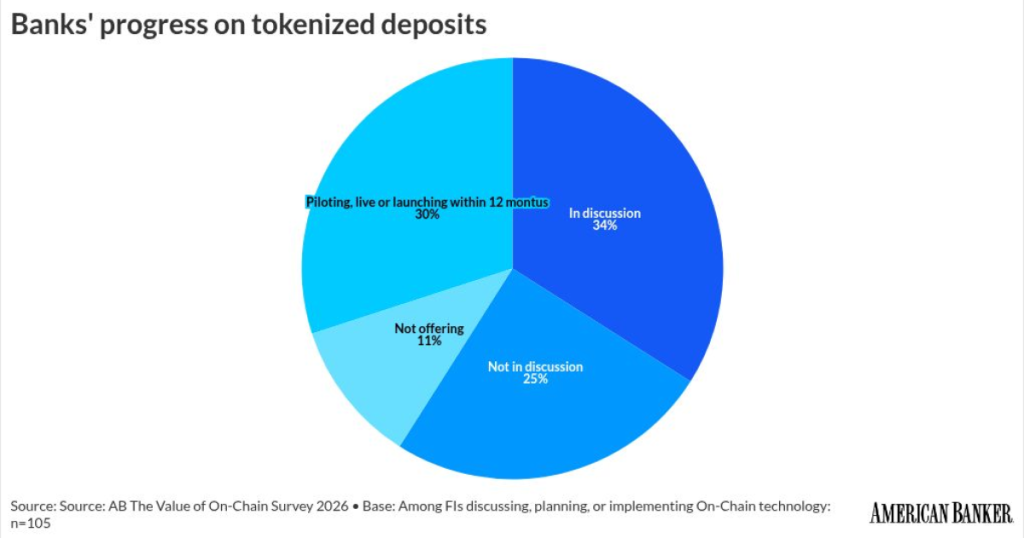
Banks are expressing interest in tokenized deposits. More than half of banks in some stage of planning, and more than a quarter adopting tokenized deposits, according to research from
“As the global ecosystem for stablecoins and tokenized deposits continues to expand rapidly, this capability marks significant progress of BMO’s ambition to bring regulated money movement into a modern, programmable environment,” Derek Vernon, head of North American treasury and payment solutions at BMO, said in a release.
Another bank, U.K.-based Monument, is tokenizing retail consumer deposits through a public blockchain with the Midnight Foundation. The partnership will bring in about $300 million of interest-bearing deposits in an initial phase, with the deposits redeemable for British pounds and insured by the U.K.’s version of the FDIC. Backers expect the initiative to eventually support other products, such as private equity investments, commodity funds and other products designed for ultra-high-net-worth consumers.
“Financial institutions around the world are exploring how blockchain infrastructure can support regulated financial products, but one of the persistent challenges has been balancing transparency with the privacy requirements of modern banking,” said Fahmi Syed, president of the Midnight Foundation, in a release.–John Adams
Starling Bank rolls out financial assistant powered by agentic AI
U.K.-based Starling Bank is launching an agentic AI tool to help its customers budget, query their payment histories and develop financial literacy skills.
The “Starling Assistant” lets customers query the large language model through using natural language via text and voice. It’s powered by Google Gemini and Google Cloud, according to Starling. Customers can set up personalized savings goals and bill payments.
“It’s time to embrace a new era of banking, one that’s powered by agentic AI,” said Starling Group Chief Information Officer Harriet Rees in a statement. “”By asking simple questions, customers can build good money habits and better organise their finances. We’ll continue to develop Starling Assistant, feeding more of our AI capabilities into this single interface. No idea is too bold right now.”
Customers can set up personalized savings goals and bill payments, and also have the agent analyze their payment habits for additional insights. For example, a customer might ask, “How many direct debits do I pay each month?,” or “Can you tell me more about my transaction history with this payee?”
Starling says it plans to roll out a similar service in the “near future” that allows customers to ask it about tax payments or payment history to specific payees.
Banks and payment companies and other lenders have been deploying agentic AI internally for
Few banks currently have customer-facing AI agents, though. Intercontinental Exchange’s mortgage technology division said it plans to

Business BNPL draws attention in the Nordics
Norwegian bank DNB and B2B payments fintech Two have partnered to offer buy now/pay later lending in the Nordic region. The bank attributed the decision to partner to build an installment lending option for businesses to a calculation that it would be lower-risk than building in-house. Two’s other banking partners include ABN Amro and Santander.
Nordic businesses can apply for credit and receive an assessment via artificial intelligence with no manual paperwork. Two and DNB assume the credit risk, so merchants receive same-day settlement without the lending appearing on their balance sheets.
“The B2B payments space is ripe for transformation…This partnership lets DNB deliver a genuinely modern payment experience to our business customers,” said Kristian Næss Fladset, group executive vice president at DNB, in a release. While consumers are BNPL’s primary users, some fintechs and banks have extended

David Paul Morris/Bloomberg
Stablecoin payment fintech Rain taps Visa to reach APAC
With fintechs and banks spending billions to support
“Businesses operating internationally should not have to stitch together multiple issuing partners and vendors just to launch a global card program,” said Farooq Malik, CEO and co-founder of Rain, in a release. “Our expansion into Asia-Pacific allows partners to build and scale global programs through a single platform, while stablecoins improve how money moves behind the scenes.”
Visa, like Mastercard, has made supporting stablecoins and other digital assets part of its strategy to gain market share outside of payment swipes. The card networks and other payment firms are selling capabilities to banks, which are increasing their investments in digital assets.
According to new research from

Circle adds stablecoin distribution in Africa
USDC issuer Circle has signed a partnership with South African firm Sasai Fintech to push the stablecoin’s adoption in Africa.
Sasai Fintech sells technology that supports business payments, cross-border payments and mobile wallets. It will work with Circle to spot potential uses for USDC, including payments and ways to reduce settlement time for Sasai’s clients. “Emerging markets are at the forefront of stablecoin adoption, and Africa represents a significant opportunity for internet-native innovation,” said Jeremy Allaire, Circle’s co-Founder, chairman and CEO, in a release. “Working with Cassava, we can extend the benefits of USDC and on-chain infrastructure into high-growth payment corridors to deliver always-on global connectivity.”
Circle has made a
It recently launched the

BNPL lender Zip launches agentic commerce framework
Australia-based Zip Co. is the latest buy now/pay later lender to develop a framework for agentic commerce.
Working with payments infrastructure platform IXOPAY, Zip is launching a Unified Trust Layer to address the emerging trust and liability challenges that agentic commerce poses to merchants and payments.
“Traditional fraud models rely heavily on static credentials,” said Rory Herriman, chief technology and operations officer at Zip, in a statement. “But agents aren’t people, and their risk doesn’t show up the same way. We’ve connected millions of consumers with tens of thousands of merchants through our ability to establish trust using behavioral and contextual signals. As machines begin transacting on behalf of humans, that same discipline needs to be applied to agent behavior. This framework is about making trust measurable and explainable in a system that was never built for it.”
The Unified Trust Layer is an open industry initiative that embeds transparency, interoperability and auditability into agentic transactions, and looks to aggregate and orchestrate trust signals between providers, networks and protocols, according to the companies.
“Payments infrastructure wasn’t built for autonomous actors,” said Jill Willard, chief technology officer at IXOPAY, in a statement. “When AI agents initiate transactions, merchants still carry the liability, but the system doesn’t consistently preserve identity and intent in a defensible way. At IXOPAY, we view tokenization and orchestration as programmable trust infrastructure, giving merchants control, portability, and auditability across fragmented ecosystems. This initiative is about extending that integrated foundation to agentic commerce.”
Other BNPL providers,

Visa joins the Canton Network
Visa is joining the Canton Network to serve as one of 40 “super validators,” according to two companies.
Financial institutions have been
“Many banks see the lack of privacy as a dealbreaker for moving meaningful activity on-chain,” said Visa’s Rubail Birwadker, global head of growth products and strategic partnerships, in a statement. “By operating as a Super Validator on Canton Network, we’re bringing Visa-grade trust, governance and operational rigor that define Visa’s global network to privacy‑preserving blockchain infrastructure, so regulated FIs can bring payments on-chain without having to rethink how they operate.”
Canton bills itself as a blockchain built for regulated financial institutions. Its super validators will help financial institutions decide how to use the technology.
“Canton was built to meet the requirements of regulated finance from day one,” said Eric Saraniecki, head of network strategy for digital assets and co-creator of Canton, in a statement. “Visa’s participation as a Super Validator reinforces that this technology has matured beyond experimentation and into production‑ready infrastructure. Bringing payments on-chain, alongside assets, unlocks the next phase of financial markets, where transactions can move with the speed of blockchain while remaining private, secure, and compliant.” —Joey Pizzolato

Veejay Villafranca/Bloomberg
Philipino digital finance platform Maya adds digital asset payments
Maya, a Philippines-based digital financial services platform, is teaming up with crypto payments company Lydian to bring digital asset payments to everyday consumers.
Lydia’s digital asset acceptance infrastructure was born out of a collaboration with Tether and Cantor Fitzgerald, and will use Maya as a distribution platform. Maya will provide a regulated infrastructure layer that supports wallet screening, Travel Rule compliance, and reporting to the country’s central bank.
Customers will be able to scan a QR code and select, “Pay with Crypto.” Payment links and point of sale systems will also be able to process crypto payments. Merchants will be able to accept those payments and receive settlement in the local currency, the Philippine peso, the same day.
“Digital assets are becoming increasingly relevant for Filipinos, particularly in remittances and savings, but practical and compliant ways to use them for everyday payments remain limited,” said Shailesh Baidwan, group president of Maya and Maya Bank co-founder, in a statement. “Our collaboration with Lydian provides a secure and regulatory-aligned framework for integrating digital asset payments into mainstream commerce, enabling businesses and consumers to transact safely.” —Joey Pizzolato