
- Key insight: The bill would index more than three dozen regulatory thresholds to nominal GDP.
- What’s at stake: Bank groups say that community banks have been pushed into higher regulatory categories because of growth in the economy rather than their growth as an institution.
- Forward look: The bill did not pass by a wide bipartisan margin, but House Financial Services Committee Chairman French Hill, R-Ark., signaled willingness to narrow the scope of the bill.
WASHINGTON — The House Financial Services Committee voted in favor of a community bank tailoring bill Thursday evening, although without significant bipartisan support.
Processing Content
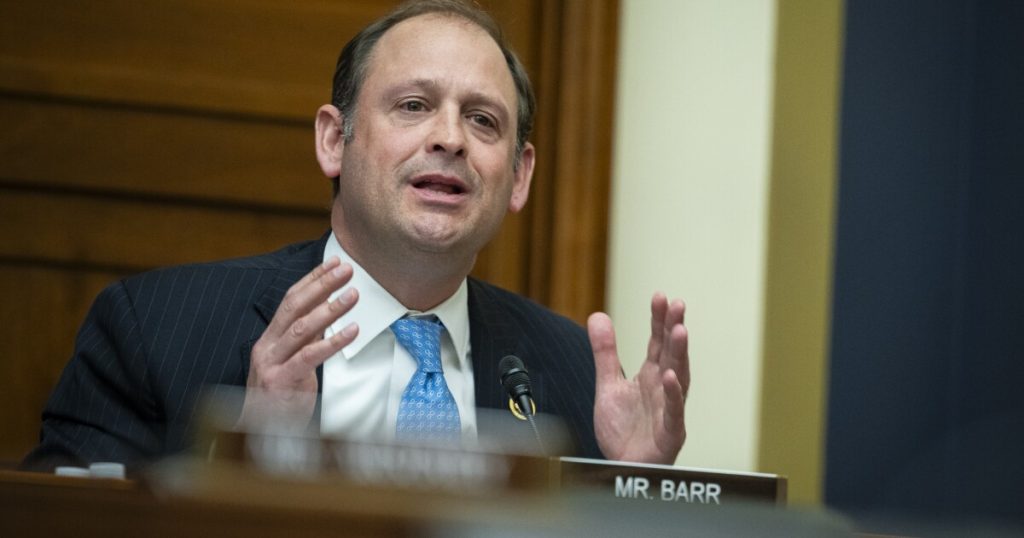
The bill from Rep. Andy Barr, R-Ky., chairman of the panel’s subcommittee on financial institutions, was approved by the full committee in a 33-21 vote in a markup on Thursday. The legislation would increase many thresholds for community banks on a number of rules — including the Bank Holding Company Act, Community Reinvestment Act and Dodd-Frank — based on GDP growth.
Specifically, the bill would affect capital standards, mortgage disclosures, the Volcker Rule, executive-compensation safeguards, and more. In a healthy economy, GDP grows faster than inflation, so tying those thresholds to GDP rather than inflation would mean more banks would be exempt from tighter rules than if the thresholds were indexed to inflation. Currently, the thresholds are not indexed to anything, but tying a number of regulatory benchmarks to inflation is increasingly being
“Institutions are improperly being pushed into a higher regulatory classification, not due to an increase in risk or complexity, but simply due to organic growth in our economy,” Barr, the bill’s sponsor, said at the markup. “As a result of this higher classification, our low risk community banks and credit unions face burdensome and excessive compliance costs that drain time and resources and limit their ability to compete and serve their communities.”
It’s legislation that’s backed strongly by the bank lobby.
“These thresholds were typically set during very different economic conditions and have not been updated to reflect significant changes in the banking sector over time,” the American Bankers Association said in a
The bill faced Democratic pushback. To become law, any legislation needs at least some Democratic support in the current tightly divided Congress. The House could also easily flip from Republican to Democrat control after the next midterm elections, so Democratic support for any policy bill is especially crucial in the next year.
“The measure is in essence, a broad deregulatory effort that would disproportionately affect low and moderate income communities, communities of color and rural communities,” said Rep. Maxine Waters, D-Calif., the ranking member of the panel.
Rep. Stephen Lynch, D-Mass., the ranking member of the financial services subcommittee, raised concerns about tying the thresholds to GDP rather than inflation, and about the bill’s lack of consideration on the risk profiles of banks.
“This bill actually is risk agnostic. In other words, we don’t care how risky people operate,” he said. “We’re going to raise these thresholds and let them take on more risk regardless of what they do, and I just think that is the wrong direction to take.”
The committee’s chairman signaled willingness to work with Democratic lawmakers to pare down the bill into something they would be willing to support. Rep. French Hill, R-Ark., has made community bank deregulation a
“I would hope, Mr. Barr, that we could actually work with the vice chairman [for supervision] of the Federal Reserve, Miki Bowman, who’s the senior supervisory official, to make a recommendation of this Congress, skimming down the number of places where we have tailoring,” he said.