
- Key insights: Companies such as Google, Visa and Mastercard race to build a framework that will allow autonomous purchases.
- What’s at stake: Global corporate investment in AI surpassed $250 billion in 2024, according to Stanford University.
- Forward look: The technology is popular with younger consumers, and agentic payments are probably only a few years away from being mainstream.
Imagine a world where everyone has a personal assistant, where purchasing replacement trash bags is as simple as calling out to Alexa from your kitchen, where finding the cheapest flight on your favorite airline at your preferred time takes nothing but a well crafted prompt to the large language model of your choice.
That future isn’t far off amid a surge in AI investment from companies such as Google, Visa, Mastercard, Worldpay and nearly
Agentic payments are having a Field of Dreams moment: Namely, payment companies are building standards to facilitate a meteoric shift in the way consumers engage in commerce. But once those frameworks are built, will consumers actually use these platforms to shop?
Early data suggests that consumers are warming up to agentic payments. Over half – 57% – of consumers said they would be comfortable letting AI agents make purchases on their behalf, according to Checkout.com’s Peak Season 2025 report, which surveyed 2,000 adults in September.
Younger consumers were more likely to be comfortable with agentic payments: 63% of consumers aged 18 to 24 years old said they would let an agent make a payment on their behalf; 72% of consumers aged 25 to 34 years old said they were comfortable; and 68% of consumers aged 35 to 44 years old said they were comfortable.
By comparison, only 49% of consumers aged 45 to 54 were comfortable with AI agents making payments on their behalf, and just 30% of consumers aged 55 to 64 said they were comfortable.
“Consumers aren’t just saying they might use AI to shop; many already are,” Jenny Hadlow, chief operating officer at Checkout.com, told American Banker. “That is not hypothetical behaviour – that is readiness waiting for the functionality that will make it possible.”
Those results are echoed in other surveys. About 86% of Americans said they would trust AI to help them buy car insurance, with 42% of Americans saying they have used AI to shop for car insurance already, according to the Insurify AI Insurance Report.
Consumers are already using AI for part of their shopping journey, according to Checkout.com. A quarter of consumers have used AI to compare product reviews, while about 19% use it to hunt for discount codes and deals, and 24% of consumers rely on agentic AI for gift ideas.
“What we’re seeing already is a strong pattern of AI-assisted shopping behaviour… people are steadily outsourcing the research, comparison and decision-support layers of shopping to AI,” Hadlow said.
Rubail Birwadker, Visa’s global head of growth who leads AI and agentic commerce products, said agentic AI is very likely to change the way people shop.
“I’m not an economist or a market researcher, but my personal belief based on the data that we see, is it’s hard to imagine a world where you’re not going to see an enormous amount of commerce move in an agentic environment,” Birwadker told American Banker.
“It’s almost like when you build a shopping mall and there’s a big parking lot. The parking lot is very over filled with things, but we’re not really seeing a lot of foot traffic into the stores yet,” Birwadker said. “This is not a funnel problem. The discovery numbers everywhere are off the charts. The number of people that are using agentic platforms, either native agentic platforms or Big Tech platforms that are providing agentic experiences, it’s just through the roof.”
But consumers aren’t quite ready to fully take the plunge into fully agentic payments. Nearly half of consumers – 48% – said fraud protection was essential to feeling comfortable, and 44% said they wanted to review every purchase before it goes through, according to Worldpay’s Agentic AI research, which surveyed 8,000 consumers across the US, UK, France, Brazil, China, Singapore and Australia in August and September 2025.
Only 6% of respondents said they would trust AI to buy something automatically without checking in first.
Largest disruption in decades
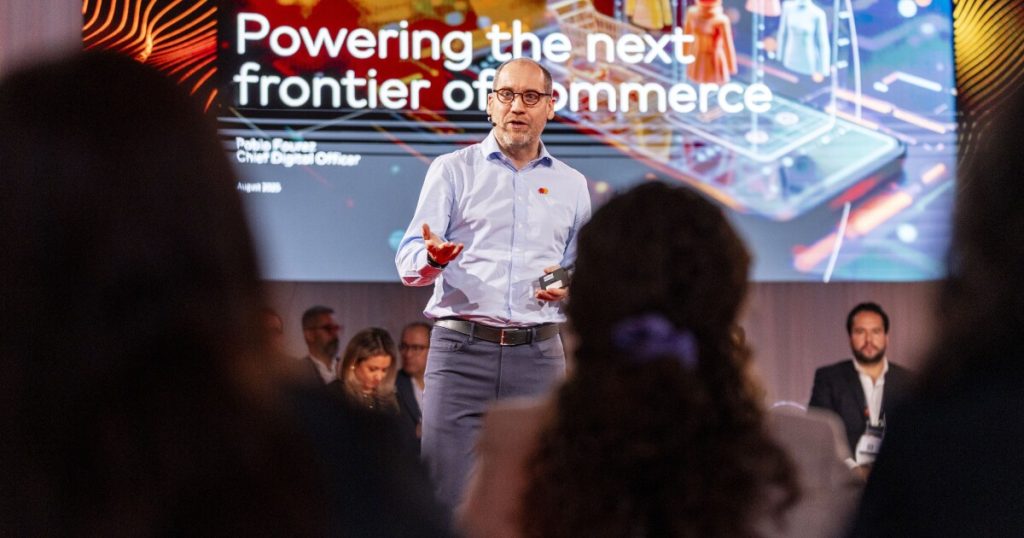
Agentic payments are shaping up to be one of the largest disruptors in commerce in decades, similar to when mobile web browsing became the status quo in the mid 2000s with the proliferation of smartphones, Pablo Fourez, chief digital officer at Mastercard, told American Banker.
“If you think about it, when we had the transition from desktop to mobile, that was a previous big transition in terms of commerce,” Fourez said. “We are now at this watershed moment where [agentic payments] is shifting from the agent being able to start to make the purchase for me to completing the last mile” of that purchase.
Nearly every payment company is at least thinking about how agentic payments will shake up their corner of the industry. Card issuers are looking for the best ways to inject their payment instrument into the chatbots and
“Typically, in payments, we had either consumer-initiated transactions or merchant-initiated transactions, but we didn’t have agent-initiated transactions,” Fourez said. “That’s a third party in the mix. You need to recognize the good ones from the bad ones. You need to be able to have traceability.”
The task at hand is building standards for disparate but symbiotic industries.
“This is not everybody has a different way to do the same thing, because then that makes the investment that the merchant would need to do much larger if I have 10 flavors of this as opposed to three flavors of it,” Fourez thinks. “It’s one of those rare instances where everybody sees the benefit of standardization.”
Getting that standardization right will be key to help drive consumer and merchant adoption of agentic payments, said Visa’s Birwadker.
“We do like standards. We do like consistency of UX, because then a consumer knows what to expect every single time and they’re not going through a different journey to go and buy something,” Birwadker said. “The same thing [is true for] a merchant. If you’re a merchant and you’re trying to sell on one agent, two agents, 10 agents, 20 agents, you want a single integration layer. You want a single settlement. You want where your money is going to work every single time you can get the charge back and disputes done the exact same way.”
What’s the hold up?
Agentic AI innovation is moving fast, but there are a few problems that companies need to solve before agentic payments can venture into the mainstream.
First, AI agents such as OpenAI’s ChatGPT, Google’s Gemini, or Anthropic’s Claude, aren’t designed to be commerce gateways but rather conversational gateways, Birwadker said.
“When Instagram first started, it was really about pictures, but then eventually became a really good commerce gateway,” Birwadker said. “We’re going to see more and more of that. You’ll see all kinds of even the existing big tech players like Google and Apple and others are also going to start to look and feel more commercey as this becomes more of a reality.”
One of the biggest issues to tackle though is figuring out how to gauge liability in a three-party system, Cindy Turner, chief product officer at Worldpay, told American Banker.
Broadly, there are two ecosystems where agents are facilitating purchases on behalf of the consumer. One is where the shopping and agentic discovery experience is being facilitated by an agent that runs a marketplace of offerings, such as OpenAI’s
“That closed loop model where the agent operator – the person who’s running the agent – is one to one with the merchant of record, the entity that holds the liability,” Turner said. “Typically in e-commerce, when you match one to one the agent operator with the merchant of record, we then have an agentic transaction, but it’s less of a slippery slope, because the person who owns the liability is also the agent operator. We’re kind of into bounds to normal shopping”
The other model is where a third party agent is the one returning information and facilitating payment with an outside source with a human in the loop. In that model, the agent would be responsible for finding information and making a recommendation based on parameters provided by the consumer. The consumer would make the final purchase decision.
“By and large, that’s not that risky, because the consumer is being presented with all of the elements, but there is a little bit of potential distortion,” Turner said. “There’s this question in that moment of purchase. Was all of the right facts presented to [the consumer], and if does the liability sit with the merchant or does it sit with the consumer? There’s no framework in which liability sits with the agent operator, it’s either the consumer’s fault or it’s the merchant’s fault, even though it’s very possible that misinformation actually sat with the agent.”
Finally, there’s the model where an agent has the authority to fully act on behalf of the consumer. That model “barely exists, and where it does, it’s very much the Wild West,” Turner said. “That’s probably the one that we need the most industry clarity on how we do those types of transactions and where liability gets assigned.”
Payment companies are experimenting with certain hacks that allow agents to screen scrape data and click a buy button for a consumer and pay with a virtual card without integrating with merchants’ API. But that doesn’t allow communication between issuer, merchant and agent.
Broadly all of the protocols are trying to design to a world in which there is no agent shopping guest checkout. Guest checkout is where all of the non-happy-path problems are going to get created.
“We’re still a long way [from fully agentic payments],” Turner said. “Most of the experimentation is going to stay with some of these hacks for quite a while, and then a couple merchants are going to be early adopters of the agent to API model.”
There will likely be a “bunch” of different permutations of what autonomous agentic payments look like, similar to the evolution of ecommerce.
“Its more likely going to work in a similar journey we saw in ecommerce over the last 30 years, Visa’s Birwadker said. “But you’ll probably see this one over three years, for what it’s worth.”