
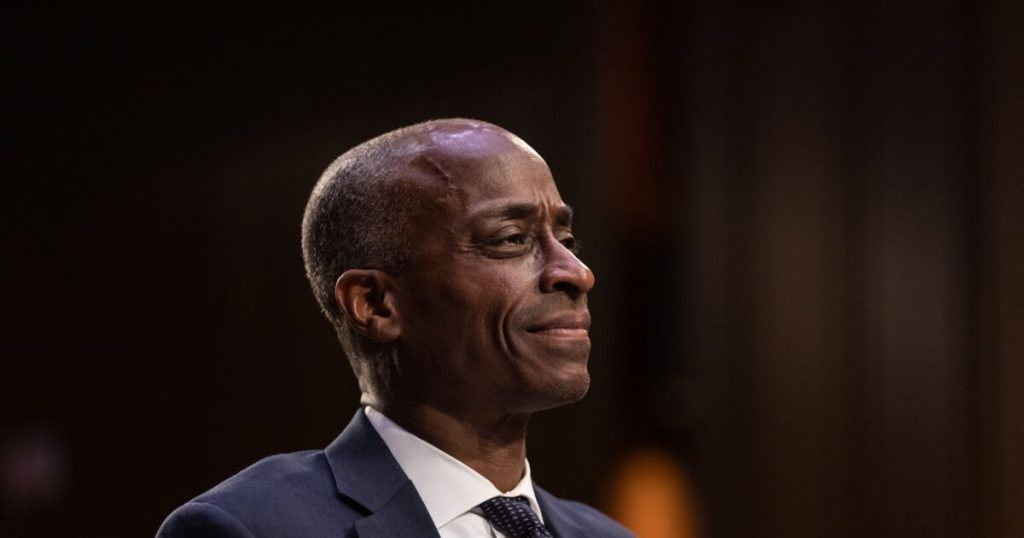
- What’s at stake: Federal Reserve Vice Chair Philip Jefferson said in a speech Tuesday that he remains concerned about the fragility of the labor market and whether employers would be reluctant to expand their payrolls if economic impediments are eased.
- Expert Quote: “Job gains recorded in recent months were enough to keep the unemployment rate stable, but a sufficiently large negative economic shock could push job gains below that range, driving up the unemployment rate.” — Federal Reserve Vice Chair Philip Jefferson
- Forward Look: Jefferson’s comments come as other members of the committee have noted that recent stabilization of the labor market could make taming inflation the central bank’s top priority.
Federal Reserve Vice Chair Philip Jefferson said he remains concerned about the fragility of the labor market despite promising data in recent months, but said the central bank’s monetary policy is currently roughly in balance.
Processing Content
Speaking at an event at the University of Detroit Mercy Tuesday afternoon, Jefferson said that recent reports from the Bureau of Labor Statistics indicating an improved employment picture may disguise persistent vulnerabilities. Jefferson noted that the “low hire/low fire” approach by employers has resulted in fewer job losses in recent years, but said it could also cause employers not to staff up when economic conditions have truly improved.
“While the labor market appears to be stabilizing, I remain cautious about that assessment,” Jefferson said. “Job gains recorded in recent months were enough to keep the unemployment rate stable, but a sufficiently large negative economic shock could push job gains below that range, driving up the unemployment rate. If the current elevated level of uncertainty persists, there is a risk that firms’ reluctance to hire could also persist and hold down job growth for longer.”
Jefferson added that the economic readings for inflation have remained above the Fed’s 2% target for five years, and that there has been “little progress in lowering core inflation over the past year” and that above-target inflation is “mainly due to tariffs.” He said he believes that disinflationary pressures will resume when the tariff effects have been fully metabolized into the economy, aided by continued economic growth and deregulation. But he warned that the war with Iran and the resulting energy price disruptions could cause his predictions not to come true.
“The recent increase in energy prices … will apply some upward pressure on headline inflation, at least in the near term,” Jefferson said. “The ongoing trade policy uncertainty and geopolitical tensions pose upside risk to my inflation forecast.”
Jefferson’s comments come as a number of Federal Reserve officials have pivoted to inflation spurred by the war in Iran as the leading
“You have to carefully monitor inflation expectations, because a series of these supply shocks can lead the public, businesses and households to start expecting higher inflation over time,” Powell said. “At the end of a certain number of years, inflation is now just higher, and that can happen.”
Fed Gov. Michael Barr said in a