
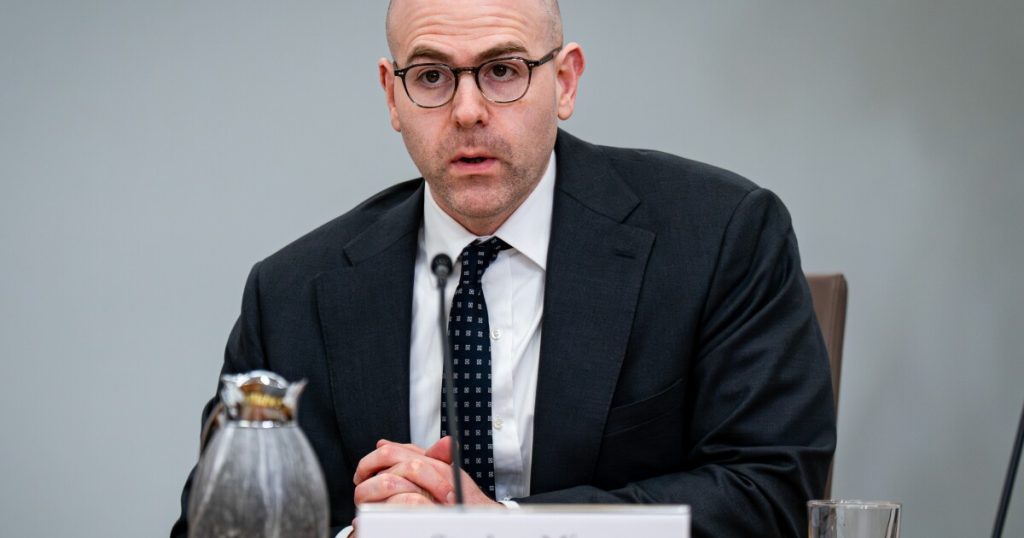
- Key insight: Federal Reserve Gov. Stephen Miran said the central bank should aim to reduce its balance sheet as much as possible so that markets can set prices and allocate money without government intervention.
- Expert quote: “We should aim for as small a footprint in markets as possible to minimize government-induced distortions, including funding market disintermediation.” — Federal Reserve Gov. Stephen Miran.
- Look ahead: The issue of shrinking the Fed’s balance sheet could take on greater importance after Fed Chair-designate Kevin Warsh is confirmed to lead the central bank.
Federal Reserve Gov. Stephen Miran said Thursday he sees significant upside in reducing the central bank’s balance sheet, though he cautioned the process will not be quick.
Processing Content
Speaking at the Economic Club of Miami, Miran said a smaller balance sheet would help make the Fed a more neutral institution by more clearly separating monetary and fiscal policy.
“A smaller balance sheet better protects the boundaries between monetary and fiscal policy by preserving the duration profile of the public debt as a fiscal policy item, keeping the Fed out of the credit allocation game across sectors, and reducing interest payments on reserve balances, which some in Congress view as a subsidy to the banking system,” said Miran.
Highlighting a recent paper he authored, Miran outlined steps the Fed could take to begin shrinking its balance sheet, including easing liquidity coverage ratio requirements and destigmatizing its standing repo operations. He warned that a return to scarce reserves “would entail trade-offs.”
“Those include accepting more volatility in short-term rates, more tolerance for active management of reserves from the Fed, and more frequent and regular use of Fed-provided liquidity like daylight overdrafts, the discount window, or standing repo operations,” he said. “How you view the impact of these side effects will inform whether you think returning to scarce reserves is desirable.”
Miran said the Fed should take steps to reduce reserve demand, allowing it to shrink its balance sheet. He added that destigmatizing repo operations, the
He added the Fed should gradually roll off securities — that is, allowing assets to mature and not replacing them — to wind down the central bank’s balance sheet over time, ensuring financial markets can absorb them with minimal disruption.
“It also means allowing securities to mature rather than selling them outright, which would realize losses on the balance sheet,” Miran said. “I could imagine selling our securities if we saw them trading at a profit, but not otherwise.”
Miran said his proposals, outlined in a paper co-authored with other economists, could reduce the balance sheet by $1 trillion to $2 trillion, but said he does not have a specific target for the Fed’s balance sheet to reach, saying determining that figure “is a subject that warrants more serious work.”
“We should aim for as small a footprint in markets as possible to minimize government-induced distortions, including funding market disintermediation,” said Miran. Miran’s views on reducing the Fed’s footprint in financial markets align with
Warsh, in a number of appearances, has said he wants the central bank to rein in its balance sheet and instead rely more on interest rate policy to support households.However, when or whether reducing the balance sheet will become a priority for Fed leadership remains unclear. Trump announced his choice for the next Fed chair in January, but as of late March the Senate Banking Committee has not scheduled a confirmation hearing.
One factor behind the delay may be pressure from lawmakers for the administration to drop its probe into Powell before confirming a successor. Sen. Thom Tillis, R-N.C., a key vote on the Senate Banking Committee,
Powell himself said during the Federal Open Market Committee press conference last week that he would