
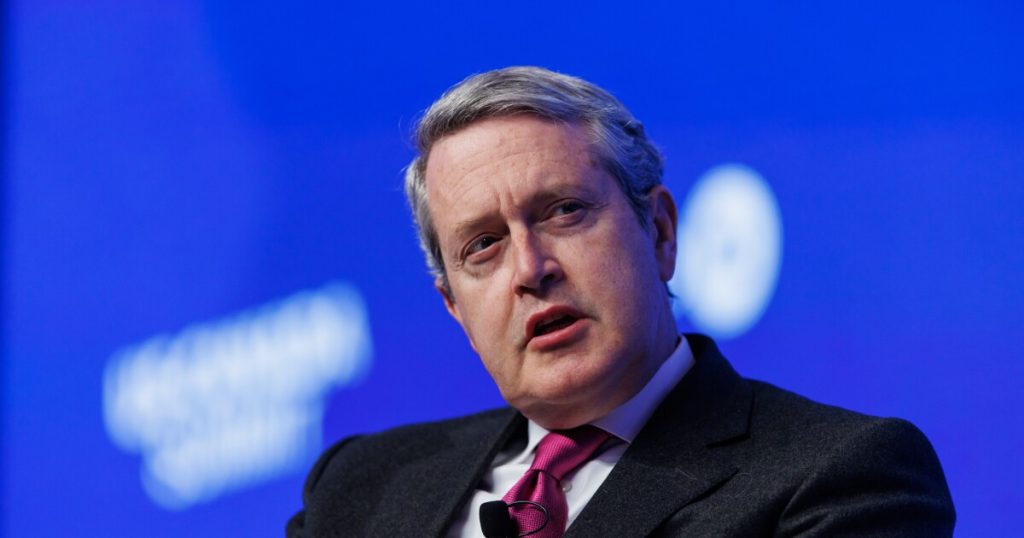
- Key insight: Former Federal Reserve Vice Chair for Supervision Randal Quarles said in a speech Friday that members of the Fed board should serve at the pleasure of the president, but added that keeping regional Fed bank presidents on the Federal Open Market Committee and ensuring their appointments are not influenced by the White House would ensure that monetary policy remains sound.
- Expert quote: “We don’t want — and can’t have — an independent Fed. What we can have is a system that assures that the monetary policy decisions of the central bank are insulated from short-term political direction.” — Former Federal Reserve Vice Chair for Supervision Randal Quarles
- What’s at stake: Quarles’ comments come as the Supreme Court stands poised to issue rulings on the president’s ability to dismiss members of independent regulatory agencies and on whether the president erred in attempting to fire Fed Gov. Lisa Cook, potentially overturning a longstanding precedent protecting those agencies from at-will removal.
WASHINGTON — An influential former Federal Reserve official said in a speech Friday afternoon that the legal protections barring members of the Board of Governors from removal by the president except for cause should be overturned, but added that the central bank’s decentralized structure would ensure that the White House would still not be able to dictate monetary policy if such an outcome became a reality.
Processing Content
Speaking at a meeting of the Shadow Open Market Committee Friday afternoon, former Federal Reserve Vice Chair for Supervision Randal Quarles said that he objects to the idea of regulatory independence as a general matter. The constitution clearly holds that Congress makes the laws and the president executes them, he said, and having pockets of executive federal power that are wielded without the consent of the president flies in the face of that arrangement.
“I wish we stopped using the word independence — independence about the Fed, independence about executive agencies generally,” Quarles said. “There is no such thing as an independent agency in our constitutional system, and as a matter of general political first principles, there should not be. We don’t want — and can’t have — an independent Fed.”
Quarles, who served as the first Fed vice chair for supervision after being
“What we can have is a system that assures that the monetary policy decisions of the central bank are insulated from short term political direction,” Quarles said. “No one should be able to direct the outcome of the process. There would be input from everywhere, and that was the purpose of the system, but that input would in fact include a lot of political input.”
Quarles has said little about President Donald Trump’s running battle with the Fed and its chair, Jerome Powell, whose chairmanship expires in May. In January 2025 Quarles said on
Quarles said that the convention that presidents do not criticize the Fed is of a relatively recent vintage, and is meant to protect the president rather than the central bank. President George H.W. Bush was publicly critical of the Fed under the leadership of Alan Greenspan, arguing for more accommodative monetary policy heading into the 1992 election. When Bush lost, he
“It was self-preservation for the president — it wasn’t because this is what’s necessary for democracy to operate,” Quarles said. “There is nothing undemocratic or a violation of the Federal Reserve system or the norms of democracy for a president to be very vocal in saying where he thinks interest rate policy ought to be. It may be unwise. I think it’s probably counterproductive in a majority of circumstances. But there’s nothing undemocratic about it.”
Quarles also expressed concern about the outcome of two forthcoming Supreme Court decisions, one concerning whether
Quarles said he was afraid that the court would strike down independent agencies but make an exception for the Fed, which he said would be regrettable because the exception would undermine the rule and isn’t required to ensure that monetary policy decisions remain sound.
“I think that’s both wrong and unnecessary,” Quarles said. “It’s wrong because it will not be sustainable. If the Supreme Court says, ‘Here’s how the system is supposed to operate: The president has to be able to dismiss entities that execute executive power. But the Fed, we’ll just magically say, is different,’ then that is an unsustainable solution that will ultimately result in the withdrawal of the necessary insulation from short-term political direction, because that’s just not a good answer.”
The solution to how to preserve both the president’s Article II powers and the Fed’s credibility is to embrace the decentralized and public-private nature of the Fed. The Board of Governors, which is composed of seven members appointed by the president, are and should be found to be executive offices serving at the pleasure of the president, he said. But the Federal Open Market Committee is made up of the Fed board as well as a rotating selection of regional Fed bank presidents, with the New York Fed president serving as a permanent member. Those presidents are chosen by the regional Fed bank boards of directors and approved by the Fed board, but are not directly chosen by the president nor confirmed by the Senate.
“It’s reserve banks that preserve this resilience to short-term direction,” Quarles said. “The board of governors is a governmental body. It is a body with executive power, and as such it is responsive to the president. Monetary policy, however, is made by the FOMC. The FOMC has participation from the reserve bank presidents. Reserve bank presidents are not government officials. And, again, I believe the right way to think about monetary policy is that monetary policy is not an inherently governmental executive power.”
Quarles acknowledged that there are seven members of the Fed board and five voting regional Fed bank presidents on the FOMC at any given time, suggesting that the president could fire the entire board at any time and gain a voting majority. But he said firing members of the Fed board would only further empower the regional Fed bank presidents in the short term.
“Now suppose the president in the current circumstance would then say, ‘I’m dismissing the whole board. I’m done with you all. It’s the end of a civilization,'” Quarles said. “Well, until he gets at least six members of the board through the Senate, monetary policy decisions will be made by those reserve bank presidents — who he does not appoint and who he cannot control.”
He concluded that Senate confirmation would also be an impediment to the president undertaking wholesale firings of Fed board members. Trump himself attempted to move
“It is not a slam dunk that the president will be able to get nominees through the Senate,” Quarles said. “For most of my time on the board we did not have six confirmed governors … the board was outvoted on monetary policy decisions, if it came down to it, by the reserve bank presidents, which is how the system is supposed to operate.
“And then I would say, if we got to a point where there was such a strong democratic pressure for a change in monetary policy that a president could in fact get six people through the Senate that would agree with a dramatic U-turn in monetary policy, then probably we should do that,” Quarles said.