
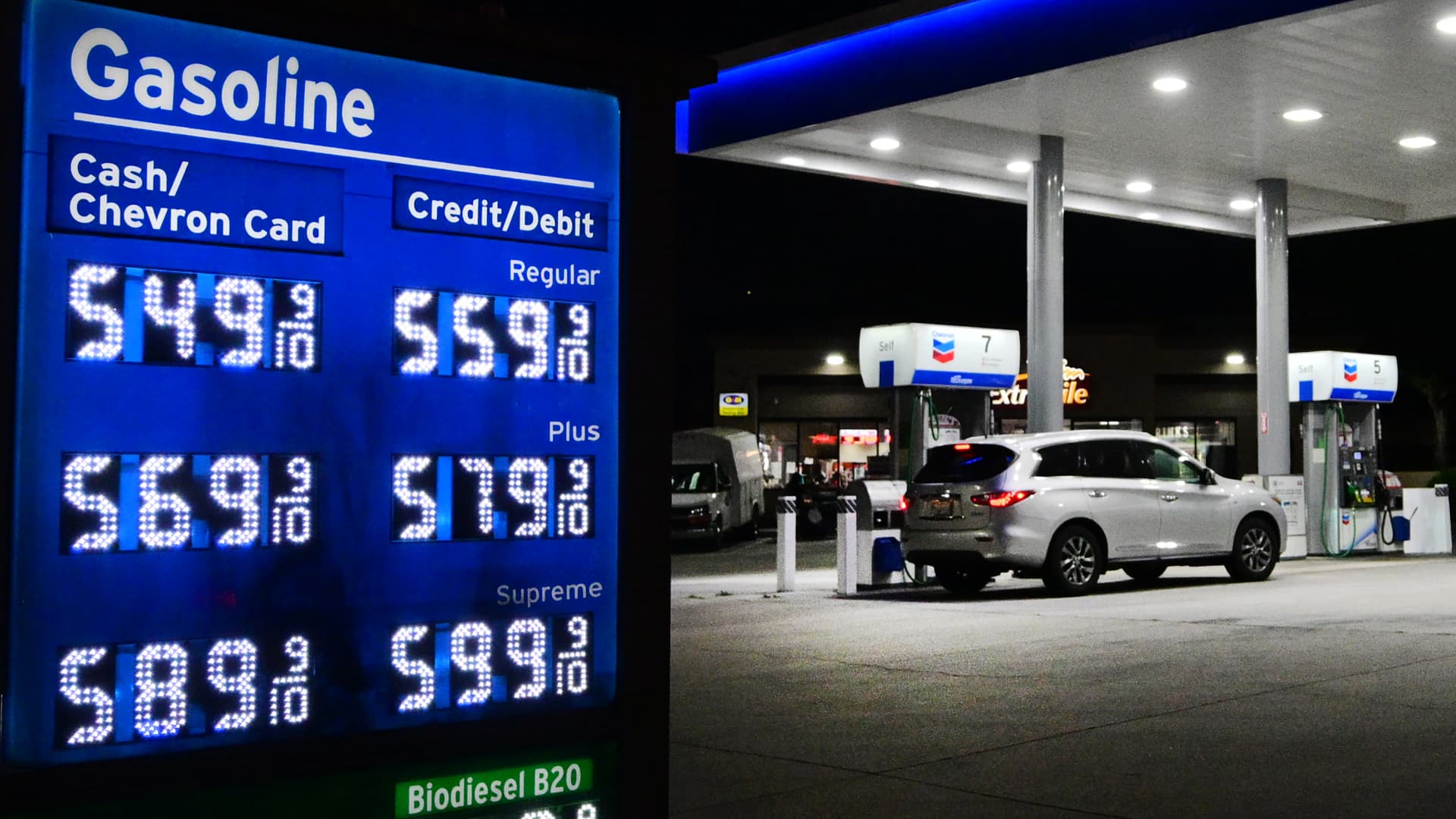
High gas prices are listed at Chevron gas station in Los Angeles on March 9, 2026, as gasoline prices surge amid the ongoing war with Iran.
Frederic J. Brown | Afp | Getty Images
“I don’t get any sense that inflation is decelerating,” said Mark Zandi, chief economist at Moody’s. “It feels like it’s uncomfortably and persistently high.”
Inflation is “stubbornly high, especially for necessities” such as electricity, food, apparel, medical care and housing, he said.
“And of course, this is all before the fallout from events in the Middle East,” he said.
The latest CPI report doesn’t account for the inflationary impact of rising energy prices in the aftermath of the U.S.-Israel attacks on Iran, which started Feb. 28.
In that sense, the CPI report is “a bit stale at this point,” said Joe Seydl, senior markets economist at J.P. Morgan Private Bank.
“It’s not incorporating what is the most important [macroeconomic] shock right now,” he said.
Inflation impact of war in Iran
It’s unclear how much the war in Iran will add to inflation in the U.S. economy.
The war has caused global oil prices to spike — leading prices for gasoline, diesel, jet fuel and other products refined from crude oil to surge, too.
That’s because the conflict has choked off oil supply through the Persian Gulf, a major corridor for global energy exports — amounting to the biggest oil supply disruption in history.
Brent crude, a global oil price benchmark, touched $119.50 per barrel on Monday, up from about $70 per barrel before the U.S.-Israeli attacks. It’s since declined from its recent peak, to around $90 per barrel.
An aerial view as oil pumpjacks operate while others stand idle in the Inglewood Oil Field on March 10, 2026 near Los Angeles, California.
Mario Tama | Getty Images
A prolonged crisis could lead oil prices to stay elevated, resulting in sustained pain at the gasoline pump for consumers, economists said.
Average gasoline prices hit $3.50 per gallon as of Monday, their highest level since 2024, according to the U.S. Energy Information Administration. Prices are up about 57 cents a gallon — or 19% — from $2.94 a gallon on Feb. 23, two weeks earlier.
Households could also see prices rise elsewhere, economists said.
For example, rising jet fuel costs could filter into higher airfares ahead of the busy spring and summer travel seasons; more expensive diesel could feed into elevated food prices due to increased costs to transport food items to the grocery store, economists said.
A prolonged conflict that leads to a sustained increase in inflation would also complicate the Fed’s interest rate policy, economists said.
“I think the Fed sits on its hands and doesn’t move,” Zandi said. “In significant part because of the uncertainty created by the war.”
Impact depends on length, scale of supply shock
The ultimate impact depends on how long the conflict drags on, and to what extent it disrupts energy supplies from the Middle East, Seydl said.
The most likely scenario is a “severe but short-lived” conflict that lasts just a few weeks, and sees U.S. oil prices gradually drop back to around $60 by the end of 2026 — roughly where they were before the conflict, Stephen Brown and Thomas Ryan, North America economists at Capital Economics, wrote in a research note on Tuesday.
However, a longer conflict that inflicts minor damage to energy infrastructure could lead U.S. oil prices to average about $100 per barrel for the rest of the year, Brown and Ryan wrote. In this case, the CPI inflation would rise to 3.5% by the end of 2026, up from the current 2.4% forecast, they estimated.
In that case, gasoline prices could rise to just shy of $5 per gallon in the second quarter, they wrote. The CPI inflation for airline fares could rise from 2.2% in January to a peak of around 20% due to jet fuel costs, they wrote.
Additionally, agriculture prices would be “most at risk” relative to other commodities if there were a sustained rise in prices for oil and for global natural gas, which is a key input for fertilizer, Brown and Ryan wrote.
Disruptions to fertilizer supply would risk a shortfall in U.S. crops, Zippy Duvall, president of the American Farm Bureau Federation, wrote Monday in a letter to President Donald Trump.
“Not only is this a threat to our food security — and by extension our national security — such a production shock could contribute to inflationary pressures across the U.S. economy,” Duvall wrote.
Tariffs were primary inflation factor
Before the war in Iran, tariffs that Trump imposed were the main factor underpinning elevated inflation, economists said.
“It’s primarily tariffs, in our view,” said Seydl of J.P. Morgan.
Without the “tariff shock” of 2025, the U.S. inflation rate would likely be back to target, he said.
The Supreme Court struck down a centerpiece of the Trump administration’s tariff agenda in February, ruling that tariffs levied under the International Emergency Economic Powers Act of 1977 were illegal.
Trump cited the IEEPA as the legal backbone for a host of tariffs he put on imports from other nations, including a 10% baseline tariff on all U.S. trading partners and even higher duties on select nations.
Shortly after the ruling, the Trump administration introduced new tariffs under a separate legal justification, aiming to keep the effective tariff rate roughly equal to what it had been before the Supreme Court ruling.
Economists said there wouldn’t be much inflationary relief for consumers in the short term as a result.
For example, before the court ruling, the average effective tariff rate was 14.3%, the highest since 1939, according to the Yale University Budget Lab. The current tariff rate, after the Trump administration’s latest maneuver, is 10.5%, the highest since 1943, according to a March 9 analysis.
Food inflation
A worker stocks beef filets in the meat section of a grocery store in Washington.
Tom Williams | Cq-roll Call, Inc. | Getty Images
Overall the CPI inflation also looks better on paper than in reality due to a quirk in the data from the government shutdown in the fall.
The record-long shutdown, which ran from Oct. 1 to Nov. 12, prevented federal statisticians from collecting typical inflation data in October. Without that data, the BLS assumed that no price increases had taken place during the month for most categories of goods and services.
Taking that measurement quirk into account, the CPI inflation is likely around 2.7%, about 0.3 percentage point higher than reported Wednesday, said Zandi of Moody’s.