
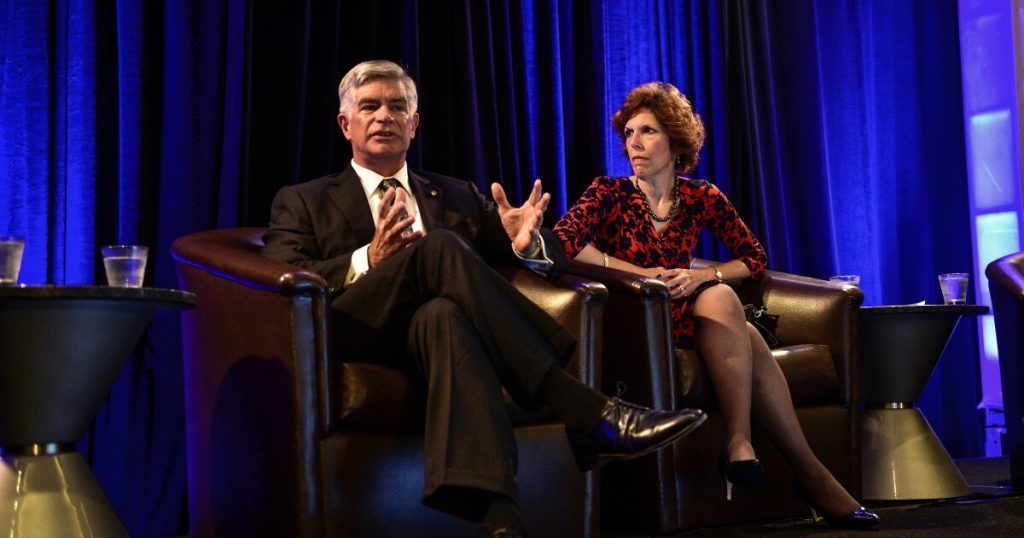
- Key insight: Patrick Harker, former president of the Federal Reserve Bank of Philadelphia, and Loretta Mester, former president of the Federal Reserve Bank of Cleveland, predict the Fed will keep its federal funds target range unchanged for the foreseeable future amid rising energy-driven inflation and concerns that expectations of higher prices will become entrenched.
- Expert quote: “There’s a lot of uncertainty, and it will depend on how long this war lasts.” — Patrick Harker, former president of the Federal Reserve Bank of Philadelphia
- Look ahead: How long the war with Iran lasts will be a key determining factor in how significant and enduring its effects on global energy prices — and, by extension, prices for food and transportation — will affect the global economy.
WASHINGTON — Geopolitical pressures emanating from the ongoing war with Iran are clouding the Federal Reserve’s already-murky monetary policy outlook, leading some former central bank officials to predict that interest rates will remain where they are into the foreseeable future.
Processing Content
The most immediate effect of U.S. military action in Iran is higher energy prices, which have already appeared at gas pumps and home energy bills. But the bigger question is whether those price increases translate into core inflation, a measure the Fed favors when considering inflationary pressure and that the central bank has struggled to
Patrick Harker, former president of the Federal Reserve Bank of Philadelphia, said in an interview with American Banker that the duration of the conflict is the key to whether and to what extent it has a lasting impact on the broader economy — and, by extension, whether the Federal Open Market Committee will make a move on interest rates.
“There’s a lot of uncertainty, and it will depend on how long this war lasts,” Harker said. “If oil prices spike and then fall quickly, the effects on the economy should fade relatively fast. But if elevated prices persist for months, that’s a different story. Shipping and fertilizer costs would rise, putting upward pressure on inflation in the medium term.
“For now, I think the Fed is going to sit tight,” he added.
The federal funds rate target range is
Loretta Mester, former president of the Federal Reserve Bank of Cleveland, echoed that view in an interview with American Banker, saying the central bank is right to focus more squarely on inflation.
“I think the strategy now is holding,” she said. “The Fed has to look at the inflation goal as the primary one, while also watching whether this develops into a drag on growth and employment, which are part of its mandate.”
Inflation slowed to 2.4% in January and February, down from about 2.7% in prior months, but above the Fed’s inflation target.
Expectations are growing that inflation could worsen as a result of the Iran conflict.
Harker said an energy shock has the potential of triggering a recession if oil prices rise to $140 per barrel for a sustained period. Seaborne Brent crude oil is currently trading above
“The economy could start to teeter on recession, but that’s a big spike from where we are now,” Harker said, stressing that “classical signals” of recession are when companies begin shedding workers and slow hiring.
Mester was less convinced that the conflict could lead to a recession, noting that the economy has remained resilient in the face of tariff-related price pressures over the past year. She added that holding rates steady as inflation rises would effectively be a more accommodative monetary policy, further reducing the possibility of recession.
“Keeping rates unchanged as inflation continues to rise means that rates will be falling, and so that would be a more accommodating policy,” she said. “The Fed is going to have to take that into account when thinking about its policy settings.”
Mester added that the Fed “won’t take hiking rates off the table,” but said holding rates would likely be the preferred approach.
Both Mester and Harker were present for Federal Open Market Committee discussions when Russia invaded Ukraine in 2022, an event that had short-term effects on energy prices. However, they said the current situation differs significantly.
“The discussion will be similar in terms of how much we can look through this event,” Harker said. “But that was a very different time, because in 2022 we were battling very high inflation, which added to the uncertainty the committee was facing.”
Cook said inflation has remained above the Fed’s target for years and warned geopolitical pressures could make progress more difficult.
“I would argue that the inflation risk is greater right now as a result of the Iran war,” Cook said during an event at Yale University. “Certainly we haven’t seen, in five years, our inflation target being met, and this could have potentially a substantial effect on inflation.”
Meanwhile, the labor market shows mixed signals, with low firing and low hiring creating an “uneasy balance,” Mester said, further supporting a hold on rates.
“We don’t yet know the path of the war and there is uncertainty about the path of the economy,” said Mester. “We’re in a good position now in terms of where policy is, and now we can react in the appropriate way as we see how things play out.”