

It seems like just yesterday we were navigating a government shutdown.
In fact, the last one ended on November 12th, 2025, less than three months ago.
That was the longest shutdown in U.S. history and disrupted both economic data distribution and mortgages in process.
The current one is simply a partial shutdown, but it’s still wreaking havoc and pushing key data reports further out.
As such, mortgage rates might be even more stuck until this gets resolved.
Delayed Jobs Report Means Mortgage Rates Lack Direction
Once again, government funding is in limbo as Democrats and Republicans work to iron out another funding package to end the shutdown.
We are currently on day four of the latest partial government shutdown, which is causing disruptions in air traffic control and delaying key economic reports.
Just this week, three separate jobs reports will be delayed as a result of the impasse.
This includes the job openings report due out today, initial jobless claims Thursday, and the most important BLS jobs report for January.
The Employment Situation from the BLS was set to be released this Friday, showing the addition of 60,000 jobs in January.
But now we have to wait for some unknown period of time to see the results.
As such, mortgage rates will likely be even more stuck until the shutdown is resolved.
Lately, the 30-year fixed has been pretty flat and this will just make it flatter all else equal.
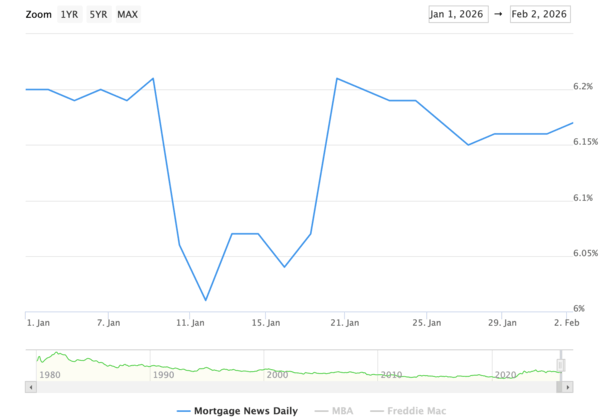
As you can see from the chart above from MND, mortgage rates have basically gone nowhere since 2026 kicked off.
Sure, there was that brief drop related to the MBS buying news, but it proved very short-lived and has been completed absorbed at this point.
Another weak jobs report had the potential to push mortgage rates back toward those low-6s we enjoyed for a brief moment.
Now we’ll need to wait a bit longer to get those results.
Unclear How Long Shutdown Will Last, But Could End Very Soon
The good news is the shutdown isn’t expected to drag out too long like the prior one. Of course, you never know how long it’ll go.
In the meantime, I will add that mortgage rates often fall during government shutdowns.
The rationale is that uncertainty leads to a flight to safety in bonds, which pushes their yields down.
As a result, long-term mortgage rates like the 30-year fixed also enjoy some relief.
However, the government shutdown is just one data point to consider and there’s a lot of other potential movers at the moment.
We’ve got rumblings of more geopolitical stuff whether it’s Cuba or Iran, not to mention ongoing issues like Venezuela and Greenland.
There are also new tariff threats floating around, all of which can impact mortgage rates and offset the shutdown news.
But because such an important report is delayed, chances are mortgage rates won’t do a whole lot this week.
The narrative lately is that the labor market has been “resilient” and holding up better than expected.
If and when a subsequent jobs report challenges that position, you could see mortgage rates fall.
Of course, if a hot jobs report is delivered, the opposite could be true as well.
While we wait, we will get the monthly ADP jobs report for private payrolls, which can have some impact as well, especially if it comes in super hot or ice cold.
It’s scheduled to be released tomorrow and won’t be affected by the ongoing government shutdown.
Read on: How to track mortgage rates with economic data.
(photo: Ivan Radic)

Before creating this site, I worked as an account executive for a wholesale mortgage lender in Los Angeles. My hands-on experience in the early 2000s inspired me to begin writing about mortgages 19 years ago to help prospective (and existing) home buyers better navigate the home loan process. Follow me on X for hot takes.