
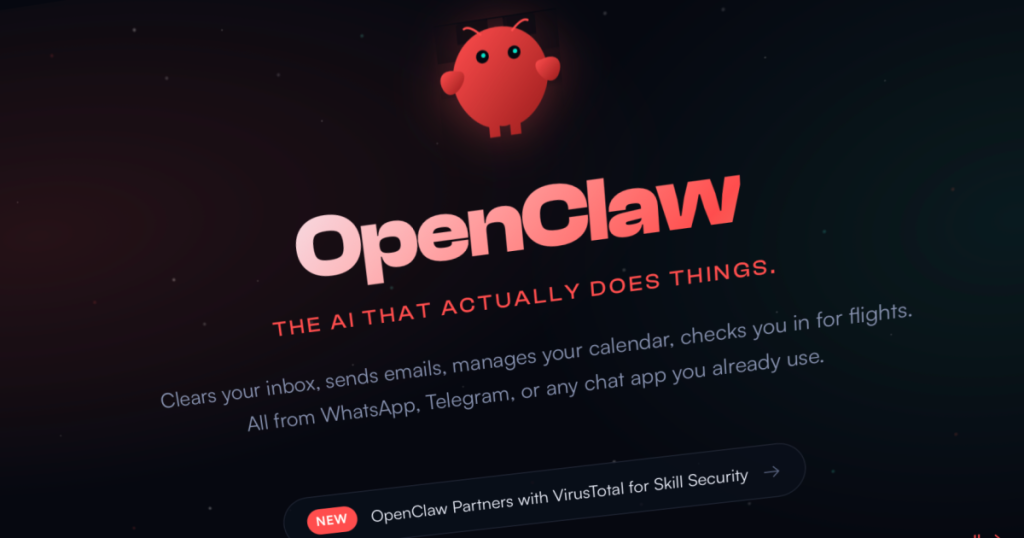
- Key insight: OpenClaw operates as an autonomous agent with the same system privileges as its human user, making it a unique shadow IT threat.
- What’s at stake: Deep integration of unapproved AI tools into enterprise systems could allow hackers to secretly steal or expose sensitive corporate data.
- Supporting data: A recent survey found that 60% of employees use unapproved AI tools at work, and 75% of those users share potentially sensitive data.
Overview bullets generated by AI with editorial review
Processing Content
The rapid rise of the open source project OpenClaw, a personal AI assistant, has created a wave of shadow IT risks for financial institutions, turning the productivity tool into a potential entry point for cybercriminals.
The software, which acts as a personalized digital worker for the user, has faced prolific scrutiny after researchers uncovered numerous critical vulnerabilities in the software itself and numerous malicious plugins on the official OpenClaw plugin marketplace.
The threat is uniquely acute because the software acts autonomously and often with a great degree of privilege and access, performing tasks and interacting with applications using the same system access its human user has.
For U.S. bankers, the emergence of OpenClaw represents a dangerous shift from passive data storage risks to active software agents operating like a rogue internal user.
Insider threats are deeply familiar to banks, so in some ways, OpenClaw does not present a significantly new challenge; banks frequently deploy systems such as endpoint detection and response (EDR), which is designed to catch unapproved software accessing privileged files.
However, the deep integration of AI tools such as OpenClaw into the daily workflows of employees still makes them a formidable challenge for network defenders.
OpenClaw has exploded in popularity since starting to gain traction in January, reaching more than 211,000 stars (equivalent to favorites) on code sharing website GitHub, and, according to a blog post by the creator behind the project, drawing two million visitors in a single week.
Upon installation, the software becomes deeply enmeshed in a user’s digital life, requesting access to handle tasks ranging from sending text messages and emails to controlling the user’s smart home lights and smart mattress.
If left unchecked, this deep integration can jump the shark from the user’s personal life into the enterprise systems of their employer, often with the user’s intent.
Employees can connect the AI agent to corporate Slack channels, Jira ticketing systems, and cloud environments containing sensitive API keys, according to a Wednesday report from cyber intelligence firm Kela.
Major cloud infrastructure companies have legitimized the software for eager developers. Alibaba Cloud and DigitalOcean both published step-by-step instructions on their websites detailing how users can install OpenClaw on their servers.
Amid the wave of attention, OpenAI has hired OpenClaw’s founding developer Peter Steinberger. In announcing the news on Sunday, OpenAI CEO Sam Altman said Steinberger would help “drive the next generation of personal agents.”
The OpenClaw project is now in the hands of an independent foundation, supported in part by OpenAI, according to a Saturday blog post from the developer.
OpenClaw presents a so-called shadow AI threat that is highly relevant to banks, where employees frequently seek out unsanctioned tools to speed up their workloads.
Security researchers at Bitsight detected OpenClaw instances operating within sensitive industries, including finance, according to a February 9 blog post from the cyber risk management firm. The U.S. currently hosts the largest global concentration of these exposed OpenClaw deployments.
Furthermore, cybersecurity firm Token Security observed OpenClaw or its variants actively running on employee devices in up to 22% of its monitored customer environments, according to a February 11 threat assessment from Kela.
Even if bank security teams have not yet spotted OpenClaw on their specific networks, the broader trend of “shadow AI” — the unauthorized use of artificial intelligence tools by employees — plagues the financial services industry.
Nearly two-thirds, or 65%, of 1,500 surveyed financial services professionals in the U.K., France and Germany said employees use unapproved AI tools to communicate with customers, according to an October report from language AI company DeepL.
The finding is corroborated by a September survey by Cybernews, which indicated nearly 60% of surveyed U.S. employees (across industries) use unapproved AI tools at work, and 75% of those users share potentially sensitive data with the tools.
Unapproved AI use presents the threat of exposing corporate data to unapproved model providers, but in the case of OpenClaw, it also presents distinct technical vulnerabilities.
Security researchers at firm Depthfirst reported this month a critical flaw in the software known as a one-click remote code execution vulnerability. The vulnerability, since patched in newer versions of OpenClaw, allowed attackers to easily take over a user’s machine.
If a user simply clicked a malicious link, the OpenClaw interface automatically sent its secret authentication token to the attacker’s server, granting the hacker full control to execute commands on the victim’s computer.
Beyond code bugs, OpenClaw suffers from inherent vulnerabilities tied to how large language models process information — most prominently, prompt injection.
Because the AI cannot reliably distinguish between a user’s commands and the outside data it reads, an attacker can hide malicious instructions inside an email or a web page.
When the agent summarizes that document, it blindly follows the hidden command, which could instruct it to secretly forward sensitive corporate data to an outside server.
Banks do not face these threats defenseless. Network firewalls and EDR systems that flag unusual behavior can detect many of these threats, and the security teams that configure these systems receive alerts if a standard developer process suddenly attempts to access sensitive system files or invoke blocked software.
The OpenClaw project has also established a partnership with Google-owned VirusTotal to automatically scan community-built plugins for malware. The OpenClaw team has also hired a dedicated security lead and published formal security models to track vulnerabilities.
However, these measures do not completely fix the project’s security issues. The VirusTotal integration scans for known malware signatures but remains blind to semantic prompt injections hidden in plain text.
And, “even with strong system prompts, prompt injection is not solved,” according to OpenClaw’s own official security documentation.