
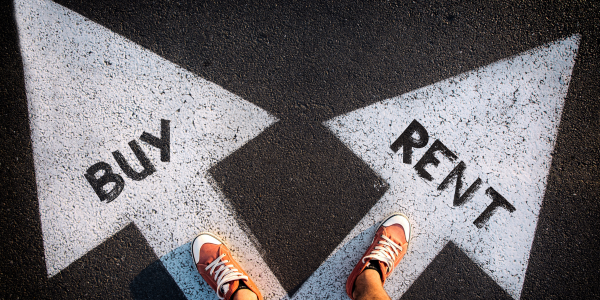
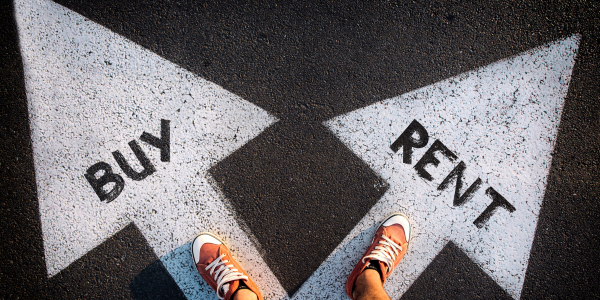
Buying vs. renting real estate will always be a personal decision—one that should be based on your lifestyle, goals, and financial well-being. Factors like interest rates, the housing market, and what others around you are doing can be influential, but the ultimate decision is up to you.
Putting all that aside, here are some pros and cons of buying vs. renting that you should consider when determining whether buying vs. renting is better for you.
Article Summary
Choosing whether to buy or rent comes down to your timeline, finances, and lifestyle priorities. Buying can offer long-term payment stability, control over your space, and the opportunity to build equity and access potential tax benefits. However, it also means taking on responsibility for repairs, maintenance, and added costs such as property taxes, insurance, and HOA fees.
Renting provides greater flexibility—especially if you’re unsure how long you’ll stay in one place—and involves fewer maintenance obligations. On the downside, it offers no equity growth and can leave you vulnerable to rent increases and lease restrictions.
In high-demand markets, renting may be more feasible in the short term, while buying can secure a home and its potential appreciation if you expect to stay put. The best choice depends on what matters most for your current stage of life.
Stability
One of the best things about owning a home is the fact that your payments will be locked in for the next 15 or 30 years, depending on the length and type of mortgage. “Volatile” may be a dramatic word to describe the rental market, but it is definitely unpredictable.
You can lock in your lease terms for one year, but you have no idea what’s going to happen after that. Your landlord could raise the rent or choose not to renew your lease. You may also have lease provisions that prevent you from getting a pet, having a significant other move in, or even painting a wall.
Owning a home means owning all the decisions. Want a lizard? Go get one! Does your brother need a place to stay while he gets back on his feet? Offer him your spare room. Tired of looking at that dirt patch in the backyard? The garden center is just a few blocks away.
There is great peace of mind that comes from knowing your house—and housing payments—will remain in your control. With a fixed-rate mortgage, this payment will change only if you choose to move or refinance.
Repairs and Maintenance
On the flip side, you have to consider that all responsibilities are now on you when you own a home. This includes the fun stuff like adopting a bullmastiff, as well as the not-so-fun stuff like fixing a leaky roof. There’s no landlord to call when the dishwasher breaks or the HOA points out a violation.
The general rule of thumb is to budget 1% to 4% of your home’s purchase price for annual repairs. This figure should be taken into account when you’re calculating the merits of buying vs. renting. Repairs and maintenance are also why it’s crucial for any home to undergo a thorough inspection before you purchase it.
Many bidders are waiving inspections nowadays to make their offers look more attractive. This is a risky game: Your home may not appraise for as much as you’d hoped, or you could find out you’ve got five figures in repairs to make.
This doesn’t mean that renting is a piece of cake when it comes to maintenance and repairs. Unscrupulous landlords do exist, though they tend to be the exception. Still, requesting a repair and having it completed can be time-consuming, as you’re more likely to be at the mercy of the landlord’s schedule, and then the repair person’s schedule. As a homeowner, you can shop around for the best deal (or best person) and schedule the service on a day and time that works for you.
Home Equity
Buying vs. renting shouldn’t simply come down to which is cheaper. It may actually cost less annually to rent a home in some neighborhoods than it would be to buy, but that doesn’t mean it’s the right decision for you.
Remember, a home is an investment. While no investment is guaranteed to make money, historically homes do appreciate over time. This makes a mortgage payment an investment in your future. With renting, you simply receive the benefit of living in that spot for the duration of your lease. Once that’s done, you leave with nothing more than what you arrived with.
The landlord, on the other hand, walks away with the added benefit that you likely covered their mortgage payment—and maybe even more—during your stay. This isn’t to say that renting is all bad. It makes economic sense if you want to save for a home, need to get out of debt, experience a life transition, or don’t plan to stay in the general vicinity long-term.
Renters also don’t have to pay property taxes on their dwellings. That’s the homeowner’s job.
Tax Considerations
Another key difference between renting and owning is how housing costs are treated at tax time. Homeowners may be able to deduct certain expenses—such as mortgage interest and eligible property-related costs—depending on their financial situation and current tax laws. These potential tax benefits can help offset some of the ongoing costs of ownership, which also include property taxes and other expenses like insurance, private mortgage insurance, or HOA fees.
Renters do not receive comparable tax advantages, so homeownership can offer opportunities for long-term financial planning that renting does not. Because eligibility varies, homeowners should consult a qualified tax professional to understand how these rules apply to their specific circumstances.
Location
One of the biggest benefits of renting is flexibility. That isn’t just flexibility in pricing or unit size, but flexibility in location. You can pick up and move whenever your lease is up. For some, that sounds like heaven.
Here’s the thing, though. If you’re after a highly desirable location—say, a beach town, dense urban metro area, or outdoor paradise—the discrepancy in price between buying vs. renting may be too much to stomach. Renting can afford you the ability to live in these destinations for oftentimes a fraction of the cost.
We know you know the other side of this coin is coming … so here it is. Yes, renting will allow you to live in locations you’d otherwise be priced out of. However, if you find a location you love, save up, and use that money toward a down payment, then you’ve secured that spot permanently.
Plus, if it’s an attractive area to you, that may mean the potential for future growth is there, which can mean more money in your pocket when it comes time to sell. Depending on your municipality and/or HOA, you may even be able to rent out a room or the entire house on a short- or long-term basis if it’s a really in-demand area. Becoming the landlord is so much better than paying the landlord!
If you’re renting and the area truly is in demand—especially for vacationers—there may be a solid chance your landlord will raise the rent substantially, choose to go the Airbnb route themselves, or sell altogether and cash in those profits. This is no problem if you’re renting for only a year. However, if your goal is to stay in this area, that could become harder and harder as prices and demand rise.
The decision surrounding buying vs. renting will always be a personal one, but at least now you’re armed with some pros and cons to consider before pulling the trigger on your next home. APM is always here to discuss these factors with you, along with your unique goals and financial situation. Connect with an APM Loan Advisor today to get started.