
Visualization created with AI assistance based on original reporting.
Processing Content
- Key insight: A diverse monetary ecosystem can foster innovation, resilience and competition. But it requires precise legal design, clear disclosure and realistic assumptions about user behavior.
- What’s at stake: If the next phase of digital monetary policy is to succeed, it must recognize that people experience money through use.
- Forward look: Narrow banking may be back in the conversation. But the future of money will be anything but narrow.
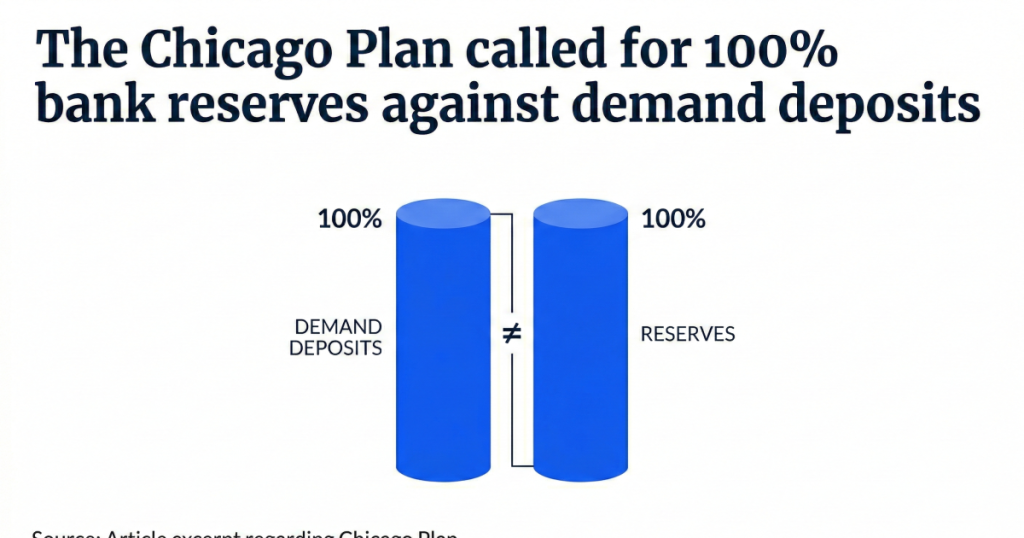
In the depths of the Great Depression, a group of economists at the University of Chicago proposed a radical solution to financial instability. Known as the Chicago Plan, their idea was simple in concept and sweeping in implication: Require banks to hold 100% reserves against demand deposits. Credit creation would be separated from money creation. Bank runs would disappear. The financial system would become safer — if much,
Nearly a century later, the Chicago Plan has returned, this time dressed in digital clothing.
On both sides of the Atlantic, lawmakers have advanced stablecoin legislation that appears, at first glance, to revive the logic of narrow banking. In the United States, the
But that reading is incomplete. Far from ushering in an era of narrow banking, these frameworks are laying the groundwork for a far more complex — and potentially confusing — monetary landscape.
The appeal of narrow banking has always been intuitive, if somewhat reactionary. If instruments function like money, regulators reason, they should be backed like money. Stablecoins fit squarely into this logic. When a stablecoin promises redemption at par, users reasonably expect it to behave like cash.
Both the GENIUS Act and MiCAR respond to this expectation. They seek to reduce maturity transformation, limit run risk, and protect consumers by requiring payment stablecoin issuers in the United States and nonbank electronic money institutions in the European Union to issue fully funded, redeemable liabilities. In the EU, this outcome is achieved not through a separate “asset reserve” requirement, but through stringent safeguarding and investment rules that ensure funds received in exchange for EMTs remain continuously available for redemption. In doing so, both frameworks echo the core intuition of the Chicago Plan: Stability comes from constraining the liabilities that function as money.
This is not accidental. After a decade of crypto experimentation — and several high-profile failures — policymakers are reasserting a familiar principle: Monetary instruments that circulate widely should not depend on fragile balance sheets or opaque risk management.
Despite the narrow banking optics, neither the U.S. nor the EU is actually moving to eliminate traditional bank money in digital form — or even to confine digital money to fully reserved structures.
In the EU, MiCAR also permits credit institutions to issue EMTs. These bank-issued EMTs — unlike EMTs issued by nonbank electronic money institutions — are backed by the issuing bank’s balance sheet rather than by safeguarded client funds. In this case, the relevant source of protection is the bank’s capital, liquidity and supervisory framework as a regulated credit institution, not the e-money safeguarding regime. Economically, these instruments are far closer to tokenized deposits than to narrow-bank stablecoins. Tokenization does not transform a deposit into a narrow-bank instrument; it merely changes the technological wrapper.
The same is true in the United States. The GENIUS Act regulates “payment stablecoins,” which must be backed one-for-one by reserve assets, but it does not regulate tokenized deposits. U.S. banks remain free to issue digital representations of deposits. This distinction has been underscored by U.S. regulators themselves. FDIC Chair Travis Hill recently testified before the Senate Banking Committee that his agency plans to develop guidance providing a regulatory pathway for tokenized deposits — an explicit acknowledgment that such instruments are not prohibited — but anticipated.
The result is not a binary world of “fully reserved” stablecoins and “fractionally reserved” tokenized deposits. It is a pluralistic monetary system in which multiple forms of digital money coexist, each governed by different legal and prudential regimes.
In practice, this means users will encounter a spectrum of digital money.
First, fully funded payment stablecoins, backed one-for-one by high-quality liquid assets such as cash equivalents or Treasuries, and insulated from issuer insolvency.
Second, tokenized deposits issued by banks, backed by the bank’s balance sheet and subject to prudential regulation, deposit insurance frameworks and resolution regimes.
Third, hybrid instruments that blur the line — for example, stablecoins that are partially backed by demand deposits, or vice versa.
From a regulatory perspective, where an instrument falls on this spectrum matters enormously. It determines who bears risk, how losses are allocated and which authorities are responsible in a crisis.
From a user perspective, they may not notice at all.
Most consumers and businesses will experience these instruments through wallets, apps and payment interfaces that abstract away legal and economic nuance. A dollar token will look like a dollar token. A euro token will look like a euro token. Users will expect them to work the same way: instant settlement, peer-to-peer transfer and redemption at par.
This expectation gap — and the reality behind it — is the real policy challenge ahead.
The Chicago Plan failed not because it was conceptually incoherent, but because it rejected the complexity of modern finance and the persistent demand for credit intermediation. History suggests that attempts to “simplify” money often fail, producing new forms of complexity instead.
Stablecoin legislation risks repeating that pattern. By carving out a narrow, fully-funded category of digital money while leaving the rest of the banking system intact — and increasingly tokenized — lawmakers are not abolishing monetary plurality. They are accelerating it.
This is not necessarily a mistake. A diverse monetary ecosystem can foster innovation, resilience and competition. But it requires precise legal design, clear disclosure and realistic assumptions about user behavior.
If the next phase of digital money policy is to succeed, it must grapple with a simple truth: People do not experience money through legal categories. They experience it through use.
Narrow banking may be back in the conversation. But the future of money will be anything but narrow.