
- What’s at stake: New eligibility rules that took effect Sunday bar lawful permanent residents from accessing SBA programs.
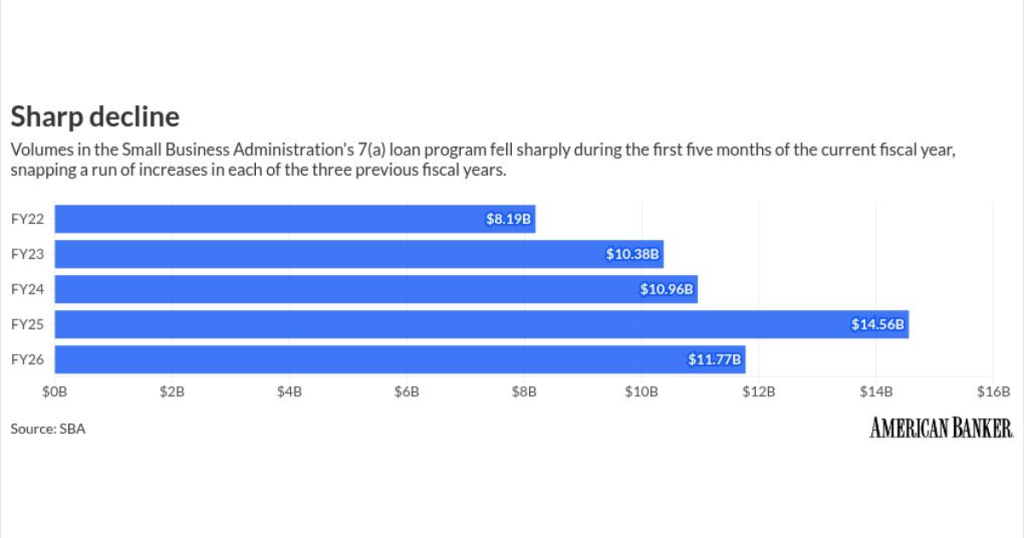
- Supporting data: Lending in the agency’s flagship 7(a) loan guarantee program declined by 18% in the first five months of the 2026 fiscal year.
- Expert quote: “What I think it could do is add more volume for alternative small-business lenders.” — Adam Benowitz, CEO of VOX Funding
New Trump administration rules that prevent non-U.S, citizens from accessing Small Business Administration loans will likely lead more borrowers to seek capital from nonbank lenders, according to industry experts.
Processing Content
Under the
“What I think it could do is add more volume for alternative small-business lenders,” Adam Benowitz, CEO of VOX Funding in New York, told American Banker. “When entrepreneurs need capital, they need capital. You need to be there to solve it for them.”
Similarly, Ben Johnston, chief operating officer of New York-based small-business lender Kapitus, said his company’s non-SBA options are likely to see more interest in the wake of the SBA’s eligibility revisions.
The SBA’s programs offer lower rates and longer borrowing terms than most loans, making them especially attractive to early-stage entrepreneurs, Johnston noted.
“It’s very hard to replicate that financing through other products,” he told American Banker.
In fiscal 2025, which ran from October 2024 through September 2025, the SBA’s 7(a) and 504 loan programs provided more than $45 billion in capital to eligible small-business borrowers.
The Trump administration began adjusting the eligibility criteria last year. A rule change implemented in March 2025 curbed access to businesses with foreign ownership, but still allowed participation by lawful permanent residents. The new version, unveiled last month, extended the prohibition to Green Card holders.
The more restrictive trend appears to have already impacted lending activity. In the first five months of the current fiscal year, which began Oct. 1, 2025, the SBA’s flagship 7(a) program reported loan volume totaling $11.78 billion, an 18% drop from the same period in the previous fiscal year.
Benowitz said it’s no surprise that the eligibility changes are having an impact in the small-business marketplace, since an estimated 5%-15% of the SBA’s lending volume has historically gone to immigrant owners, according to one recent
“Immigrants are natural entrepreneurs,” Benowitz said in an interview Monday. “It’s hard to tell what the effect [of the new rules] will be since they went into effect yesterday, but it’s certainly going to be profound.”
SBA spokesperson Maggie Clemmons said in a statement that the Trump administration is “committed to driving economic growth and job creation for American citizens.”
“Across every program, the SBA is ensuring that every taxpayer dollar entrusted to this agency goes to support U.S. job creators and innovators,” Clemmons added.
But Democratic lawmakers have blasted the new rules. Indeed, a group of House and Senate Democrats, including New York Rep. Nydia Velazquez, the ranking minority member on the House Small Business Committee, and Massachusetts Sen. Edward Markey, ranking member on the Senate Small Business and Entrepreneurship Committee, predicted last week that the restrictions will increase compliance burdens for lenders while limiting job-creation efforts.
“Instead of denying more American small businesses access to necessary affordable capital, we should be working together to strengthen the SBA’s capital access programs and increase financing opportunities for more small businesses in order to improve our local communities and national economy,” the Democratic lawmakers wrote in a letter to SBA Administrator Kelly Loeffler.
Nimi Natan, president and CEO of the SBA lending subsidiary of the $3.6 billion-asset Gulf Coast Bank and Trust Co. in New Orleans, said his team has had to walk away from a handful of deals due to the SBA’s new eligibility requirements.
Many SBA lenders are focused on serving larger, more-established businesses, Natan said. At that level, most of the foreign-born business owners have resolved their citizenship issues.
Lending to early-stage entrepreneurs, including lawful permanent residents, is more risky. “SBA is an imperfect program for that,” Natan said.