
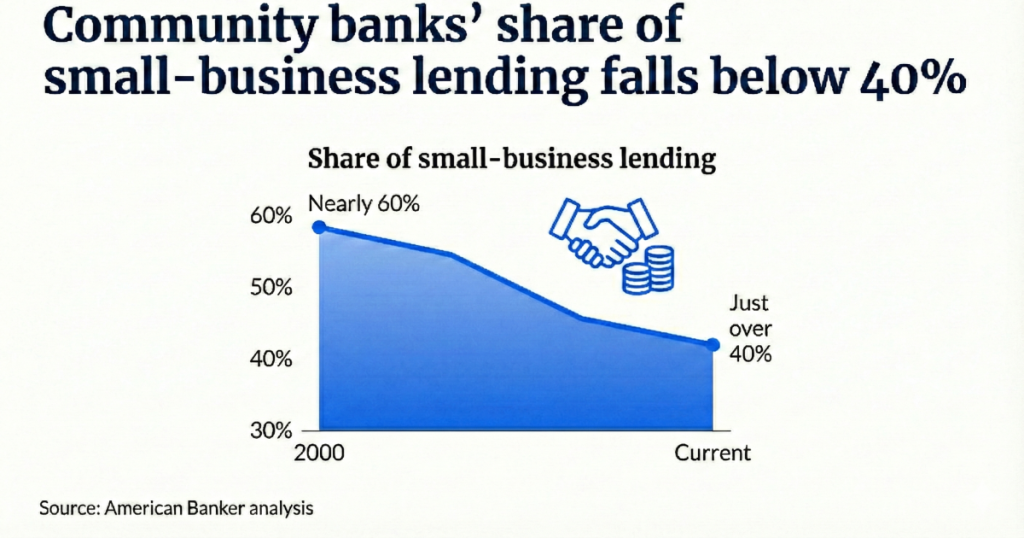
Visualization created with AI assistance based on original reporting.
Processing Content
- Key insight: Stablecoins present opportunities for community banks to explore new forms of capital formation while strengthening their own exposure to risk.
- Supporting data: The share of small-business lending handled by community banks has dropped from almost 60% at the turn of the century to just over 40%.
-
What’s at stake: It’s important that community banks stay relevant, given their role in servicing the small businesses that account for 40% of U.S. GDP, 39% of private employment, 97% of U.S. importers and 33% of import value.
One of the main
While the logic may seem simple, banking isn’t, and the conclusion rests on erroneous assumptions about how funds flow into and around the U.S. economy. But here I’m not going to dwell on how recent history has shown that most deposits are not sensitive to interest rates (existing yield-bearing alternatives have not made much of a dent), nor on how aggregate deposits wouldn’t change and could even increase should stablecoins end up attracting significant inflows. Rather, I want to focus on the opportunity stablecoins present for community banks.
That’s not to say strong inflows into stablecoins pose no threats at all. They wouldn’t reduce overall deposit levels, but they would lead to a reallocation toward large banks as the sellers of Treasuries and other reserve assets tend to use national institutions.
This does not need to imply that community banks lose relevance, however. Indeed, it’s important that they don’t, given their role in servicing the small businesses that
Yet to maintain their relevance, community banks need to rethink their approach to their core business, whatever happens with stablecoin regulation, as competition from other corners of finance has been building. With
Stablecoins, rather than a threat, are an ally in this necessary evolution. Rather than fighting the technology’s flexibility and appeal, community banks could harness it to deepen their competitive moat: specifically, their relationship to the savers and small businesses in their communities.
First, community banks can offer stablecoin custody, combining wallets conveniently embedded in banking apps with the lure of rewards for balances or activity, funded by distribution fees paid by the stablecoin issuers out of the interest they earn on the backing reserves. With stablecoins held in-app, community banks can earn payment fees while offering local importers and exporters a better experience with cross-border transactions. And as more merchants onboard direct stablecoin acceptance via existing banking relationships, some fees could be competed away from the large card issuers.
Second, looking ahead, stablecoins can support a new type of funding: token issuance. True, fiat dollars can settle any type of asset transaction, regardless of the underlying rails; but stablecoins enable banks and businesses to plug into blockchain connectivity, powering faster settlement and more complex automation while harnessing enhanced transparency to meet compliance requirements.
Tokenization is still young and heavily weighted toward on-chain representations of existing assets such as equities, bonds and real estate. But we are seeing signs of progress in native blockchain issuance, such as
After all, their competitive moat has long been based on a familiarity with local businesses. This moat is being eroded by cheaper services, but can be recovered via a new type of funding relationship, one that could also open up new business lines for banks and their customers. For instance, tokenized cross-border invoices swapped for stablecoins that can then be used to efficiently settle the trade, with smart contracts handling the timing and execution; data center financing via yield-bearing tokens that can be used as collateral for a separate loan; tradeable membership tokens issued by a local event venue that trigger discounts and grant privileged access; on-chain equity interests in local restaurants, bowling alleys and hardware stores that accrue loyalty points for activity.
By helping customers to test token issuance with the support of a trusted name, small banks could tiptoe into the investment banking activity typically concentrated in the large banks. And in the process, they could reduce their exposure to
In sum, once new rules are developed to lower the barriers of uncertainty and cost of tokenization, community banks will be able to broaden their offering for businesses looking to raise capital, more effectively competing against fintechs and large banks while reinforcing their resilience.
As for the considerable development costs, we’ve seen
A key connector of a distributed on-chain landscape? Stablecoins.
Community banks know their communities. They also know that their communities’ priorities are changing, that global finance is undergoing a transformation, and that demographics are impacting expectations: As younger clients create or take over businesses, digital adaptation increasingly becomes an essential pillar of growth.
In developing and offering stablecoin and tokenization services, community banks can strengthen their exposure to risk as well as their core relationship with customers, while future-proofing digital services for a younger generation of businesses.
What’s more, rather than clinging to the futile hope that the current structure of banking will hold, they would be wading into the bracing efficiency of competition, a defining feature of American business and one that decides who sits at the table around which the format of tomorrow’s financial system is decided.