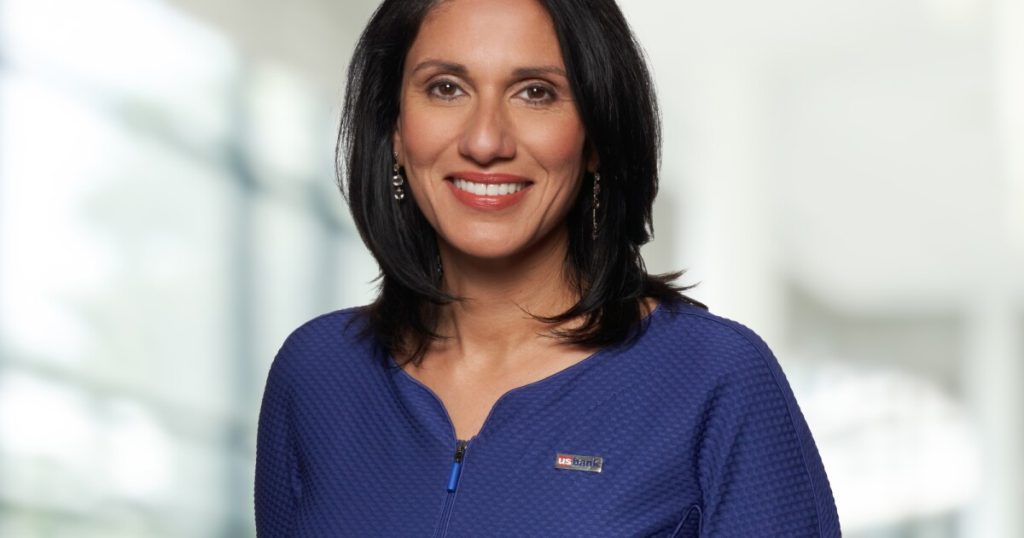
- Looking ahead: Chief Financial Officer John Stern says acquiring the BTIG investment bank should boost revenue by as much as $200 million a quarter.
- Key insight: Growth in the consumer deposit portfolio allowed U.S. Bancorp to reduce reliance on more costly time deposits.
- Expert quote: “We are very committed to meaningful positive operating leverage:” CEO Gunjan Kedia
U.S. Bancorp’s quarterly revenue hit a record $7.4 billion for the three months ending Dec. 31, with the result traceable in large part to success executing on banking fundamentals, controlling expenses, maintaining a clean loan portfolio and gathering plenty of low-cost core deposits.
Processing Content
Reporting Tuesday, U.S. Bancorp, the holding company for Minneapolis-based U.S. Bank, said its fourth-quarter net income totaled $2.05 billion, up 23% from the same period in 2024.
“We feel like it was a really strong quarter,” Chief Financial Officer John Stern told American Banker in an interview.
U.S. Bancorp continued to report solid numbers from its Bank Smartly consumer banking suite, especially the savings option the company added to the Smartly bundle late in 2024. “At the beginning of 2025 [Smartly savings deposits totaled] $10 billion; now it’s $38 billion,” Stern said.
Smartly-linked deposit growth helped push the $692.3 billion-asset U.S. Bancorp’s average consumer deposits to $270 billion on Dec. 31, up more than 2.5% year-over-year. The program is also attracting an affluent, younger client set.
“We find these clients to be stickier,” Stern said on a conference call with analysts held prior to the interview. “Overall, over long periods of time, it’s going to be very helpful from a funding cost perspective.”
Those funding benefits were evident in the fourth-quarter results. U.S. Bancorp was able to scale back reliance on more costly time deposits, which declined to $50.5 billion, down 11% from the fourth quarter of 2024.
U.S. Bancorp reported total deposits of $522.2 billion on Dec. 31, up about 1% from a year ago. Loans of $391.3 billion were up 3% year-over-year driven by commercial loans, which jumped 10% to $154 billion at year-end.
Cost control proved another bright spot for U.S. Bancorp. Quarterly noninterest expenses of $4.2 billion ran about 2% lower than in the final three months of 2024. The decline resulted in significant positive operating leverage — which occurs when revenue growth outstrips increases in operating costs — a trend the company expects to see carry over into 2026.
“Our expense initiatives continue to generate sustainable productivity in our operations and will remain foundational disciplines going forward,” CEO Gunjan Kedia said on the conference call.
“We are very committed to meaningful positive operating leverage,” Kedia added.
U.S. Bancorp delivered its fourth-quarter report eight days after agreeing to acquire San Francisco-based investment bank BTIG in a deal valued at up to $1 billion. The transaction, which is slated to close midyear, should boost revenue by $175 million to $200 million per quarter going forward, Stern said.
Analysts were generally positive about U.S. Bancorp’s fourth-quarter report, with Citi analyst Keith Horowitz describing it as a “strong print” in a research note Tuesday. RBC Capital Markets’ Gerard Cassidy cited “solid fourth quarter results driven by higher net interest income, higher-than-expected noninterest income, and lower-than-expected noninterest expense,” in his research note.
Similar to the Buffalo, New York-based M&T Financial, which reported its fourth-quarter earnings Friday, U.S. Bancorp posted solid credit-quality metrics, including year-over-year declines in net chargeoffs and nonperforming assets At $527 million, net charge-offs were down $35 million from the Dec. 31, 2024 level. Nonperforming assets of $1.59 billion were down $240 million.
Kedia, for her part, said she is entering 2026 in an optimistic frame of mind. “I would say the economic backdrop feels like tailwinds rather than headwinds going into the year,” she said on the conference call. U.S. Bancorp is projecting 4% to 6% revenue growth in 2026.
In line with her remarks after U.S. Bancorp reported its third quarter earnings, Kedia reiterated the company’s bias for organic growth despite the quickening pace of bank merger-and-acquisition activity.
“We are very focused on our organic growth opportunities and seeing a lot of momentum there,” Kedia said.