
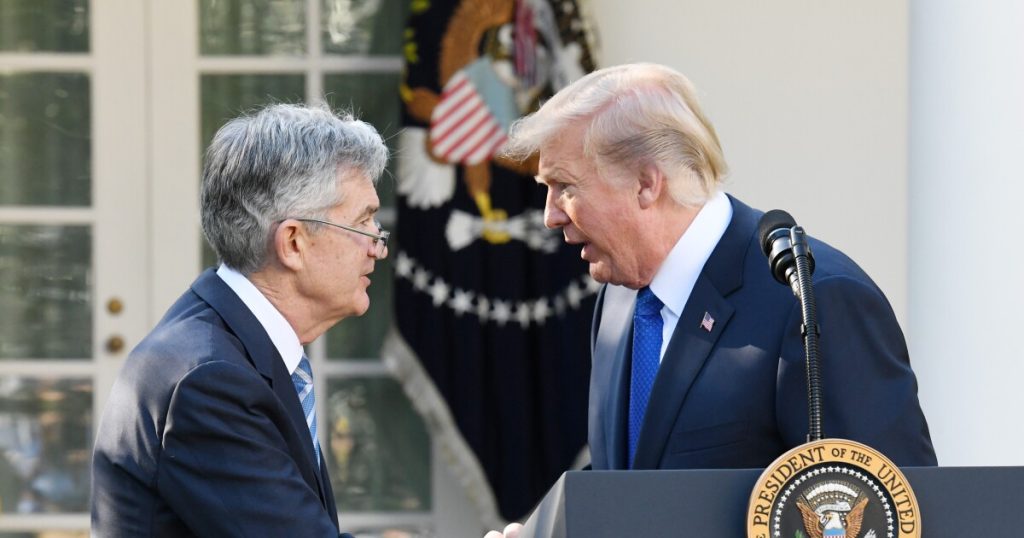
- Key Insight: One of the most consequential developments will be President Donald Trump’s choice to replace Fed Gov. Stephen Miran, because whomever Trump selects is likely to also serve as the next Fed chairman after Fed Chair Jerome Powell’s term expires in May.
- Expert Quote: “If the FOMC is no longer acting purely neutrally with the data in hand, then it becomes more difficult and potentially more costly for U.S. borrowers to access credit and potentially for lenders to price that risk correctly.” — Derek Tang, CEO of Monetary Policy Analytics.
- What’s at stake: Throughout 2025, the Trump administration has sought to exert influence over the Federal Reserve’s monetary policy, and that pressure is unlikely to subside in 2026.
Federal Reserve watchers expect a number of major developments could test the central bank’s independence in 2026, and those developments will shape how it functions for years to come.
Two events early in the year will likely set the stage for the Fed. The first is President Donald Trump’s expected announcement of
Processing Content
The uncertainty around agency leadership and independence has resulted in a similarly murky near-term trajectory for monetary policy, as
Since taking office for a second term, Trump has pulled numerous levers in an attempt to exert more influence over the central bank. Those efforts have included
Whatever happens next year, Alex Pollock, senior fellow at the Mises Institute, is certain that there will be “plenty to write about.”
Who will run the Fed?
One of the biggest unanswered questions hanging over the Federal Reserve is who will lead the central bank when Powell’s term expires in May 2026. President Donald Trump said in early December that he plans to announce his pick sometime in January, though Pollock said the president may not be in a hurry to make an announcement.
“I think the President is enjoying having everybody so interested in this,” he said.
Several names have been circulating as possible replacements for Powell, among them
Hassett currently serves as director of the National Economic Council, advising Trump on domestic and global economic policy. He previously chaired the White House Council of Economic Advisers from 2017 to 2019. Hassett has also served as chief economic advisor to Sen. John McCain during the 2000 Republican primaries and advised the presidential campaigns of George W. Bush in 2004, McCain in 2008 and Mitt Romney in 2012.
Waller has been a member of the Fed board since 2019, nominated to the post by President Trump in his first term. He has recently advocated for
Whoever is chosen to lead the Fed will face pressure from the Trump administration to move quickly toward a lower interest rate environment.
Derek Tang, CEO of Monetary Policy Analytics, said the degree to which the Fed chair is politically aligned could have consequences for the central bank’s independence.
“If the FOMC is no longer acting purely neutrally with the data in hand, then it becomes more difficult and potentially more costly for U.S. borrowers to access credit and potentially for lenders to price that risk correctly,” said Tang in a written statement.
Powell’s term as chair ends May 25, 2026, though his term as a Fed governor runs through Jan. 31, 2028. It remains unclear whether he will stay on the Fed’s board after stepping down as chair.
Lisa Cook litigation
The Supreme Court is expected to take up the case in January to decide whether Fed Gov. Lisa Cook can remain on the board while lower courts consider whether Trump has the authority to remove her from the central bank for cause.
A ruling from the high court, expected in early 2026, could have significant implications for the Fed. If the justices determine that Cook must step aside while the case proceeds, the decision would open a vacancy on the Board of Governors that the Trump administration could fill.
If the court allows Cook to remain in her post, she would continue to serve and vote on the board while her legal challenge plays out.
Once the injunction is resolved, the underlying legal case, challenging Trump’s attempt to fire
Stakeholders say the outcome of Cook’s litigation could have significant implications for the Federal Reserve’s independence from political intervention.
“The executive power of the United States is vested in me as President, and as President, I have a solemn duty to ensure that the laws of the United States are faithfully executed,” Trump wrote. “I determined that faithfully executing the law requires your immediate removal from office.”
Monetary policy uncertainty
The new year will begin with a rate-setting committee divided over the appropriate path for monetary policy.
Despite three consecutive 25-basis-point rate cuts in September, October and December, differences among policymakers have begun to surface as officials voice competing concerns.
Some FOMC members have argued that the Fed should refocus on bringing inflation down to its 2% target. Inflation is currently running near 2.7%, according to the
That view has clashed with concerns from other officials who point to strains in the labor market, as the unemployment rate has ticked higher and hiring has cooled. Nonfarm payrolls increased by
Waller has said there is no urgency to sharply reduce interest rates but has argued the Fed should gradually move policy toward a neutral stance to support the labor market.
“I still think we’re maybe 50 to 100 basis points off of neutral,” he said. “We still got some room. We could bring things down again.”
Fed watchers expect divisions within the FOMC to deepen in 2026 as both sides of the Fed’s mandate remain under pressure.
Whether or not that actually presents issues in how the Fed-rate setting committee operates remains to be seen. For now, the disagreements among officials have been “thoughtful and respectful,” Powell said
“Everyone around the table at the FOMC agrees that inflation is too high and we want it to come down, and agrees that the labor market has softened and that there’s further risk,” Powell said. “Where the difference is how you weigh those risks.”
Beyond uncertainty over monetary policy, some stakeholders believe the Fed could again expand its balance sheet with mortgage-backed securities as a way to support the housing market.
“The housing market is still very slow,” Pollock said. “I think politicians will think that in order to help the housing market, the Fed could start buying mortgages again. I hope they won’t do it, but I think it’s highly likely that they will experience this pressure.”