
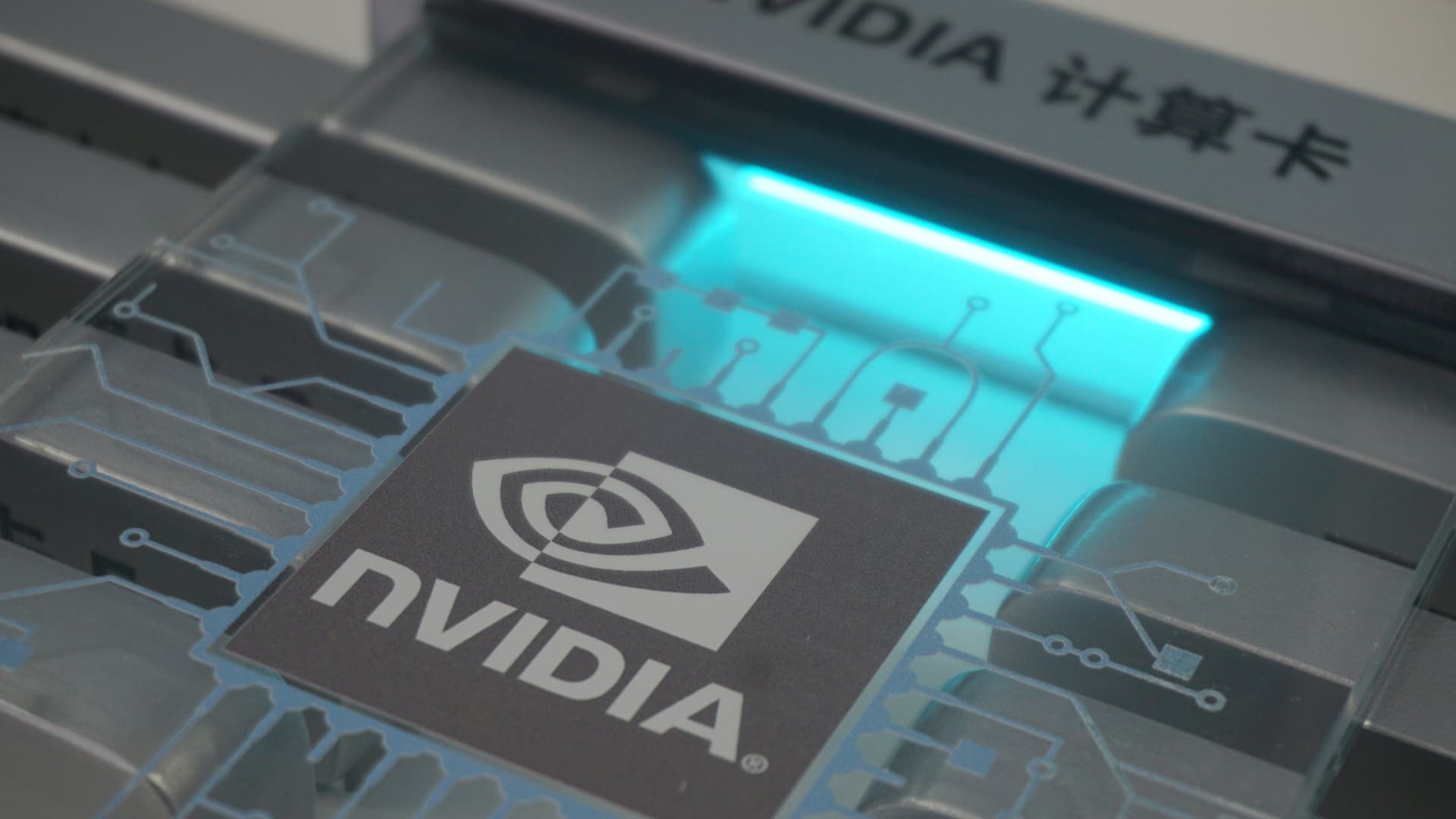
NVIDIA AI Computing Card captured in Hangzhou, Zhejiang Province, China on Dec. 9, 2025.
Cfoto | Future Publishing | Getty Images
BEIJING — U.S. President Donald Trump’s move to allow Nvidia to ship a more advanced artificial intelligence chip to China will significantly boost Beijing’s tech capabilities, according to analysts.
That signals a shift in policy as the U.S., over the past several years, has ramped up restrictions on Chinese access to advanced semiconductors. Though the curbs have not kept Chinese companies such as DeepSeek from finding ways to build AI models that rival their U.S. peers, often at lower operating costs.
“Compute is our main advantage,” Rush Doshi, assistant professor at Georgetown University, said on social media platform X, noting that China already has an edge over the U.S. in electrical power, engineers and other areas.
“By giving this up we increase the odds the world runs on Chinese AI,” said Doshi, who was a deputy senior director for China and Taiwan affairs with the National Security Council under the Biden administration.
Trump’s on Monday said in a post on his Truth Social platform that Nvidia can ship a more advanced chip called the H200 to “approved customers in China” and other countries — on condition the U.S. gets a 25% cut. That’s up from the 15% rate agreed to in the summer.
He noted that Nvidia’s more advanced Blackwell and Rubin chips were not part of the China deal.
“The Biden administration forced our Great Companies to spend BILLIONS OF DOLLARS building “degraded” products that nobody wanted, a terrible idea that slowed innovation, and hurt the American Worker,” Trump said.
Nvidia had created a less powerful chip called the H20 to comply with U.S. rules, but had to halt shipments to China in April.
“This move is giving China a bunch of advanced AI compute it wouldn’t otherwise have,” said Tim Fist, director of emerging technology at Washington, D.C.-based think tank Institute for Progress.
“The new Chinese stack will be NVIDIA chips, Tencent/Baidu/Alibaba cloud, and DeepSeek/Qwen/Kimi models,” Fist said in a social media post on X, noting that these AI capabilities will then compete with U.S. rivals overseas.
The think tank on Sunday published a report that said the U.S. advantage over China in AI compute next year diminishes from around 10 times to at most 5 times, if Nvidia were allowed to export H200 chips.
The H200 can help many Chinese AI developers improve their models, making the chip “far more useful and effective” than the H20, said George Chen, partner and co-chair, digital practice, The Asia Group.
He pointed out that Trump’s decision is a sign of improving Washington-Beijing relations as the U.S. leader plans to visit China in April. Nvidia “has a good time window to sell H200 but it won’t be … forever.”
China aims for tech self-reliance
Faced with U.S. restrictions, China has sought to reduce its reliance on foreign technology. The country’s upcoming 5-year plan that kicks off next year underscored how policies and government funds will increasingly go toward homegrown chips and AI applications.
Chinese telecom giant Huawei in September revealed its multi-year plans to create chips that would have the most computing power in the world when clustered at scale, according to the company.
“China will continue to do everything in its power to reduce its dependency on US AI chips, even while it retains access to US chips,” Chris McGuire, a senior fellow for China and emerging technologies at the Council on Foreign Relations, said on X. He pointed out that it will still take time as China doesn’t plan to make a chip better than Nvidia’s H200 until at least the fourth quarter of 2027.
Trump’s decision “negates the biggest U.S. advantage over China in AI,” McGuire said, calling the move “a seachange in U.S. policy, and a significant strategic mistake.”
The White House Office of Science and Technology Policy did not immediately respond to a CNBC request for comment.

Subscribe now
Nvidia CEO Jensen Huang has often spoken in public about China’s improving AI capabilities, and called on the U.S. to let the company sell its products to the country.
U.S. restrictions so far have not kept China completely shut off from advanced chips.
Separately, the U.S. Department of Justice on Monday announced it had seized more than $50 million in advanced graphics processing units meant for China and other restricted areas. The release said people apprehended and others “exported and attempted to export” at least $160 million worth of Nvidia H100 and H200 chips between Oct. 2024 and May 2025.
Nvidia shares rose 2% in after-hours following Trump’s post. Chinese AI chip names Moore Threads climbed more than 2% and Cambricon rose by over 1% in the mainland market, while SMIC shares fell more than 2% in Hong Kong trading.