
- Key insight: Upstart is pivoting to secured loans like auto and home equity lines, a move analysts say will compress profit margins in the near term.
- Supporting data: Upstart reported net income of $18.6 million for the fourth quarter, swinging from a loss in the same period a year prior.
- Forward look: Incoming CEO Paul Gu said he is prioritizing market share in massive secured lending markets over immediate margin maximization.
Overview bullets generated by AI with editorial review
Processing Content
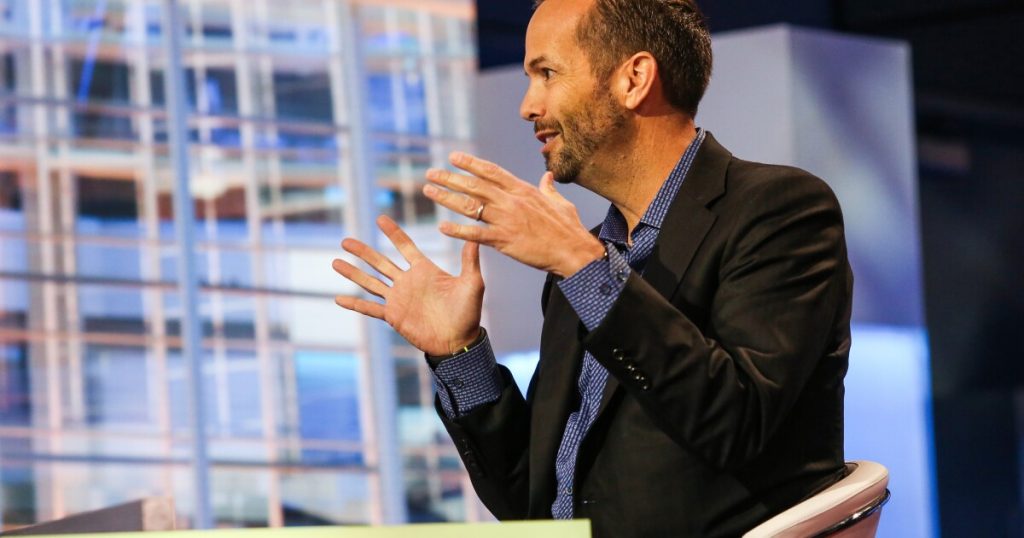
Upstart will see a major leadership transition this spring as co-founder and CEO Dave Girouard steps down to make way for co-founder and current chief technology officer Paul Gu.
The San Mateo, California-based fintech reported the transition on Tuesday alongside its fourth-quarter results that beat analyst estimates and introduced a bullish three-year revenue outlook, but its share price fell approximately 15% following the after-hours earnings release.
Analysts attributed the market reaction to guidance suggesting that the company’s shift toward secured loans — auto and home equity lines of credit, or HELOCs, in particular — will compress profit margins in the near term.
The leadership shuffle marks an important transition for the company as it seeks to scale beyond its core personal loan product. Girouard will become executive chairman on May 1, when Gu assumes the CEO post.
Additionally, chief financial officer Sanjay Datta will become president and chief capital officer, with Andrea Blankmeyer joining from Cityblock Health to take over as CFO.
Financial performance and guidance
Upstart reported net income of $18.6 million for the fourth quarter of 2025, a turnaround from a $2.8 million loss in the same period a year prior.
Revenue for the quarter reached $296 million, up 35% year over year, and beating the $288 million consensus estimate of 12 analysts surveyed by S&P Global Capital.
For the full year 2025, Upstart reported total revenue of $1 billion, a 64% increase from 2024, and reestablished profitability with a net income of $53.6 million.
The company issued full-year 2026 guidance of $1.4 billion in revenue, and compound annual growth rate of 35% through 2028.
However, for 2026, the company forecasted an adjusted EBITDA (earnings before interest, taxes, depreciation and amortization) margin of 21%, which is lower than analyst expectations. That margin implies $294 million in EBITDA — lower than the consensus median expectation prior to Tuesday of $312 million.
Analysts react to margin compression
Analysts said that, while Upstart’s volume is growing, its pivot toward secured lending is weighing on margins.
“The FY26 guide suggests upside to funded loans and revs, but a contraction in margins,” wrote John Hecht, an analyst at Jefferies, in a Tuesday note.
Hecht noted that the company’s focus on secured products and higher-quality borrowers typically results in lower “take rates” — the fees Upstart collects per loan — which impacts contribution margins.
David Scharf, an analyst at Citizens Bank’s investment research division, maintained a “Market Perform” rating, suggesting the current valuation already accounts for the turnaround.
“We believe that much of the margin variance results from lower contribution margins per loan as the company’s mix of prime receivables, along with larger balance auto loans and HELOCs, carry lower take rates,” Scharf wrote in a Wednesday report.
Despite the margin concerns, some analysts highlighted the company’s operational momentum. Peter Christiansen, an analyst at Citi, pointed to data released by the company showing January 2026 origination volumes tracking up 64% year over year.
“We came away positive on improving momentum,” Christiansen wrote in a Wednesday report, noting that Upstart also reduced its balance sheet exposure by approximately $250 million, primarily by offloading research and development loans.
A transition of generations
On the earnings call, Girouard said the leadership changes were part of a long-standing succession plan. He highlighted his age gap with Gu.
“Why now? Well, in a few weeks, as hard as it is for me to believe, I’ll celebrate my 60th birthday,” Girouard said during the earnings call Tuesday.
“When we co-founded the company, Paul was barely old enough to drink — and I was older than his parents,” Girouard said separately, in a press release about the announcement.
He added that the succession plan has been under discussion for five years and that this milestone was the right time frame for Paul to step in.
“I can’t imagine a succession plan more thoroughly considered or executed with any finer level of detail than what we’ve done at Upstart in the last few years to prepare Paul and the company for this day,” Girouard told analysts Tuesday.
Gu, who has led the company’s product, engineering and machine learning functions, emphasized that the company’s strategy would be to prioritize market share in massive secured lending markets over immediate margin maximization.
“We have grown rapidly in secured products and prime borrowers, segments which come with lower take rates but dramatically larger market sizes,” Gu said during the call.
He added that the company is increasingly weighing the “long-term value of acquiring a customer and the reputation value of saving them more money than anyone else.”
Funding and balance sheet
For bankers watching Upstart’s relationship with capital markets, the company reported progress in diversifying its funding. Upstart reduced the loans held on its balance sheet by 20% sequentially in the fourth quarter.
Management noted that 70% of funding for its newer auto and home loan products in the fourth quarter came from third-party partners. This includes 11 different partners signed for the coming year, which analysts view as a critical step in reducing the company’s balance sheet risk.
“We are encouraged to see the reduction in balance sheet exposure, but management is not prepared to commit to any long-term target for retained assets,” Scharf wrote.
Addressing potential competitive threats from generative AI, Gu dismissed the idea that general-purpose large language models pose a risk to Upstart’s specialized underwriting models.
“Humans have never really been very good at precisely underwriting loans,” Gu said during the earnings call. “It’s not something that you can just do because you have a language model that replicates human behavior.”