
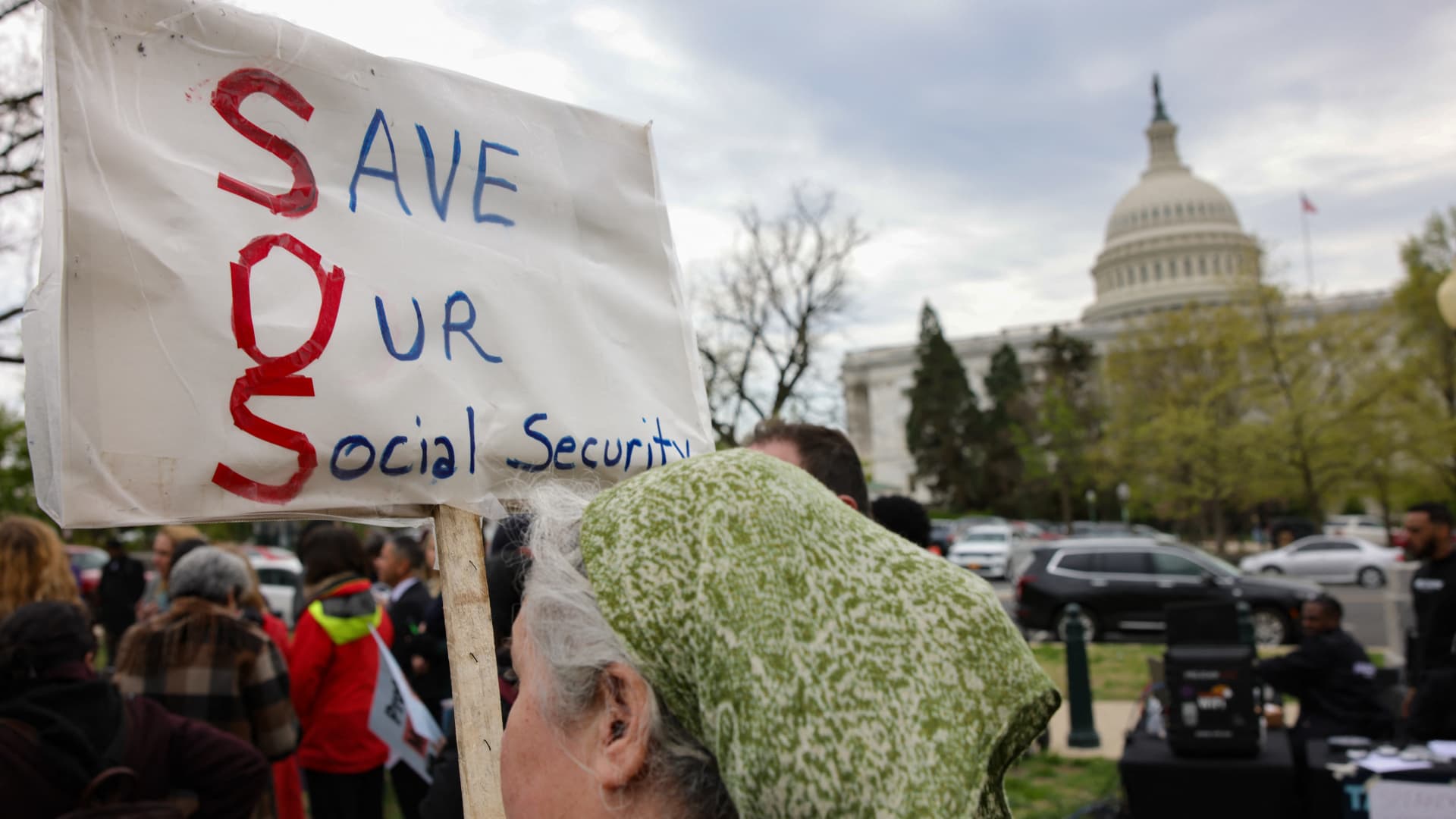
A person holds a sign reading “Save Our Social Security” during a rally against President Donald Trump’s tax plan, near the U.S. Capitol in Washington, D.C. on April 10, 2025.
Bryan Dozier | Afp | Getty Images
The clock is ticking to fix Social Security to ensure it continues to pay full benefits to millions of Americans who rely on monthly payments from the program.
By 2032, the trust fund Social Security draws from to help pay benefits to retirees, their spouses, children and survivors of deceased workers will be exhausted, according to the Social Security Administration.
When that date arrives, there could be a 24% benefit cut for all beneficiaries if Congress does not act sooner to address the program’s shortfall, based on current projections.
Because Social Security is a pay-as-you-go program, with money continually coming in from payroll taxes, benefits would still be paid if the calendar reaches that date without any action by Congress to address the program’s solvency.
Experts generally say there could be an across-the-board benefit cut at that time.
With just six years left on the calendar, it is an “unfortunate but now likely contingency” that Congress may not address the situation in time, Mark Warshawsky, senior fellow at the American Enterprise Institute, a conservative-leaning Washington, D.C., think tank, wrote in recent research.
Lawmakers may wait until the last minute — either right up to the time or after the trust funds are due to be exhausted — based on their reactions to recent federal government shutdowns, Warshawsky said.
However, an “alternative contingency policy” could make it so not everyone suffers a benefit cut at that time, according to Warshawsky, who previously served as deputy commissioner for retirement and disability policy at the Social Security Administration.
What may happen when trust funds run out
When 2032 comes — and if there have been no changes to curb Social Security’s funding shortfall — Congress may be able to buy some time, Warshawsky said.
One option: The retirement and disability trust funds could be combined, which would push the depletion date to 2034. At that time, 81% of scheduled benefits would be payable, according to Warshawsky’s research.
Instead of an across-the-board reduction for all beneficiaries, policymakers may instead opt to choose who absorbs those temporary reductions, Warshawsky said. His “alternative contingency policy” is inspired by Australia’s approach to part of its asset means test for its age pension program.
The cuts would focus on those ages 62 to 74 who receive either retirement or widow(er) benefits, based on the idea that younger retirees could more easily adapt or perhaps reenter the labor force to make up for the lost income, according to Warshawsky’s proposal. Disability beneficiaries would be exempt.
Additionally, the benefit changes would focus on certain net worth thresholds. Those with a net worth of less than $470,400 in 2025 dollars would be excluded from cuts. Partial benefit cuts would apply to individuals with a net worth below $785,400 at the median benefit, according to Warshawsky’s plan.
Beneficiaries with a significant net worth may be able to tolerate cuts, at least on a temporary basis, under his proposed contingency policy, Warshawsky told CNBC. Meanwhile, much older individuals would be spared from the benefit cuts.
“In the interim, that seems to me that this is a fair way of allocating the reduced revenues,” he said.
The enforcement of the proposed plan would depend on accurate government data, which may require the sharing of information between the Social Security Administration and IRS, according to Warshawsky.
Warshawsky’s proposal follows 2024 research from Andrew Biggs, a senior fellow at the American Enterprise Institute, and Kristin Shapiro, partner at BakerHostetler, a law firm. They also wrote that across-the-board benefit cuts are not inevitable if and when Social Security crosses the projected insolvency dates.
Under Biggs’ and Shapiro’s plan, monthly benefits would be capped at $2,050, based on 2024 dollars. Approximately half of beneficiaries would still get their monthly payments as scheduled. The other half, comprised of those with higher incomes, would see progressive benefit reductions.
Those changes would mean that 80% of beneficiaries would see a smaller benefit cut than under the implementation of across-the-board reductions, according to Biggs’ and Shapiro’s analysis. Moreover, the elderly poverty rate would not increase, according to their research.
“Whatever solution they come up with for the 2032 problems can involve a lot of borrowing,” Biggs said in an interview with CNBC.
But if lawmakers decide to borrow money that can’t be paid back, the markets may react negatively, he said.
Anticipated shortfall may affect claiming decisions
Prospective Social Security retirement beneficiaries may already be factoring the program’s uncertain future into their decision on when to claim, surveys have found.
Eligibility for Social Security retirement benefits starts at age 62. Beneficiaries get a permanent benefit reduction for taking it early.
By waiting until full retirement age — age 66 or 67, depending on year of birth — or even later to age 70, beneficiaries may lock in bigger monthly payments.

Nevertheless, a 2025 Schroders survey found 44% of non-retirees plan to file before age 67.
While the most commonly cited reason respondents gave for wanting to claim before age 70 was wanting to access the money as soon as possible, with 37%, fears about Social Security running out of money or stopping payments altogether followed closely, with 36%.
The decision on when to claim Social Security should not be an emotional decision, financial advisors say. A variety of factors — such as health, marital status, income, investments and taxes — should be considered.
“If you aren’t in the best health and you don’t have longevity in your family, it probably makes sense to take it at 62,” said Crystal Cox, a certified financial planner and senior vice president at Wealthspire Advisors in Madison, Wisconsin.
Other reasons may make it make sense to claim early, according to Cox. “Depletion I don’t think is one of them,” she said.
At full retirement age, retirees stand to get 100% of the benefits they’re owed. For each year they delay past retirement age, up to age 70, they can get an 8% increase to their benefits.
By waiting until 70, beneficiaries would see 132% of their monthly benefit, according to the Social Security Administration, based on a full retirement age of 66.
Yet research has found that just around 10% of beneficiaries wait until the highest claiming age.