
President Trump’s plan to restrict institutional investor purchases of single-family homes through bipartisan legislation to promote consumer access to affordable housing does match a past goal pursued by Democrats but has many practical challenges, industry professionals said Thursday.
Processing Content
“Trying to crack this nut of the affordability issues that we have in this country is something the Biden administration was chasing after and
While the two parties’ goals may be the same, their approaches have differed at times.
Some Democratic programs aimed at giving consumers and nonprofits the edge in distressed mortgage sales, like
Broader restrictions on institutional investor home purchases are among many high-level ideas set for exploration at the World Economic Summit in Davos, so it’s likely too early for housing agencies to know how it may affect specific industry programs.
It’s worth noting that foreclosure property sales have been a past target for reform, but the Trump administration may want to pursue a different tack that seems to be broader. Either path has challenges, experts say.
What housing market numbers show
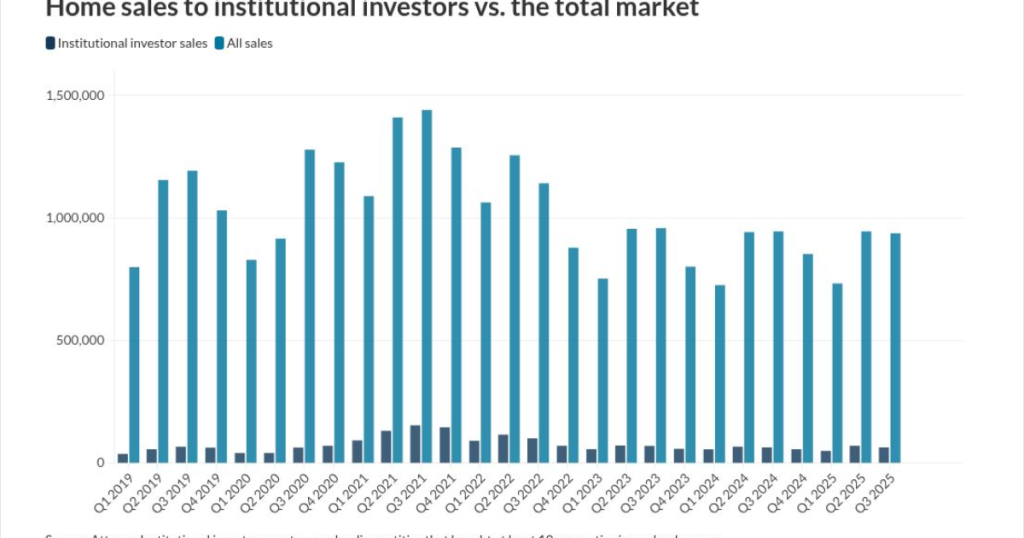
Some single-family housing markets have higher institutional investor shares than others but the overall numbers are low. That means on a national basis, how much restricting involvement could have on home prices and whether it would lower them is in question.
Single-family home purchases by nonlending that bought at least 10 properties as investors in a calendar year bought 63,676 properties in 2025, representing 6.8% of the market, according to Attom. That percentage has run consistently in the single digits.
President Trump has specified a ban would target “large” institutional investors, a definition that would likely reflect an even smaller subset of a housing market
The total number of properties owned by institutional investors who own 1,000 or more properties is around 2% of all investor-owned homes or just 0.4% of all single-family properties, said Rick Sharga, president and CEO of CJ Patrick Company.
“I’m delighted to see the Trump administration trying to find ways to address housing affordability but tiny percentages of homes are actually owned by the largest of those entities,” said Sharga, whose numbers are drawn from analysis he does for BatchaData’s Investor Pulse report.
Around 4% buyers who purchased properties on
All these numbers suggest the institutional investors are likely not having a large effect on the market’s pricing and even if they were, how much upward pressure could be debated given that investors are looking to buy at as low a price as they can to generate a return.
“The idea that ‘Wall Street’ is preventing people from buying homes simply doesn’t match the numbers,” Richard Kruse, managing partner of Gryphon USA Ltd., a specialized real estate auction and receivership firm, said in an email.
Institutional investors’ role in the distressed market
Pursuing a new way to restrict institutional buying in the foreclosure property market could give consumers more access to homes with lower purchase prices but would also require consideration of whether the houses are affordable in terms of any necessary repairs.
“Distressed properties need serious capital to fix them up and bring them back to market. Small investors often can’t access that kind of money,” said Kruse, who called the idea of restricting investors at odds with free-market principals the administration has supported.
Buyers also may have to be equipped to manage certain procedures associated with foreclosures if they buy some of the distressed mortgage properties government-related agencies like the Department of Housing and Urban Development or Fannie Mae sell.
Policymakers may want to pursue policies that focus more on the end goal of getting more lower-cost properties in consumers’ hands than who initially buys the property, possibly through the kind of private-market competition the Trump administration has supported in some policies.
“The local investor linked with community developers, in most cases, is the buyer that can most efficiently renovate the property and turn it back into affordable housing supply,” Blomquist said.