
- Key insight: Banks are adopting tokenized deposits at a greater rate than stablecoins, according to American Banker’s analysis.
- What’s at stake: Both stablecoins and tokenized deposits are bringing banks and fitness into the digital assets.
- Forward look: Banks will need to build networks to support both stablecoins and tokenized deposits.
Even given the
Processing Content
Nineteen of the largest 50 U.S. banks are in some stage of developing a tokenized deposit strategy, compared to 15 for stablecoins, according to an analysis by American Banker. Four banks have a tokenized deposit product, compared to one bank that is issuing a stablecoin. Three are piloting tokenized deposits, with one piloting a stablecoin.
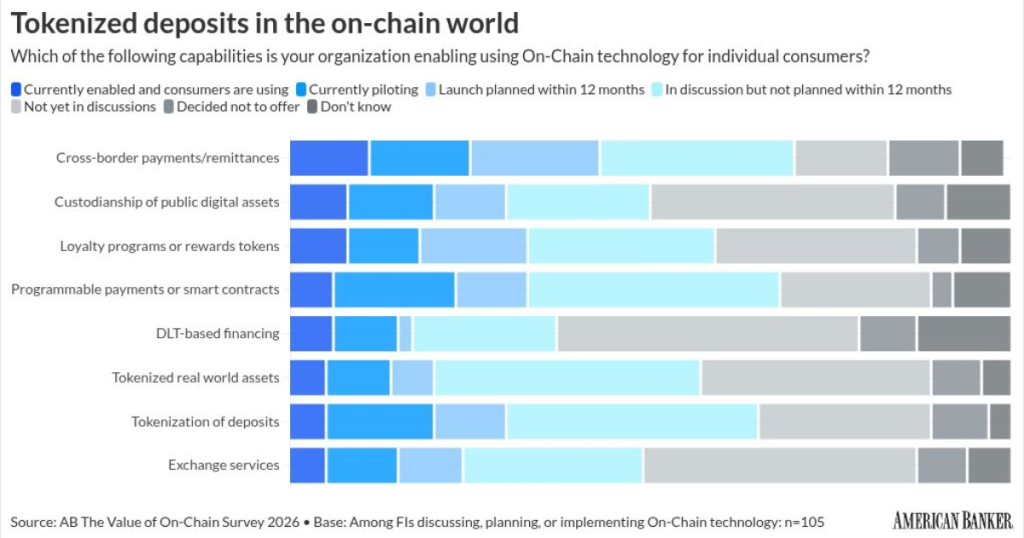
Across a broader set of banks by size, nearly two-thirds of banks are offering or are in some form of developing tokenized deposits for corporate clients, according to research from American Banker as part of its
“The big attraction for deposit tokens is that they offer the flexibility of digital money and real-time, 24/7 settlement, but without requiring any different regulatory treatment,” James Wester, director of cryptocurrency for Javelin Strategy & Research, told American Banker. “They simply represent deposits in a new form on a blockchain. That makes them more attractive to banks.”
Making the appeal
Deposit tokens also operate within the same compliance and regulatory requirements as other bank deposits, Toprak said.
“As such, institutional clients can treat deposit tokens in the same way they would treat a traditional bank deposit as there is no distinction (subject to a client’s auditors) between a deposit token and a bank deposit on their balance sheet,” Toprak said. “It can be interest bearing and is subject to the same protections as traditional bank deposits.”
Elsewhere, the startup Cari is working with a group of design partner banks that are shaping a tokenized deposit and network. “It’s really just a modern version of checking, where tokens replace paper checks as the mechanism for moving deposits,” Eugene Ludwig, a former Clinton cabinet officer who is also
There are “low hundreds” of banks directly in the Cari network pipeline, the startup said. “It’s natural that a bank would embrace digitized deposits,” Ludwig said. “It builds and supports a bank’s deposit base and is built to high bank safety and soundness standards, while giving banks all the modern tools of other digitized payment rails.”
Among other banks,
Outside of the U.S., U.K.-based Monument is tokenizing retail consumer deposits through a public blockchain with the Midnight Foundation. The partnership will bring in about $300 million of interest-bearing deposits in an initial phase, with the deposits redeemable for British pounds and insured by the U.K.’s version of the FDIC.
“Unlike stablecoins, tokenized deposits remain on bank balance sheets and operate under established prudential oversight, modernizing how funds move rather than creating a parallel form of value,” Derek Vernon, head of North American treasury and payment solutions at BMO told American Banker, adding the bank’s focus is on modernizing payments and settlement by bringing the efficiencies of digital assets to traditional bank deposits, while preserving the trust, protections, and accountability of the traditional banking system.
“[Tokenized deposits] are direct obligations of the issuing bank, redeemable at par and fully embedded within BMO’s existing payments infrastructure and regulatory framework,” Vernon said.
How tokenized deposits fit in
Deposit tokens are often grouped with stablecoins, or considered an alternative to stablecoins. While banks are pursuing tokenized deposits at a slightly greater rate than stablecoins, American Banker’s analysis suggests banks are casting a wide net in on-chain finance, with more than a quarter of the 50 largest banks also pursuing distributed ledgers for trade finance and payments, in addition to stablecoins and tokenized deposits.
Tokenized deposits are both a strong “hold” asset due to their profile as yield-bearing commercial bank deposits and “payment” assets (like stablecoins) as they enable peer-to-peer, real-time transactions, Toprak said, adding
“These institutions typically participate actively in both crypto and real-world asset digital transactions, which is why native on-chain deposit-based cash solutions fit well with their needs,” Toprak said.
Banks can use their commercial deposit balances for clearing and settlement at any time, with less reliance on intermediaries and prefunding, and those deposits remain available for lending, according to Wester. “The drawback is that they only have value to institutions or partners willing to use them. Stablecoins are built for open networks and broader interoperability,” Wester said. “Deposit tokens are meant for moving in permissioned ecosystems.”