
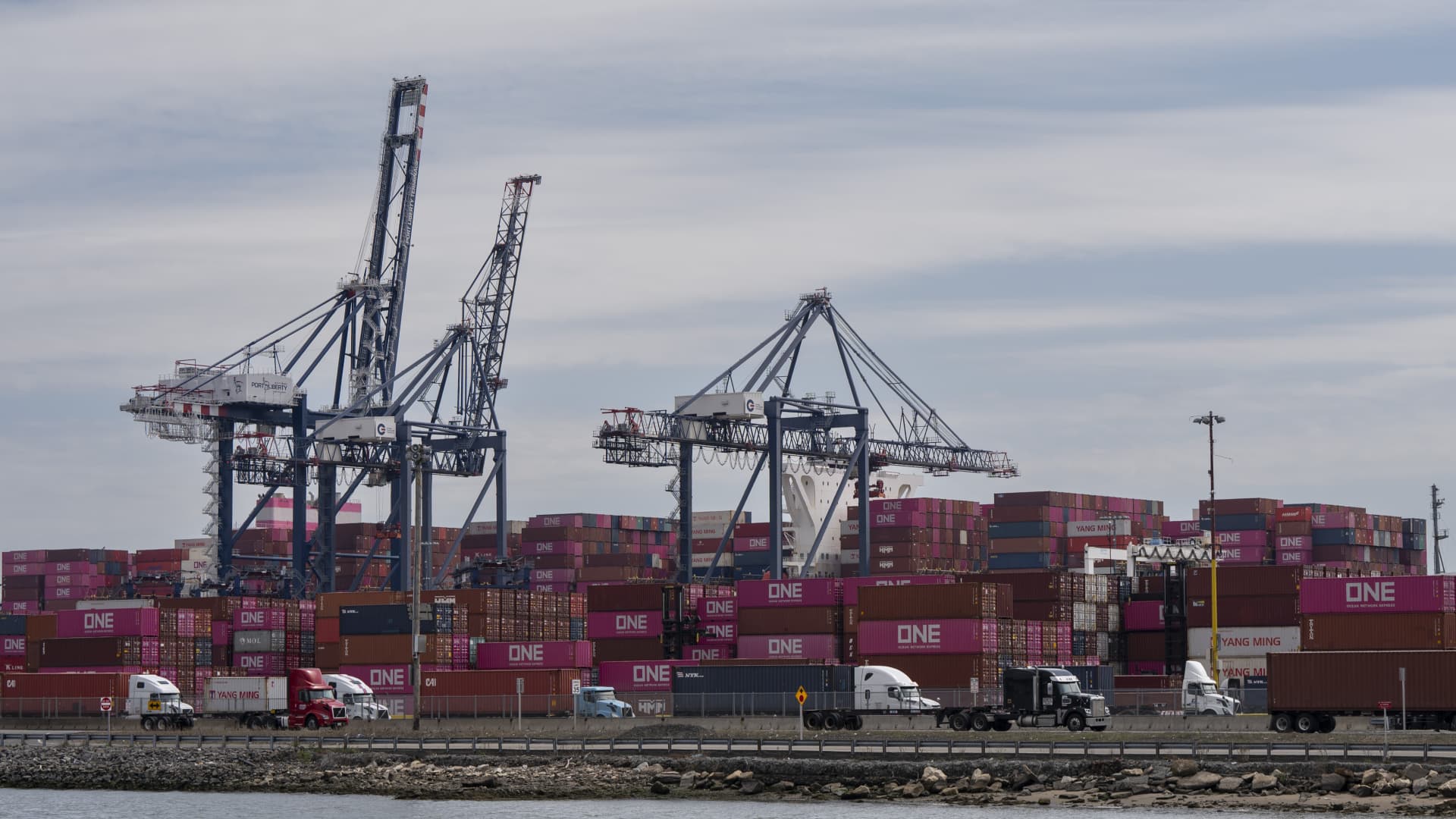
Containers are loaded and unloaded at Port Jersey Container Terminal in New Jersey, on May 1, 2025.
Mostafa Bassim/Anadolu via Getty Images
The Trump administration is scrapping the “de minimis” rule on Friday, a move likely to raise prices for consumers who buy inexpensive goods online and that may trigger near-term shortages for certain items, economists and trade experts said.
“It’s a massive change for the U.S. consumer,” said Rathna Sharad, CEO of FlavorCloud, a cross-border logistics firm.
‘Quite a big price increase’
The de minimis exemption lets U.S. consumers import $800 worth of goods free of tariffs, duties and fees. The rule makes it cheaper for consumers who buy products directly from international sellers.
The volume of these low-value shipments has swelled amid the rise of e-commerce, experts said.
In 2024, the U.S. received about 1.4 billion de minimis shipments, more than double the 637 million in 2020, according to U.S. Customs and Border Protection data.
The average de minimis shipment was about $48 in 2024, according to CBP data.
Most of the shipments come from China, which accounts for about 60% of the volume, Sharad said.
President Donald Trump ended the de minimis exemption for China in May. He’s now doing the same for the rest of the world.
Cheap items bought online and shipped to consumers’ doorsteps will be slapped with duties, whereas they’d previously applied just to packages over $800, Sharad said.
All shipments — including beauty products from Korea, leather shoes from Italy, kitchen knives from Japan — will be subject to additional fees and taxes, such as tariffs that the Trump administration has levied on most U.S. trading partners.
“For the consumer, it can be quite a big price increase,” said Mary Lovely, a senior fellow at the Peterson Institute for International Economics, whose research specializes in trade with China and global supply chains.
‘Pro-poor trade policy’
Amazon delivery person sorting packages to be delivered, Manhattan, New York.
Lindsey Nicholson/UCG/Universal Images Group via Getty Images
The actual price increase for consumers will depend on many factors such as country-specific tariff rates, duties the U.S. places on goods and manufacturing materials, and how businesses adjust pricing, economists said.
Here’s how the end of de minimis would impact some specific consumer goods, according to a FlavorCloud analysis:
- $30 slippers (lightweight, premium cotton) from China would cost about $45, a 51% increase;
- $37 nutritional supplements (plant-based, performance-formulated) from Canada would cost about $60, up 60%;
- A $240 chef’s knife (with wooden handle and white steel) from Japan would cost about $298, up 24%.
Pablo Fajgelbaum, an economics professor at University of California, Los Angeles, and Amit Khandelwal, an economics professor at Yale University, write that de minimis is a “pro-poor trade policy.”
More from Personal Finance:
Wealthy Americans are traveling to Europe to dodge tariffs on luxury goods
Why it may be time to diversify away from the S&P 500
More changes are ahead for student loan repayment plans
An end to the rule would disproportionately hurt low-income and minority households, which derive more of a financial benefit from the duty exemption than richer households, according to research they published in February.
“Most people [using the de minimis exemption] are people who were living on a budget and are concerned about prices,” Lovely said. “I think some people will just buy less.”
It’s not just consumers: Small businesses will also have to adjust to the new regime, Lovely said.
It puts more pressure on them when tariffs are already raising their costs for goods and manufacturing materials like steel and aluminum, she said.
More transparency for imports
The Trump administration argues that scrapping the de minimis rule will limit trafficking of counterfeits, illicit drugs and weapons by bad actors.
The government currently has little insight on de-minimis shipments due to the simplified customs clearance procedures for them, attorneys at law firm Hogan Lovells wrote recently.
Collecting duties on more imports also raises federal tax revenue, economists said.

However, beefing up oversight of these shipments creates a larger administrative burden and requires more manpower to screen packages — all of which come with an extra cost for the federal government, economists said.
It’s unclear whether the additional tax revenue collected by the federal government will outweigh the extra costs, Lovely said. “I don’t think we’ll ever really know.”
A U.S. Customs and Border Protection spokesperson wasn’t immediately able to provide comment for this story.
Meanwhile, postal services in Australia, India, Japan, New Zealand, Switzerland, the UK and other European nations said recently that they’d suspend shipments to the U.S. amid confusion over questions like how customs duties would be collected.
While the trade system will eventually adjust, there may be delays and higher prices in the short term, economists said.
The near-term impact may be “unavailability” of certain items, especially with the end-of-year holidays approaching, said Ernie Tedeschi, director of economics at the Yale University Budget Lab and former chief economist at the White House Council of Economic Advisers during the Biden administration.
“I would not say this will have a large macroeconomic impact on the U.S.,” Tedeschi said. “That said, for certain people it will cause a great deal of headache,” he added.