
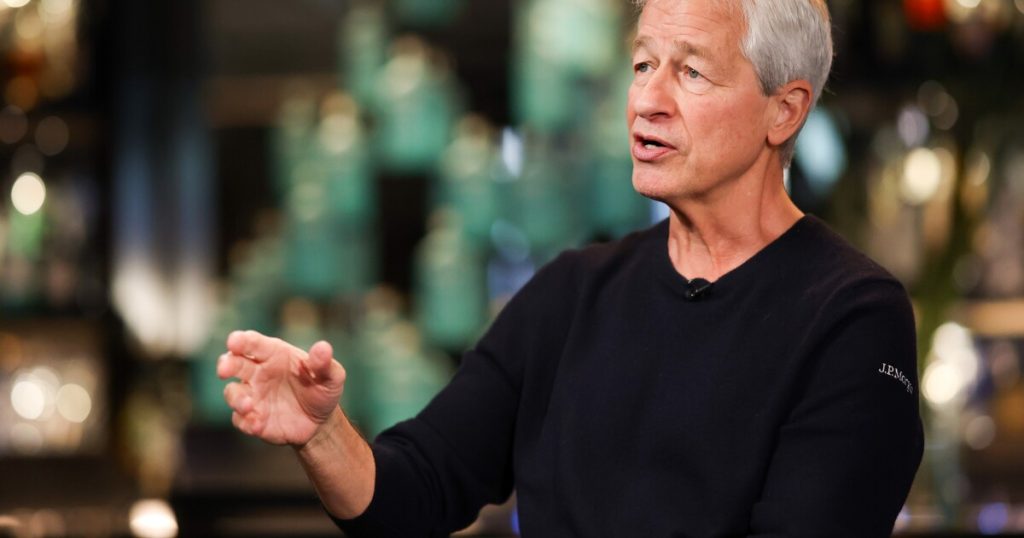
- Key insight: CEO Jamie Dimon said Monday night that the bank has to invest big to stay ahead of technology competitors, which have “badly beat” JPMorgan in the past.
- What’s at stake: In a presentation to investors, the company said that the current landscape is the most competitive for banks since before the global financial crisis.
- Forward look: Current rumblings in the private-credit market could be a bellwether for a larger credit cycle down the line, Dimon said.
Processing Content
America’s largest bank is ramping up its investments in artificial intelligence and other technologies as it vies for business with other traditional banks, payments companies and private credit firms. The environment that’s been favoring the industry recently has meant that competitors are fighting for consumer clients and loans, as well as commercial business.
Dimon and his top deputies laid out what they see as the competitive threats during a two-hour-long update for investors on Monday night.
“We got beat badly, so we should be very cautious of that,” he said. “When we do a lot of this investing we’re talking about … .we try to be very disciplined about it, but we have to compete at that level, too. We can’t just put our head in the sand and say that doesn’t affect us.”
Opportunities and threats from AI
Dimon said Monday that it’s difficult to measure the company’s investments in AI, or their payoff. He noted that 150,000
The bank is focusing its AI efforts on areas such as customer service and internal technology for software engineers, said Chief Financial Officer Jeremy Barnum.
But the bank isn’t just dealing with AI internally. In recent weeks, AI innovation has spooked investors, who fear the technology could pose a threat to software companies and, to a lesser extent, their creditors.
Dimon said that, in the bigger picture, AI will likely create more productivity, but it could also spell trouble for consumers who are laid off across the economy.
“Laying those people off will cause a problem, even if it creates more productivity in society,” Dimon said. “And that’s why society has got to think this through a little bit. It may happen faster than we can adjust to it … and therefore, we should be prepared.”
Private-credit jitters
Troy Rohrbaugh, co-CEO of
“We’re in the heart of the ecosystem,” Rohrbaugh said. “We’re doing a lot of financing. We’re doing a lot of lending. …We really have a competitive advantage because we have all these ancillary products that we want to do with these clients. The people that are just lending don’t.”
Doug Petno, the other co-CEO of the commercial and investment bank, said that lending is “an outcome, not the strategy,” in
Rohrbaugh said Monday that, as of the end of 2025, the bank had deployed almost $14 billion.
He added that while both traditional banks and nonbank lenders have room to grow in private credit,
But even though private-credit firms have been taking the hit amid AI jitters on Wall Street,
“I’m shocked that people are shocked,” he said. “I mean the reality is, in this environment, as the world gets more volatile, as you get towards the end of the cycle, these outcomes should be expected.”
The first chips to fall?
Rohrbaugh added that while the damage may be isolated now, “that could quite easily change,” though he thinks
Last fall, a number of banks, including
On Monday night, Dimon expressed similar concern, saying that some of the big bets certain companies are making now, while they’re on the front foot, may come back to bite them.
“There will be a cycle one day,” Dimon said. “I don’t know when there’s going to be a cycle. I don’t know what confluence of events will cause that cycle. My anxiety is high over it. I’m not assuaged by the fact that asset prices are high. In fact, I think the assets are the risk.”