
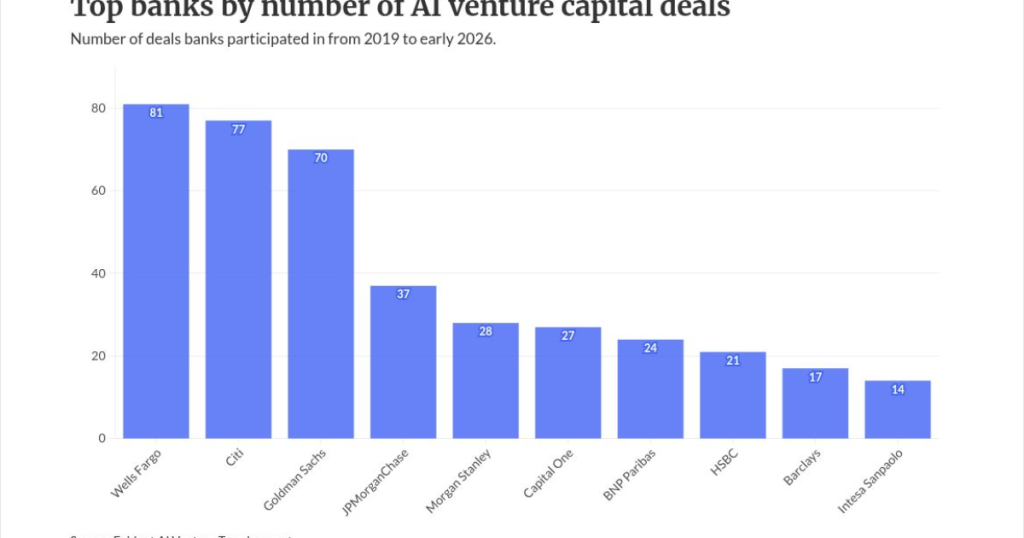
Large banks’ venture investments in AI companies have increased at a compound annual growth rate of 21% since 2023, according to the Evident AI Venture Trends report, which came out Tuesday and offers analysis of the 50 biggest global banks.
Processing Content
Wells Fargo, Citi and Goldman Sachs are the most active U.S. bank investors in AI companies, in that order. Wells Fargo has made 81 AI venture deals since 2019, Citi has made 77 deals and Goldman 70, according to Evident AI’s research. JPMorganChase comes in fourth with 37 deals.
A look at where and how the largest banks are investing paints a picture of how traditional financial services are starting to be reshaped by AI.
“The nature of the transformation of AI is so substantial that every startup company has an AI story, or needs to, for it to have a chance, for it to be sustainable, for it to have a promising future,” Arvind Purushotham, head of Citi Ventures, told American Banker. “There is no non-AI company that’s being funded and started in this environment.”
One startup reaping the benefit of this increased investment is Rogo, a New York fintech founded in 2021, whose product investment bankers use to prepare for client meetings. J.P. Morgan Growth Equity Partners joined Rogo’s $50 million Series B funding round last April. Wells Fargo, J.P. Morgan and Truist participated in its $75 million Series C in January.
“We’re in this unusual moment where every single bank globally needs an answer for, ‘What is our AI strategy?'” Rahul Rekhi, president of Rogo and a former managing director at Lazard, told American Banker. “We have the privilege of being a great answer for that question. The adoption cycles that historically for banking have been long and complex have sped up within just a handful of years.”
Venture capitalist Ryan Falvey has been bullish for years about what he calls AiFi, a time when most financial services are AI-driven.
“This is here today, with firms already offering payment services to AI agents and AI-powered commerce,” he wrote in a
“I think we’ve been validated,” Falvey, founder and investor at Restive Ventures, told American Banker. “You’re seeing a tremendous amount of innovation from across a wide variety of startups. We’re seeing a lot of interest from traditional banks.”
Seeking to “co-shape” AI
Banks that invest in AI companies gain early access to emerging AI capabilities, which translates into improved internal processes, products and services.
“I think there’s a lot of co-shaping going on,” Alexandra Mousavizadeh, co-CEO and co-founder of Evident, told American Banker. “The venture arms of the banks have gone in with a partner mindset — how can we create this so it really fits into what we need?”
For instance, some banks that have invested in financial crime agentic AI vendors have been able to put the technology into production ahead of rivals.
An early example of this dynamic was Citi Ventures’ investment in the data science platform provider Anaconda in 2018, after using the technology throughout the bank for two years.
“They were a strategic advisor and investor, and then had that relationship where it was rolled out internally, and they got a leg up when it comes to having that Python stack within the bank,” Maryam Akram, senior research manager at Evident AI, told American Banker.
Another example at Citi is its early investment in Lakera, a San Francisco startup whose flagship product, Lakera Guard, uses machine learning to screen prompts before they reach a large language model, denying malicious prompts to keep generative AI applications secure. Check Point acquired Lakera last fall.
Citi helped Lakera scale and mature its product.
“It’s quite difficult to serve a large and complex institution like ours, all the different knobs and levers that you need for the product, the connectivity that you need, the controls that you need for the product itself, all of those kinds of things that need to get hardened and mature,” Purushotham said. When Citi works with an early-stage company, it often becomes a collaboration, he said.
How Citi invests in AI startups
Citi aims to invest in AI companies that might solve problems within its business.
“We’re looking at the application of AI into our frontline businesses, as well as some of the middle-office and back-office functions, ” Purushotham said.
For instance, the bank has invested in New York City-based Norm Ai, whose generative AI model conducts legal reviews of marketing materials and handles other compliance tasks.
“We were interested in how they could help a large financial institution like ours bring efficiencies into the compliance review function,” Purushotham said.
Citi Ventures has also invested in Jump AI, whose technology helps wealth advisors prepare for client interactions, capture client notes and enter those notes into customer relationship management systems.
And Purushotham’s team has a thesis about cybersecurity for AI.
“AI is getting rolled out at scale within Citi and within most enterprises,” Purushotham said. “Security needs to be top of mind in terms of making sure that information is protected, information is not leaking outside the enterprise, that there are appropriate controls so that people are getting access only to information they’re authorized to get access to. So security is a big, big aspect of how AI needs to get rolled out within Citi or within any large financial institution.” Hence Citi’s decision to invest in Lakera.
Citi has also invested in Prophet Security, whose technology uses AI to help security operations centers automate some work.
“At a security operations center at a large bank, you’re seeing a lot of different alerts come through,” Purushotham said. “The job of the people in the security operations center is to understand what’s important, what’s not important, address the important alerts and discard the false positives. Prophet Security is trying to bring AI into how you can expand the capacity of humans to handle security operations tasks.”
Purushotham declined to comment on which of these vendors Citi uses internally.
Generally, Citi Ventures invests in companies that already have a product. They could be at the earlier stages, such as Series A or Series B, Purushotham said.
“What we don’t want to do is to take on a huge amount of product and technology risk going in early and then waiting for a year or 18 months for them to have a product,” he said. “Even in our earlier-stage investments, we want to go in when we know that the company already has a product that we can try.”
Sometimes Citi Ventures makes late-stage investments. For instance, in October it participated in a Series C round for ClickHouse, a company with an open-source database management system built for use by AI.
Overall, Citi makes strategic investments because it thinks the startups are working in areas that are important to financial services. “And when these startups take our capital, they recognize the importance of financial services as a vertical for them, where their initial big customers may come from,” he said.
AI startup popular with banks: Rogo
Rogo offers an AI agent called Felix that acts like a digital colleague. It can help create pitch decks, analyze spreadsheets and market research, generate ideas and more. Felix works on top of the major foundation models from Anthropic, OpenAI, Google and the like. Investment bankers use Rogo to stress-test deal theses. Portfolio managers pressure-test investment frameworks.
Venture investors JPMorganChase, Truist and Lazard are among Rogo’s 200-plus financial firm clients. The company estimates that 25,000 bankers and investors across those firms use its technology. It’s hired several former bankers who embed deeply within bank clients to help customize and deploy the software.
From Rogo’s point of view, banks typically use its technology for a while, then choose to be part of its next round.
Joshua Pulman, principal at Truist, noted in a LinkedIn post that in wholesale banking, “bankers are expected to synthesize massive amounts of information, deliver high-quality analysis, and advise clients with precision — often under tight timelines.
“Yet many of the workflows that power these outcomes have remained highly manual, fragmented and time intensive.”
At the core of Rogo’s technology is a proprietary retrieval augmented generation approach that synthesizes and fact-checks data, reduces hallucinations, and delivers reliable outputs across multiple foundational large language models, Pulman said.
The software “not only accelerates research and analysis, but also improves the quality, consistency, and confidence of the insights our bankers use to serve our clients,” Pulman said.
It automates manual and time-consuming tasks like data gathering, market analysis, and preparation of client materials.
Danger of being bypassed by AI
In Falvey’s view, banks that don’t heavily invest in AI are in serious trouble.
“They’re getting passed by on a level that I don’t think many of them realize,” he said. “Some banks are very aggressively adopting these tools and rethinking how they can use technology to gain significant competitive advantage, and there are others that are not investing in it at all.”
Falvey compares the AI boom to the gold rush of the 1840s and 1850s. “There was gold coming out of the ground in California,” he said. “If you were interested, if you were in New York, you could figure out how to load up a stagecoach or eventually a train and get that gold back to New York City.” This led to the creation of Wells Fargo, American Express, Western Union and the railroads, he said.
“The same thing is happening right now with AI,” he said. “There is now an entirely new way you can exchange money between two machines that doesn’t involve any people, and is going to require an entirely new way of creating tools to allow that to occur: new security systems, new ways of safely storing, transacting, extending credit, and all that is being built.”
There will be demand for new ways to send payments and wires to large language models like OpenAI, Falvey said. There will be new ways of managing money. One Restive Ventures portfolio company, personal finance app provider Hiro,
“Hiro allows you to pull all your financial records into one place and do real-time analysis on your finances,” Falvey said.
Falvey’s kids are on a ski team. He asked Hiro how much more money he was spending each weekend taking the kids skiing, versus staying home. Hiro found he was actually saving about $100 per weekend.
“To do that, it crunched all the numbers in my spending for the last year and a half, compared my weekends, adjusted for inflation, and figured out how much it cost me,” he said. “It took about 15 seconds to look across all of my finances and it was perfectly accurate.”