
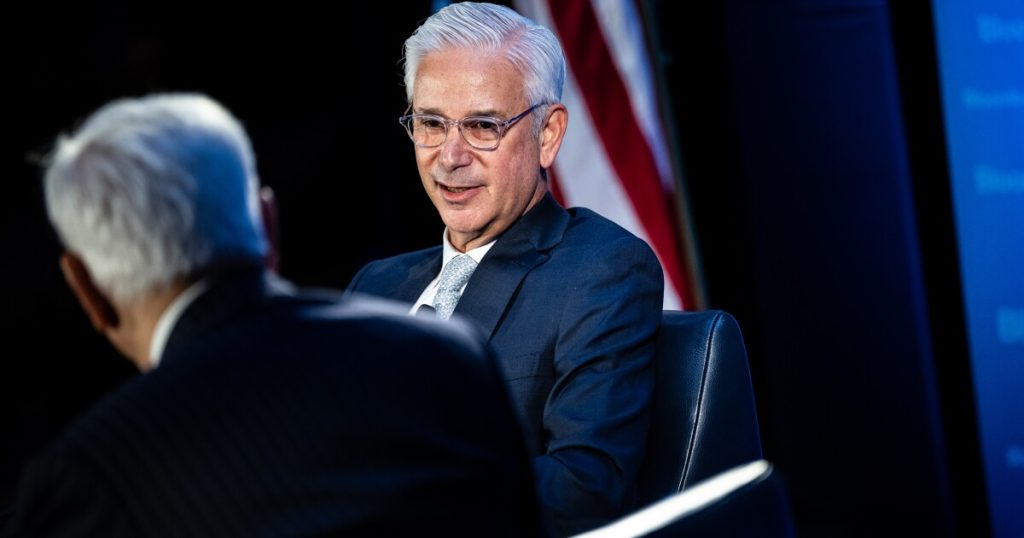
- Key takeaway: Wells Fargo CEO Charlie Scharf said in an appearance in Washington on Monday that lowering interest rates at the present moment would be unwise in the face of broad economic uncertainties related to the ongoing war in Iran.
- Expert Quote: “I think right now there’s pretty clear consensus that it would be the wrong thing to do. Until it’s clear that the end is in sight, there’s real risk out there. We don’t know how significant it is.” — Scharf
- Forward look: Scharf’s comments come a day ahead of the Senate Banking Committee’s confirmation hearing for Kevin Warsh, President Donald Trump’s pick to replace Jerome Powell as chair of the Federal Reserve.
WASHINGTON —
Processing Content
Speaking at a fireside chat sponsored by the Economic Club of Washington Monday afternoon, Scharf was asked by interviewer David Rubenstein, chair of the board of directors of the Carlyle Group, whether it would be difficult for the Federal Reserve to lower interest rates at the present moment — a move that President Donald Trump has been pushing for over the course of his time in and out of public office.
“I think right now there’s pretty clear consensus that it would be the wrong thing to do,” Scharf said. “Until the Iran conflict is … until it’s clear that the end is in sight, there’s real risk out there. We don’t know how significant it is. I think as you hear voting committee members talk about it, there’s a high degree of consistency — including, I think, from the Treasury secretary — in terms of waiting to see how this all plays out. And that seems like the prudent thing to do.”
Scharf’s comments come as the nearly two-month-old Iran conflict tamps down Fed officials’ views of how many rate cuts there may be in 2026, with many saying that war-related economic uncertainty is bringing inflation concerns more front-and-center. President Trump, meanwhile, has consistently complained in social media posts and public appearances that the Fed is keeping interest rates too high and has implored the central bank to lower them drastically and quickly.
Scharf said there is something of a disconnect between economic indicators and attitudes about the economy among the general public and in the business community.
He noted that loan demand is strong, consumer delinquencies are under control and consumer spending remains robust — none of which suggest the onset of an economic recession.
But he relayed the more negative outlook of a
“The real question is going to be: How long do crude oil and gas prices stay high?” Scharf said. “If the conflict ends, the straits open up and production returns in some reasonable period of time, there will be this impact on consumer spending and on some of these other things, but in that kind of environment it won’t be damaging. If it goes on for a longer period of time, it can be more damaging.”
Scharf’s comments came amid a broader set of questions about his views on the importance of Fed independence, which will be a central focus Tuesday at the Senate Banking Committee confirmation hearing for Kevin Warsh, Trump’s pick to replace Fed chair Jerome Powell as the leader of the central bank.
Scharf — who leads the fourth-largest bank in the U.S. — said that Fed independence is critical, but that part of what makes that independence work is the diffuse nature of the Federal Reserve system and the incorporation of different regional and industrial perspectives into monetary policy decision-making.
“The financial services industry has been pretty consistent [that] the independence of the Fed is critically important, not just here in the U.S. but in other parts of the [world],” Scharf said. “Here we have a political infrastructure that turns over, that has points of views, and we have a more long-term structure at the Fed that has people from different walks of life, and the committee vote is extremely important. So creating the right kind of balance between fiscal and monetary policy to get to the best outcome in the political environment we have is extremely important.”
Scharf added that he does not think there is anything nefarious or inherently challenging to the Fed’s independence when the President expresses his preference for lower interest rates, saying the White House is entitled to an opinion and may express it however they choose.
“There’s no reason, in my mind, why the president shouldn’t have a point of view. All presidents have for a long period of time, they’ve done it in different ways. This president does it very openly in terms of what his points of views are,” Scharf said. “But even as it comes to who he’s choosing to nominate to lead the Fed — in this case he’s chosen someone who has a point of view on what’s going on the the world, AI, what’s it’s going to mean for jobs and productivity, and that’s a point of view — and [Warsh’s nomination has] got to be approved by Congress. But the idea that there’s total separation is just not true. But it is true when it comes to the actual decision-making, and that’s really important.”
Scharf added that he does not think that stablecoins will pose a significant competitive risk to banks’ services in the U.S., but he does think the technology is likely to have a bigger impact outside of the country. He noted that in many countries, consumers do not have ready access to dollars and dollar-denominated assets and thus have greater exposure to inflationary risks, which will likely make stablecoins attractive. In the U.S., cross-border payments are a use case where stablecoins could serve a useful purpose, he added.
“Beyond that, it’s not clear to me that there’s a winning edge here,” Scharf said. “By the way, that doesn’t mean we aren’t going to partake in it. We’re building stablecoin solutions both within the U.S. banks and more broadly, in case what I said is wrong, so that we’ll have something in place and be able to compete with a very broad network of participants. But it’s just not clear yet.”